# Articles

Locally archived articles about Ashes: Reborn, as well as links to external text content.

# A beginner's guide to Ashes: Reborn

<p class="callout info">Originally published at **[https://beckism.com/2021/04/a-beginners-guide-to-ashes-reborn/](https://beckism.com/2021/04/a-beginners-guide-to-ashes-reborn/)** on **April 28, 2021**; archived Jan. 9, 2023</p>

So you’re interested in playing [Ashes Reborn: Rise of the Phoenixborn](https://www.plaidhatgames.com/games/ashes/), but feeling nervous because it seems daunting? Never fear! Ashes is one of those great games that’s easy to learn but hard to master, and although becoming an excellent player is mainly a matter of experience, I can at least provide some general pointers so that you have a better idea about why experienced players make the choices they do.

This article will not cover the rules or how to play the game. Rodney Smith’s [Watch It Played](https://youtu.be/vR77Rzzc7vU) is hands-down the quickest way to learn Ashes (and if you prefer reading…well, that’s what Ashes’ [excellent rulebook](https://cdn.ashes.live/files/ashes-reborn-rules.pdf) is for!).

## What should I buy?

Everyone asks this, so let’s get it out of the way. In Ashes Reborn, you only have one constraint: dice (many expansions require dice that are not included in the Master Set). Every Ashes product comes with a full playset of every card, and there are no repeat cards between products (which means that if you buy one copy of everything, you’ll have everything you need). First, you need the [Master Set](https://www.plaidhatgames.com/product/ashes-reborn-rise-phoenixborn/) for the rules, tokens, and first four dice types. If you enjoy the game, you should get the “deluxe” expansions ([Laws of Lions](https://www.plaidhatgames.com/product/ashes-law-lions-deluxe-expansion/), [Song of Soaksend](https://www.plaidhatgames.com/product/ashes-reborn-song-soaksend-deluxe-expansion/), and soon Breaker of Fate) so you have the final three dice types. After that, you can buy any small box expansion that looks interesting to you.

If you aren’t sure if you’ll like the game, pick up the Master Set (lots of gameplay to be had there, and it will give you a good feel for which dice types do the things you enjoy). If you’re sure you’ll like the game, but aren’t quite ready to drop a couple hundred dollars on it, get the Master Set and the deluxe expansions.

Once you have those, some good next steps are the single-dice small-box expansions ([Children of Blackcloud](https://www.plaidhatgames.com/product/ashes-reborn-children-blackcloud/), [Frostdale Giants](https://www.plaidhatgames.com/product/ashes-frostdale-giants/), [Roaring Rose](https://www.plaidhatgames.com/product/ashes-reborn-roaring-rose/), and [Duchess of Deception](https://www.plaidhatgames.com/product/ashes-reborn-duchess-deception/)). A lot of people recommend [King of Titans](https://www.plaidhatgames.com/product/ashes-king-titans/), as well, because it has a lot of solid cards for building decks. And dinosaurs. Who doesn’t like dinosaurs?

Beyond that, there’s no wrong answers. Buy decks that use dice types you enjoy. Buy decks whose Phoenixborn look awesome. Buy all of them in a single go, because you’re going to end up there anyway…

### Do I need extra sets of dice?

No.

### No, seriously, I really think I need extra sets of dice

Even if two players are building out of the same collection of cards, you probably will never need extra dice (you’re much more likely to be fighting over cards). If you really, really, really want to play your Snakes in Silver deck against your Frostdale Giants deck, you can easily proxy whatever D6 dice you have lying around for the five Natural die you’re short (sides 1 &amp; 2 are Basic; sides 3-5 are class; side 6 is power).

If you’re regularly running four player drafts out of your collection, you might want extras, I guess. Or if you just really like dice.

## Playing the game

Alright, so you’ve bought every Ashes Reborn product under the sun, including a bunch of extra dice despite my advice, and now you’re wondering how to actually win because you’ve discovered that when you and your opponent are trading a whole bunch of really small turns back and forth sequencing matters *a lot*. And for some reason their plans all seem to be coming to fruition while yours burn down around your ears.

I can’t tell you how to know what to do and when to do it (it’s way too situational; you’ll need to play the game to get a feel for that stuff). But I can provide a few guiding principles so you can at least make more informed decisions and start building good habits.

### Meditation leads to power

New players are often *very* leery of meditating off the top of their deck. It just feels awful to flip that top card over and see a [Molten Gold](https://ashes.live/cards/molten-gold/) or something that you know could have *actively helped you win* and is now sitting useless in your discard.

Here’s the thing, though: assuming you play all five cards in your hand every round (not guaranteed), the game would have to last **six rounds** before you’d played every single card in your deck. Many Ashes Reborn games will end in rounds three to four. That means that in a typical game, 10-15 cards in your deck will *never see play*.

If almost half of your deck will make no impact on the match anyway, then meditation is not discarding cards that you could have played. It is instead allowing you to play what you need to win at the cost of advancing the point at which you’ll take fatigue damage downwards from the top of round 7.

As a result, the vast majority of the time you should decide exactly what dice you need to adjust to play the cards in your hand or spellboard, and meditate exactly that many cards off the top of your deck regardless of what it places in your discard pile. Unless a card is in your hand, it’s effectively blank because it has no impact on the game, so don’t worry about meditating off the top of your deck!

The only exception is if you expect the game to go long (or if you are reasonably sure you’re facing a deck that’s got a lot of discard from deck effects—colloquially known as “mill”—or cards that spin your dice down). However, you’ll be able to recognize those decks with experience. It’s much easier to think about whether you should meditate and choose not to when you’re a more experienced player than it is to overcome the hesitance or habit of *not* meditating. Meditate early. Meditate often. You’ll need those side actions later in the round to do things that will actually help you win.

### Know your win condition

The only way you win in Ashes is to deal lethal damage to your opponent’s Phoenixborn. Knowing *how* the particular deck you are playing plans to do this is arguably the most important part of playing the game, whether you are playing preconstructed decks or fully custom constructed decks, because it will strongly inform the choices you make in-game.

For instance, let’s say you’re playing your first game with [Aradel](https://ashes.live/decks/7707/) vs. [Maeoni](https://ashes.live/decks/7710/) (a very common match-up). Just looking at the deck-lists, you can see that Aradel has a large battlefield, low life, and lots of cheap, small units. This means that her deck is trying to swing around her opponent’s threats by summoning more units than they can block, and you’re likely going to need to play very aggressively to try and end the game before her low starting life becomes a problem.

Maeoni, on the other hand, has high life, a small battlefield she can’t even fill, units that have no attack whatsoever (but a Silver Snake that will get more and more dangerous the longer it is alive), and a card that allows her to attack with a single unit without being blocked (Hypnotize). Just from that, you can figure that she’s going to need to stall the early game, try to clear as much of her opponent’s battlefield as she can, and then swing past her opponent’s threats with a giant snake for the win.

Identifying the win condition for a deck that you have not built can be very tricky (particularly when the deck is built by a higher level Ashes player). My best advice is to familiarize yourself with the [common archeyptes in Ashes](https://beckism.com/2021/04/archetypal-strategies-in-ashes-reborn/), and then look for cards that only have a single copy (particularly Ready Spells). That will usually allow you to guess the deck’s typical First Five, which is often a strong indicator of the strategy it is likely to use (you ask yourself: “how would this collection of units or card effects allow me to gain long-term advantage and win?”).

### Identify your opponent’s win condition

Knowing your own win condition will help a lot for picking a good First Five. However, you also need to determine what your opponent’s win condition is so that you can adjust your tactics, if necessary. This is often why players in the first round of a game will slowly trickle out their ready spells and units without necessarily doing anything with them; they’re hoping that they’ll be able to get a read on their opponent’s strategy so they can accurately evaluate whether their default approach is smart or suicide.

In the example pairing above, for instance, summoning an early Gilder can be a very important play for Maeoni against some opponents, because it can guard an attack against her Snake. However, versus Aradel, she actually wants to wait to summon the Gilder until Aradel has played one of her single life units so that the damage dealt when summoning a Gilder can kill a unit and feed the Silver Snake. Similarly, the Maeoni player will likely want to use Open Memories to dig up a second copy of either Empower or Summon Gilder rather than another Summon Silver Snake because they need those cards to clear Aradel’s units (whereas in other matchups they might want to get a token on the Snake right away when they summon it so that it can defend itself and doesn’t take as long to build up its attack).

There’s no hard and fast rule here, but a good general idea in the first round is to wait to attack or actively try to destroy your opponent’s threats until you’ve seen 3-4 of their cards. Of course, the more experience you gain (or the more familiar you are with your opponent’s deck or preferred playstyle), the more you’ll be able to ignore this because you’ll be able to more accurately judge what they are doing based on less in-game information.

### Why a particular deck wins

Generally speaking, if you have two decks that are well balanced compared to each other piloted by two players of a similar skill level, the player who wins will:

<div class="entry entry-content" id="bkmrk-deal-more-damage-for"><div class="entry entry-content">- Deal more damage for less dice
- And/or make better use of card effects and unit abilities

</div></div>This can be difficult to grok for people coming from other card games, because Ashes doesn’t have an economic engine the way other dueling card games typically do (so building or disrupting an economy is much less a thing in this game). Both players have exactly 10 dice to spend, card draw is often a niche effect instead of being game-defining (due to non-random first rounds, and not being able to play extra cards because you’ve run out of dice), and with Ready Spells that summon units board presence is easy to guarantee. As a result, it’s pretty common for new players to be good at building or piloting a deck to achieve a specific win condition, but to struggle when their opponent successfully disrupts their plans.

It’s important to keep these goals in mind, though, because juggling the concern of dealing more damage for less dice and making better use of effects/abilities directly informs your decisions both during deck construction and during the game.

If that seems frustratingly abstract, it’s because it’s a very difficult topic to illustrate outside of specific examples. For now, it’s best to keep in mind that killing your opponent’s units is often a secondary consideration (because it doesn’t advance your win condition; only damaging the Phoenixborn will do that). However, if you can kill your opponent’s units for less dice than they spent on them—or do so before they are able to compound their investment across multiple rounds—then that *does* advance your win condition, because the gain in efficiency typically leads to long-term advantage.

### When and what should I attack?

So much about Ashes is about sequencing and timing, and one of the biggest head-aches for new players is figuring out when and what they should attack. This choice is complex, situational, and very difficult to simplify into generic principles. A lot of really good players just have a good “feel” for it, and probably can’t describe exactly *why* they make the choices they do, outside of describing their reasoning in specific situations.

However, this choice usually boils down to choosing between actively pursuing your deck’s win condition vs. disrupting your opponent’s deck by dealing more damage with less dice.

As an example, consider the Aradel vs. Maeoni precon example. The Maeoni player summons a Silver Snake, which costs her two dice and comes into play with no attack. The Aradel player now has a dilemma: they can try to destroy the Snake, but thanks to its 4 health it will likely cost them at least 3 dice (1 for Aradel’s Water Blast ability to deal 2 damage; 2 for a couple 1 attack units); and quite possibly more, because the Maeoni player can disrupt their plans (by guarding with their Phoenixborn or Gilder; killing units before they can attack with the ping damage from Summon Gilder or the Natural dice power; etc.). That being the case, an alternative would be to avoid spending resources on the Snake early and try to sneak some damage past or kill the Gilder while establishing a board presence in hopes of dealing with the Snake once the Maeoni player has sunk more dice into buffing it up. After all, if a Mist Spirit attacks in two rounds, then it gets you two damage for one die instead of one damage for one die.

As ever, sequencing here will be key: if the Aradel player can wait until the Snake has 2-3 counters, then drop a Massive Growth on a Blue Jaguar and hit the Snake directly without a Gilder getting in the way, it’s history (and they’ve spent 4 dice vs. the Maeoni player potentially spending 4-5 at the high end, depending on how they got the counters on). If the Snake gets big enough, though, a Massive Growth unit might just get killed instantly with Maeoni’s Command Strike ability. The key point is that unless you’re able to kill a unit without spending more dice than your opponent spent to play it (or has since invested in improving it), you might want to take your licks from it and focus on pursuing your core strategy (in Aradel’s case, swinging around the edges of her opponent’s battlefield with a lot of small units).

### Compound the value of your dice

It may seem strange to use spells or attacks to remove your opponent’s units if they can just play them again in the next round, but there’s a very simple reason you want your units to survive and your opponents’ to get destroyed: whenever a unit survives to attack or counter in a subsequent round, the controller of that unit has compounded the value of their dice investment. For instance, if you play a [Hammer Knight](https://ashes.live/cards/hammer-knight/) and attack with it, you’ve dealt 3-4 damage for three dice (depending on whether it deals damage with its ability). If it survives until the next round to attack again, you’ve dealt 6-8 damage for three dice.

This is something that you have to factor into your decisions over what and when to attack. If you expect your opponent to kill your unit before the next round no matter what, it might be worth using it to try and deal damage to their Phoenixborn instead of trying to force the damage onto a unit (since only damage on the Phoenixborn ultimately matters). Alternately, you might have a free shot at their Phoenixborn (e.g. if all their stuff is exhausted), but attack a unit instead to ensure that they cannot compound the value of the unit in the next round. This is highly situational and something you’ll need to get a feel for through actual play, but balancing the conflicting concerns of keeping your units alive to fight multiple rounds, killing your opponent’s units before they can act twice, and actually dealing damage to their Phoenixborn is a key skill for winning in Ashes Reborn.

## Building decks

Deck-building in Ashes can be daunting, because you can include literally any card in any deck as long as you include the dice to play them (aside from Phoenixborn uniques). And how do you decide how many dice to use? Aaaaaaargh…*head explodes*.

That said, getting into deck construction is actually really easy. Here’s how:

<div class="entry entry-content" id="bkmrk-play-at-least-one-ga"><div class="entry entry-content">1. Play at least one game with every preconstructed deck in the Master Set
2. Pick your favorite deck, and ask yourself: which cards were useless or underperforming when I played this deck? Which cards from the other decks would have allowed me to win (or win more)?
3. Swap the bad cards out and the good cards in, and play again. As you continue to test the deck, you can tweak the number of cards and maybe add or remove dice. You’ll be surprised how quickly you get a feel for what this deck does well, and what kinds of cards it needs to do it better.

</div></div>But who am I kidding? No one wants to do the hard work of learning through experience! So here’s some quick tips that guide more experienced players as they build decks.

### Your spellboard should be odd

If you include **one** copy of a spellboard card, it means you plan to include it in your First Five (could mean you always include it, or you sometimes include it based on what you expect your opponent to be running).

If you include **three** copies of a spellboard card, it means that you want to draw into it (whether or not you plan to First Five it).

If you include **two** copies of a spellboard card, it means that you’re virtually guaranteed to meditate one of them off the top of your deck when you most need it, and in many games you’ll never see it before the third or fourth round when it doesn’t do you a lick of good.

Ready spells are costed on the assumption that you will get value on them across multiple rounds, so rather than wasting a slot on a second copy of a Ready Spell, you would be better off including an Action Spell or Ally that will make a difference regardless of when you draw it.

Keep your spellboard odd.

### The meaning behind the numbers for non-spellboard cards

For cards that *aren’t* Ready Spells, you can include one, two, or three copies as you like. Here’s what those numbers mean:

Like Ready Spells, **one** copy of a card means you plan to First Five it. It’s very common for decks to build around a standard First Three or First Four and have 1-2 flex cards. For instance, if I’m running Ceremonial dice, I might include one copy of [Choke](https://ashes.live/cards/choke/) on the off chance that I run across a Phoenixborn whose ability is going to cause me grief or is repeatable (like [Odette Diamondcrest](https://ashes.live/cards/odette-diamondcrest/), [Coal Roarkwin](https://ashes.live/cards/coal-roarkwin/), or [Rimea Careworn](https://ashes.live/cards/rimea-careworn/)). I might also include one copy of [Fester](https://ashes.live/cards/fester/) if I see a dice spread that likely means I’ll be facing threats that cost three dice (like Natural plus Divine). I probably will never First Five both of those cards in the same game, but they’re there when I need them.

**Two** copies of a card means that you want to see it at least once every couple games, and you don’t want to break down in tears if you meditate it off the top of your deck. For me, these are often cards with high impact but that might be situational. For instance, if I’m using Divine dice I might include two copies of [Meteor](https://ashes.live/cards/meteor/) because that really wrecks decks that rely on lots of small units, but it’s not something I necessarily want to play more than once per game.

**Three** copies of a card means that you want to see at least one copy every single game, and you wouldn’t mind seeing it more frequently. These are typically the cards that are central to your strategy, and having three copies both means that you’re more likely to draw into them and that if you meditate one off the top of your deck you can feel confident that you are still likely to find another copy later.

### Start with your First Five

If you’re having trouble coming up with a deck, start with your First Five. What are five cards that you strongly want to play together (or what are five cards with really interesting synergy)? What is the win condition those cards will push you toward? Once you know those two things, fleshing out your deck with cards that support that win condition or thwart decks that you think your deck will have trouble against is a lot easier.

I recommend looking for cards that work well together in your First Five. (An alternative is to look for cards that are highly efficient, but those are often harder to spot for a new player.) For instance, maybe you really love the idea of [Secret Door](https://ashes.live/cards/secret-door/). So in that case, you’re going to need units with high attack and a life value of 1. [Frost Fang](https://ashes.live/cards/frost-fang/), [Summon Shadow Hound](https://ashes.live/cards/summon-shadow-hound/), [Shadow Guard](https://ashes.live/cards/shadow-guard/), and [Stormwind Sniper](https://ashes.live/cards/stormwind-sniper/) all fulfill that requirement. Pick your favorite and look for which cards you’ll need to keep them alive, recur them, or grow them into even worse threats before using Secret Door.

(You may have noticed that these are the two ways decks commonly win; often times starting with what you want to do—”I want to deal more damage for less dice” or “I want my cards to do something cool that’s more than the sum of their parts”—is a good way to focus your deck down and reduce the number of cards you need to worry about trying to include.)

Another perfectly valid choice would be to pick a Phoenixborn you really like, and then look for cards that compliment them. For instance, [Echo Greystorm](https://ashes.live/cards/echo-greystorm/) has a mid-size battlefield and manipulates exhaustion, clogging your opponent’s battlefield. What cards might help him to do that even better? What cards can capitalize on units being temporarily exhausted?

With a tentative First Five in hand, your next step is usually to count up how many dice you’ll need to play those cards. More than 10? You might want to swap a higher cost card out for something lower cost. Significantly less than 10? You probably want to do the opposite. Part of dealing more damage for less dice includes spending all of your dice every round. (Which isn’t to say you can’t start a First Five that only uses 8 dice or similar, as long as spending dice powers will directly help your deck. Alternately, if you include card draw in your deck, it might make sense to start with cards that cost fewer dice so that you can afford whatever you draw into.)

Once you have a First Five that costs close to 10 dice, you should take it for a spin! Don’t worry about dealing with potential opponent’s decks too early; worry about crafting a solid starting place for your own deck. It’s usually a lot easier to see where your deck is lacking after you’ve played a game or two with it, and as you accumulate more experience you’ll get a lot better at pre-emptively spotting decks’ weak points.

### Picking your dice

There are two main things you need to worry about when choosing how many dice of each type to include in your deck:

<div class="entry entry-content" id="bkmrk-how-many-and-what-ty"><div class="entry entry-content">1. How many and what types of dice do you need to activate your spellboard cards?
2. What is the ratio of dice costs in your deck? (This gives you a rough sense for your likely cost distribution in average draws.)

</div></div>For instance, if you are a Maeoni player with a slightly-modified deck who is starting out with [Summon Silver Snake](https://ashes.live/cards/summon-silver-snake/), [Summon Gilder](https://ashes.live/cards/summon-gilder/), and [Summon Frostback Bear](https://ashes.live/cards/summon-frostback-bear/) you will need four Natural dice for your first round (one for the Snake, one for Gilder, and two for Frostback Bear). However, on subsequent rounds you will probably only need two (one for Gilder, and one for the Frostback Bear) because Silver Snakes are hard to kill. That means that even if your deck has more Natural cards than other colors, you might not need more than 4-5 Natural dice, since most cards will only require a single Natural cost to play. On the other hand, if you’re also running three copies of [Frost Fang](https://ashes.live/cards/frost-fang/) and [Molten Gold](https://ashes.live/cards/molten-gold/), you might want to have 6 Natural dice so that you can be sure you can cast two cards that require 2 Natural dice each.

You can get away with quite a lot fewer dice in a single color in Reborn than you might expect, as long as you can afford the hands of cards you’re likely to draw. Choosing dice is more of an art than a science, though, so to some extent you should just pick what feels right and then see if it works in an actual game.

### Power faces are discard costs

One thing that new players might be surprised about is that even if every cost for a particular dice type in your deck is a power face, you still don’t need any more dice than it takes to play a typical draw of those cards.

This is because you should always assume that power costs require meditation. While you can sometimes lean more heavily into a dice type whose dice power you want to be able to play more often, you should generally just assume that any card with a power face on it has a hidden discard cost, as well.

If a predominance of the cards in your deck are using power symbols, then you might want to give some thought to dice fixing cards like Call Upon The Realms, Magic Syphon, Hidden Power, or Dark Reaping so that you don’t kill yourself with fatigue damage.

## Where to go from here

Play the game. Seriously, it’s the single best way to improve. Not comfortable with deck construction? Play a few preconstructed matches, and you’ll pretty quickly start to recognize what works and what doesn’t in those decks (and have some ideas about how you could do it better). Having trouble making constructed decks that function the way you think they should, or choosing how many and which type of dice to include? Play a couple games with it, and watch for moments where you’re wishing you had a different dice spread or card in hand.

If you’re having trouble finding partners, I highly recommend checking out the [Ashes Community Discord](https://discord.gg/UU5bduq) for matchmaking on Tabletop Simulator or [Ashteki](https://ashteki.com). At the time of this writing, there is a very active Friday virtual get-together every week called First Five Fridays that’s explicitly targeted at teaching new players the game, preconstructed matches, and casual constructed. Several online tournaments have been running regularly, as well (which is a *great* way to gain experience fast; even if you lose games initially, you’ll have a chance to experience directly how more experienced players build decks and pilot them, which will teach you far quicker than any sage advice I can try to dish out).

I agree: playing with strangers is scary. But Ashes is one of the most uniquely friendly communities I’ve ever participated in. I have literally never had a bad experience playing this game, even when I’m getting stomped into the ground. It’s honestly a little weird.

In any case, I hope some of these ideas help you with playing or constructing decks! Welcome to Ashes Reborn!

# Deckbuilding

A collection of theory on how to build a deck for Ashes PvP.

# Deck Building Packages: A Beginners Guide To Common Card Combinations

By Timothy Cathcart

When deckbuilding for Ashes Reborn you may find yourself putting together a deck with an awesome new idea, with card combos that work really nicely together. Then when you play the deck it simply underperforms, unable to pull out ahead.

Don’t despair! This doesn’t actually mean that your idea for a deck necessary sucks or your card interaction inclusion is a bad one. However it is incredibly difficult for your deck to be an entirely new mix of cards and also be competitively viable.

Sometimes an entirely new archetype of deck is created by a player, but more often new successful decks are remixes, a bit of a new idea along with a bit of an old idea.

This article aims to give you an overview of several tried and tested deck building packages, combinations of cards that often are added to a deck to give it an edge or bring it close to a win condition. Combine these old ideas with your new ideas to help your cool deck ideas shine!

Not everything in a package is necessary, mix and match different parts depending on how much you want to lean into the archetype. For every package there is a variation that only uses some of the mentioned cards. Ashes is a game of spending dice, so most packages focus on the exploitation of a particular card that is particularly high value for dice.

##### **Time Value Spellboard**

[![image.png](https://wiki.ashes.live/uploads/images/gallery/2023-12/scaled-1680-/Mk1image.png)](https://wiki.ashes.live/uploads/images/gallery/2023-12/Mk1image.png)[ ![image.png](https://wiki.ashes.live/uploads/images/gallery/2023-12/scaled-1680-/V5rimage.png)](https://wiki.ashes.live/uploads/images/gallery/2023-12/V5rimage.png)[ ![image.png](https://wiki.ashes.live/uploads/images/gallery/2023-12/scaled-1680-/t2timage.png)](https://wiki.ashes.live/uploads/images/gallery/2023-12/t2timage.png)[ ![image.png](https://wiki.ashes.live/uploads/images/gallery/2023-12/scaled-1680-/st3image.png)](https://wiki.ashes.live/uploads/images/gallery/2023-12/st3image.png)

[![image.png](https://wiki.ashes.live/uploads/images/gallery/2023-12/scaled-1680-/M0Simage.png)](https://wiki.ashes.live/uploads/images/gallery/2023-12/M0Simage.png)[ ![image.png](https://wiki.ashes.live/uploads/images/gallery/2023-12/scaled-1680-/2Fiimage.png)](https://wiki.ashes.live/uploads/images/gallery/2023-12/2Fiimage.png)[ ![image.png](https://wiki.ashes.live/uploads/images/gallery/2023-12/scaled-1680-/7DDimage.png)](https://wiki.ashes.live/uploads/images/gallery/2023-12/7DDimage.png)

This spellboard package is all about efficient single dice allies with tokens and card draw.

The key card is [**Summon Wishing Wing**](https://ashes.live/cards/summon-wishing-wing/) which gets more efficient the more you can summon those pesky birds and add tokens to them. Use [**Summon Time Hopper**](https://ashes.live/cards/summon-time-hopper/) to give status tokens to the Wishing Wings. Having problems with all these units clogging up your battlefield? Use **[Summon Seafoam Snapper](https://ashes.live/cards/summon-seafoam-snapper/)** to eat your own Wishing Wing after it's exhausted and guarantee that card draw. All the card draw of the Wishing Wings should enable you to play extra books from your deck and unlock the focus abilities of the Wishing Wings themselves as well as the Time Hoppers.

All these 1 health units can be exposed to ping damage, what is your actual win condition here? Use [**Fighting Spirit**](https://ashes.live/cards/fighting-spirit/) to load up for an attack boost. With enough tokens only a couple of massive attacks from a boosted unit might be what is needed to clinch victory.

This package has a large number of possible cards, so many variations of combinations of these cards exist. You can even run Time Hopper and Seafoam Snapper without Wishing Wing. Another card often paired is [**Summon Tidal Crab**](https://ashes.live/cards/summon-tidal-crab/), to add even more tokens to your units. **[Stand Still](https://ashes.live/cards/stand-still/)** can help you land your big attacks and **[Accelerate](https://ashes.live/cards/accelerate/)** can enable you to string together Time Hopper and Fighting Spirit side actions.

If you do run a spellboard like this with many cheap unit summons, consider including [**Gates Thrown Open**](https://ashes.live/cards/gates-thrown-open/) in your first five to summon everything twice in round 1. Otherwise you may find your first five is too cheap and you'll have unspent leftover dice in round 1 which is never a good idea!

##### **PACT**

[![image.png](https://wiki.ashes.live/uploads/images/gallery/2023-12/scaled-1680-/hFQimage.png)](https://wiki.ashes.live/uploads/images/gallery/2023-12/hFQimage.png)[ ![image.png](https://wiki.ashes.live/uploads/images/gallery/2023-12/scaled-1680-/YKAimage.png)](https://wiki.ashes.live/uploads/images/gallery/2023-12/YKAimage.png)[ ![image.png](https://wiki.ashes.live/uploads/images/gallery/2023-12/scaled-1680-/oaPimage.png)](https://wiki.ashes.live/uploads/images/gallery/2023-12/oaPimage.png)[ ![image.png](https://wiki.ashes.live/uploads/images/gallery/2023-12/scaled-1680-/Dsgimage.png)](https://wiki.ashes.live/uploads/images/gallery/2023-12/Dsgimage.png)

PACT is so called because of the interaction between [**Phoenix Attendant** ](https://ashes.live/cards/phoenix-attendant/)and **[Chant of Transfusion](https://ashes.live/cards/chant-of-transfusion/)** but the key card is the chant, exploiting the value of Chant of Transfusion is a powerful package.

Start round 1 with either a single copy of Transfusion or by playing **[Ritualist](https://ashes.live/cards/ritualist/)** to pull an extra chant from your deck you can even start with 2. With an ally heavy deck triggering the chants with an ally death shouldn't be too difficult (Though you may wish to include some ways to ensure your allies die like [**Blood Chains**](https://ashes.live/cards/blood-chains/).) Use the Phoenix Attendant side action to heal damage and the Chant of Transfusion main action to immediately move that damage onto an enemy. The amount of healing and damage here can be extremely efficient. For a more aggressive play, play **[Old Salt](https://ashes.live/cards/old-salt/)** to deal 1 damage to an enemy unit before immediately using the side action of the Chant of Transfusion to move the default damage Old Salt enters play with onto the same enemy. Taking out a 2 health enemy has never been more dice efficient!

There are a lots of combinations of ceremonial allies that can help fuel the chant machine. One to keep an eye on is [**Blood Archer**](https://ashes.live/cards/blood-archer/), who's side action damage can also combo with Transfusion. Since you're flinging wounds around and even ignore armour while you're at it, [**Fester**](https://ashes.live/cards/fester/) is also a lovely removal option.

#### **Bear Bypass**

[![image.png](https://wiki.ashes.live/uploads/images/gallery/2023-12/scaled-1680-/HNAimage.png) ](https://wiki.ashes.live/uploads/images/gallery/2023-12/HNAimage.png)[![image.png](https://wiki.ashes.live/uploads/images/gallery/2023-12/scaled-1680-/Fbvimage.png) ](https://wiki.ashes.live/uploads/images/gallery/2023-12/Fbvimage.png)[![image.png](https://wiki.ashes.live/uploads/images/gallery/2023-12/scaled-1680-/d9cimage.png) ](https://wiki.ashes.live/uploads/images/gallery/2023-12/d9cimage.png)[![image.png](https://wiki.ashes.live/uploads/images/gallery/2023-12/scaled-1680-/YXOimage.png)](https://wiki.ashes.live/uploads/images/gallery/2023-12/YXOimage.png)

[![image.png](https://wiki.ashes.live/uploads/images/gallery/2023-12/scaled-1680-/ruBimage.png) ](https://wiki.ashes.live/uploads/images/gallery/2023-12/ruBimage.png)[![image.png](https://wiki.ashes.live/uploads/images/gallery/2023-12/scaled-1680-/jHNimage.png)](https://wiki.ashes.live/uploads/images/gallery/2023-12/jHNimage.png)[ ![image.png](https://wiki.ashes.live/uploads/images/gallery/2023-12/scaled-1680-/B68image.png)](https://wiki.ashes.live/uploads/images/gallery/2023-12/B68image.png)

[**Summon Frostback Bear**](https://ashes.live/cards/summon-frostback-bear/) on its own it is a value machine. On round 1 three dice for a fairly large body is slightly underpowered compared to a three cost ally, but on round 2 and onwards two dice for the mighty Frostback Bear is such great value. The Bear also comes with an built-in win condition, Terrifying 1 which can be consistantly used to deal damage over the heads of smaller enemy blockers. With 2 starting attack the bear is a prime candidate for [**Massive Growth** ](https://ashes.live/cards/massive-growth/)to deal a whopping 6 damage to the enemy Phoneixborn should you successfully bypass their defences. Want even more value? Use the cheapest option [**Call to Action**](https://ashes.live/cards/call-to-action/) or another similar unexhaustion card to attack twice with the massive bear. All this investment in a single unit can be dangerous however so you may want to run [**Golden Veil**](https://ashes.live/cards/golden-veil/) to prevent your costly conjuration combo from getting hit by a removal spell. Want to spread your bypass damage between two units? Use [**Summon Mind Fog Owl**](https://ashes.live/cards/summon-mind-fog-owl/) and attack in tandem with your bear. If the Frostback Bear cannot be blocked then neither can the Mind Fog Owl!

If you have charm dice to spare, don't forget you can slip a sneaky **Charm Dice Power** into the mix and debuff an enemy blocker's attack which would otherwise be high enough to block the bear. There are also more additional options than ever to boost the attacks of your units. Use[ ](https://ashes.live/cards/wallop/)**[Wallop](https://ashes.live/cards/wallop/)** to unexpectedly hit harder than your opponent was expecting and **[Clashing Tempers](https://ashes.live/cards/clashing-tempers/)** to combo your attack with removal options.

#### **Burn**

[![image.png](https://wiki.ashes.live/uploads/images/gallery/2023-12/scaled-1680-/fp8image.png) ](https://wiki.ashes.live/uploads/images/gallery/2023-12/fp8image.png)[![image.png](https://wiki.ashes.live/uploads/images/gallery/2023-12/scaled-1680-/qoNimage.png) ](https://wiki.ashes.live/uploads/images/gallery/2023-12/qoNimage.png)[![image.png](https://wiki.ashes.live/uploads/images/gallery/2023-12/scaled-1680-/Sryimage.png)](https://wiki.ashes.live/uploads/images/gallery/2023-12/Sryimage.png)

The most common commination of cards referred to as a card package is the "Burn Package", cards that define burn in Ashes Reborn.

Nature, Ceremonial, Charm and Sympathy, these are the dice types each with access to a high efficiency burn card. **[Final Cry](https://ashes.live/cards/final-cry/)** offers 2 damage for 1 dice and requires a unit death to trigger. **[Sympathy Pain](https://ashes.live/cards/sympathy-pain/)** requires an opponent to deal you damage and offers the same ratio, 2 damage for 1 dice. Both of these requirements are usually easy to trigger, though for Final Cry you may wish to pack effects that will destroy your own units like [**Reclaim Soul**](https://ashes.live/cards/reclaim-soul/), and for Sympathy Pain you may wish to ensure your opponent attacks you with [**Summon Light Bringer**](https://ashes.live/cards/summon-light-bringer/), an attack you can immediately Phoenixborn Guard to trigger the pain. **[Molten Gold](https://ashes.live/cards/molten-gold/)** offers even more damage, technically less dice efficient at 3 damage for 2 dice, yet it more than makes up for it by being more action and card efficient.

You can include just Molten Gold in your deck for closing out games or go all in and stack your deck with 3 of each card for the full burn package. Just remember, this powerful burn can be high variance simply because unlike other games there aren't enough powerful burn cards like these three to fill out an entire deck. You'll have a different round 2 plan for when you don't draw many of your burn cards. I also recommend caution when including burn cards in your first five. You may find that spending dice early on burn will just put you too far behind on the fight for the battlefield.

[![image.png](https://wiki.ashes.live/uploads/images/gallery/2023-12/scaled-1680-/VZRimage.png) ](https://wiki.ashes.live/uploads/images/gallery/2023-12/VZRimage.png)[![image.png](https://wiki.ashes.live/uploads/images/gallery/2023-12/scaled-1680-/mcOimage.png) ](https://wiki.ashes.live/uploads/images/gallery/2023-12/mcOimage.png)[![image.png](https://wiki.ashes.live/uploads/images/gallery/2023-12/scaled-1680-/fEeimage.png)](https://wiki.ashes.live/uploads/images/gallery/2023-12/fEeimage.png)

Less powerful but more consistent, slower burn makes up a parallel collection of cards. **[Fire Archer](https://ashes.live/cards/fire-archer/)** offers both a unit and 1 burn for 1 dice. Once in the discard, it can be recurred and played, any time you can use a **Ceremonial Dice Power** side action. This is an even worse ratio of 1 burn for 2 total dice, but it could be just the 1 extra damage you need to win the game. **[Chant of Revenge](https://ashes.live/cards/chant-of-revenge/)** promises to offer a base value proposition of 1 dice for 1 burn, with each round you can trigger it afterwards making it even better. Spending dice however on the chant in round 1 won't help you with control of the battlefield so the efficiency proposition can be a double edged sword. [**Frost Bite**](https://ashes.live/cards/frost-bite/) offers 1 dice for 1 burn and with the focus effect you can spend whatever dice you want on it. Most decks that use Frost Bite run three copies of it in the deck and leave a spellboard slot open for drawing and playing it in later rounds.

With slower, less dice efficient burn cards it will take longer to kill your opponent with burn, but this is offset by the fact that both spellboard cards with stick around from round to round, and the Fire Archer can be recurred. Feel free to try any combinations of these burn cards to supplement your unique deck strategy.

#### **Aggressive Light Bringer Opener**

#### [![image.png](https://wiki.ashes.live/uploads/images/gallery/2023-12/scaled-1680-/Vm9image.png) ](https://wiki.ashes.live/uploads/images/gallery/2023-12/Vm9image.png)[ ![image.png](https://wiki.ashes.live/uploads/images/gallery/2023-12/scaled-1680-/Xd9image.png) ](https://wiki.ashes.live/uploads/images/gallery/2023-12/Xd9image.png)[![image.png](https://wiki.ashes.live/uploads/images/gallery/2023-12/scaled-1680-/79Yimage.png)](https://wiki.ashes.live/uploads/images/gallery/2023-12/79Yimage.png)[ ![image.png](https://wiki.ashes.live/uploads/images/gallery/2023-12/scaled-1680-/SR1image.png)](https://wiki.ashes.live/uploads/images/gallery/2023-12/SR1image.png)

Some decks just want to get in early with a lot of damage before their opponent has time to react. There are many variations of the early ally aggressive opener but they all follow the same logic. In Ashes it takes time to first play a summon spell and then use it to summon a conjuration. Can you race your opponent and get in a massive attack before they have time to set up?

Choose to go first if you can and play the key card to this strategy, **[Summon Light Bringer](https://ashes.live/cards/summon-light-bringer/).** Hopefully your opponent won't quite know what's afoot yet and will play something slow like a conjuration summoning spellboard card of their own. Then play an high attacking ally, like [**Hunt Master**](https://ashes.live/cards/hunt-master/) or[ **Grave Knight**](https://ashes.live/cards/grave-knight/). Your opponent will want to block your big attacker with something, but whether they play an ally or summon a conjuration, on your turn you can activate Summon Light Bringer and force them to attack with their new blocker. Use your Phoneixborn Guard on whatever they attack with and then swing back at them with all your attackers, a total of 5 attack usually with the Light Bringer included.

There are many variations on this early Light Bringer strategy including those with more swarming attackers like [**Raptor Herder**](https://ashes.live/cards/raptor-herder/) and [**Summon** ](https://ashes.live/cards/summon-vampire-bat-swarm/)**[Vampire Bat](https://ashes.live/cards/summon-vampire-bat-swarm/).** You can commit these four dice to the opening attack of 5 damage and it still leaves you with six more dice for whatever else you want to do with your first five.

#### **Realm of the Absurd**

[![image.png](https://wiki.ashes.live/uploads/images/gallery/2023-12/scaled-1680-/1aMimage.png) ](https://wiki.ashes.live/uploads/images/gallery/2023-12/1aMimage.png)[![image.png](https://wiki.ashes.live/uploads/images/gallery/2023-12/scaled-1680-/fSgimage.png)](https://wiki.ashes.live/uploads/images/gallery/2023-12/fSgimage.png)[ ![image.png](https://wiki.ashes.live/uploads/images/gallery/2023-12/scaled-1680-/VAnimage.png) ](https://wiki.ashes.live/uploads/images/gallery/2023-12/VAnimage.png)[![image.png](https://wiki.ashes.live/uploads/images/gallery/2023-12/scaled-1680-/7EXimage.png)](https://wiki.ashes.live/uploads/images/gallery/2023-12/7EXimage.png)

This early damage combo is even more all in on attacking your opponent's Phoenixborn directly and many players have tried a variation of this first five. The key card here is [**Realm Walker** ](https://ashes.live/cards/realm-walker/)which exhausts whatever unit your opponent tries to block you with, If your opponent manages to play 2 blockers then fear not, attach [**Hunting Weapons** ](https://ashes.live/cards/hunting-weapons/)to your Realm Walker just before attacking to both take out a 1 health blocker and force your opponent to instead exhaust the higher health blocker, as well as deal an extra point of damage when your attack hits. Throw in an Unexhaust card like **[Flute Mage](https://ashes.live/cards/flute-mage/)** to get double the value out of your Realm Walker, and **[Golden Veil](https://ashes.live/cards/golden-veil/)** to protect your investment into a single unit.

Just like with any of these strategies you don't have to use all the cards of the combo to get good value. Just be careful with the Realm Walker's 3 life total which put them in unfortunate range of 3 damage removal like [**Molten Gold**](https://ashes.live/cards/molten-gold/).

#### **Creeper**

[![image.png](https://wiki.ashes.live/uploads/images/gallery/2023-12/scaled-1680-/XDAimage.png) ](https://wiki.ashes.live/uploads/images/gallery/2023-12/XDAimage.png)[![image.png](https://wiki.ashes.live/uploads/images/gallery/2023-12/scaled-1680-/US8image.png) ](https://wiki.ashes.live/uploads/images/gallery/2023-12/US8image.png)[![image.png](https://wiki.ashes.live/uploads/images/gallery/2023-12/scaled-1680-/fnximage.png) ](https://wiki.ashes.live/uploads/images/gallery/2023-12/fnximage.png)[![image.png](https://wiki.ashes.live/uploads/images/gallery/2023-12/scaled-1680-/INbimage.png)](https://wiki.ashes.live/uploads/images/gallery/2023-12/INbimage.png)

[![image.png](https://wiki.ashes.live/uploads/images/gallery/2023-12/scaled-1680-/1jZimage.png) ](https://wiki.ashes.live/uploads/images/gallery/2023-12/1jZimage.png)[![image.png](https://wiki.ashes.live/uploads/images/gallery/2023-12/scaled-1680-/w3Zimage.png) ](https://wiki.ashes.live/uploads/images/gallery/2023-12/w3Zimage.png)[![image.png](https://wiki.ashes.live/uploads/images/gallery/2023-12/scaled-1680-/M0Simage.png)](https://wiki.ashes.live/uploads/images/gallery/2023-12/M0Simage.png)[ ![image.png](https://wiki.ashes.live/uploads/images/gallery/2023-12/scaled-1680-/2Fiimage.png) ](https://wiki.ashes.live/uploads/images/gallery/2023-12/2Fiimage.png)[ ](https://wiki.ashes.live/uploads/images/gallery/2023-12/Ty5image.png)

The potential value of **[Summon Indiglow Creeper](https://ashes.live/cards/summon-indiglow-creeper/)** is pretty insane. What starts off as a fairly humble small unit can turn into 2 massive units, all for the price of 2 dice. If you can consistantly blossom your Luminous Seedlings into Brilliant Thorns then you'll most likely command the battlefield, so its no surprise that many decks make this value proposition a goal of their deck. Use **[Summon Gilder](https://ashes.live/cards/summon-gilder/)** to provide both unit guard against attacks to your otherwise defenceless Luminous Seedlings and fuel to grow them when your Gilder dies and bestows its status token inheritance. If your opponent refuses to kill your Indiglow Creeper conjuration for fear of the Brilliant Thorns, use [**Summon Seafoam Snapper** ](https://ashes.live/cards/summon-seafoam-snapper/)to do it yourself.

Snapper isn't the only way to kill your own creeper of course! [**Guilt Link**](https://ashes.live/cards/guilt-link/) is another favourite for the job. So long as you can get a token on it you'll also force your opponent to destroy a unit while you're more than happy to destroy your Creeper and get a Seedling. Check out [Redirect](https://ashes.live/cards/?q=Redirect)** and **[Seeds of Aggression](https://ashes.live/cards/seeds-of-aggression/)** for other options of gaining some kind of benefit while killing your own creeper.

There are lots of different ways of getting status tokens onto your Luminous Seedlings. Grabbing more copies of your Summon Indiglow Creeper to unlock its focus effect it one. Using [**Summon Tidal Crab** ](https://ashes.live/cards/summon-tidal-crab/)to offload tokens directly is another. Try out a variation of the creeper deck and see how you can incorporate its powerful value into your plan.

#### **Fallen**

[![image.png](https://wiki.ashes.live/uploads/images/gallery/2023-12/scaled-1680-/acTimage.png) ](https://wiki.ashes.live/uploads/images/gallery/2023-12/acTimage.png)[![image.png](https://wiki.ashes.live/uploads/images/gallery/2023-12/scaled-1680-/akTimage.png) ](https://wiki.ashes.live/uploads/images/gallery/2023-12/akTimage.png)[![image.png](https://wiki.ashes.live/uploads/images/gallery/2023-12/scaled-1680-/nNIimage.png) ](https://wiki.ashes.live/uploads/images/gallery/2023-12/nNIimage.png)[![image.png](https://wiki.ashes.live/uploads/images/gallery/2023-12/scaled-1680-/Dwyimage.png)](https://wiki.ashes.live/uploads/images/gallery/2023-12/Dwyimage.png)

The bane of many a despairing player, [**Summon Fallen** ](https://ashes.live/cards/summon-fallen/)has the potential to reward its owner with an overwhelming large number of zombie units. At first glance, Summon Fallen operates like a chant, triggering with a status token whenever an ally dies and allowing you to spend that token for a benefit, in this case summoning a Fallen unit. However its unbelievable power ceiling is revealed upon closer inspection. Unlike a chant, you do not have to exhaust the card to spend the token, and the number of Fallen you get scales with the number of copies you have in play. That means with all 3 copies of Summon Fallen in play, each time an ally dies you can summon 3 units for just 1 dice. It's easy to see why this incredible value engine can be a go-to when designing a deck. Use [**Open Memories** ](https://ashes.live/cards/open-memories/)to get your second copy of the ready spell in play as quickly as possible in round 1. Then start pumping out allies, and each time one dies you get the ability to summon 2 zombies. If your opponent thinks they are clever and avoids killing your allies, include cards like [**Reclaim Soul** ](https://ashes.live/cards/reclaim-soul/)to kill your own allies and trigger your fallen books.

Many players have given their own unique twist to a fallen deck. How will you get you hands on the second copy from your deck, or even better still, the third? Be careful though, you may run out of allies to sacrifice to the machinations of war and you might simply get destroyed by your opponent before you have time to setup your value engine.

#### **Raptor Herder Spam**

[![image.png](https://wiki.ashes.live/uploads/images/gallery/2023-12/scaled-1680-/fPLimage.png)](https://wiki.ashes.live/uploads/images/gallery/2023-12/fPLimage.png)[ ![image.png](https://wiki.ashes.live/uploads/images/gallery/2023-12/scaled-1680-/tDLimage.png) ](https://wiki.ashes.live/uploads/images/gallery/2023-12/tDLimage.png)[![image.png](https://wiki.ashes.live/uploads/images/gallery/2023-12/scaled-1680-/yOsimage.png) ](https://wiki.ashes.live/uploads/images/gallery/2023-12/yOsimage.png)

Which unit is the best unit? For the cheap cost of only a single dice, **[Raptor Herder](https://ashes.live/cards/raptor-herder/)** might offer the best value for money. 3 attack spread between 2 units won't suit every deck, but there is no denying the aggressive power of playing Raptor Herder over and over again. Opponent killed your Raptor Herder? Use **Ceremonial Dice Power** Recursion or play **[Shepherd of Lost Souls](https://ashes.live/cards/shepherd-of-lost-souls/)** and get it back into hand to play again. Opponent doesn't want to kill your Raptor Herder? Use one of the mount cards, like **[Summon Cerasaurus Mount](https://ashes.live/cards/summon-cerasaurus-mount/)** to create a powerful unit and put the Raptor Herder underneath it. When your opponent inevitably kills your mount, you get to play Raptor Herder again! There are lots of other creative ways to replay this extremely efficient ally, a useful tool to have in your deckbuilding arsenal.

#### **Conclusion**

There are of course many more combinations of cards that are often seen together in great Ashes Reborn decks. In particular, yet unmentioned are spindown and mill archetypes, with fun powerful combinations, like mill spellboards of **[Abundance](https://ashes.live/cards/abundance/), [Summon Three-Eyed Owl](https://ashes.live/cards/summon-three-eyed-owl/)** and **[Summon Orchid Dove](https://ashes.live/cards/summon-orchid-dove/)** as well as spindown combos with cards like [**Dreamlock Mage**](https://ashes.live/cards/dreamlock-mage/), **[Dream Fracture ](https://ashes.live/cards/dream-fracture/)**and **[Hollow](https://ashes.live/cards/hollow/).** However I'm a little less confident on exactly how to make these packages work best in the current meta.

[![image.png](https://wiki.ashes.live/uploads/images/gallery/2023-12/scaled-1680-/3Elimage.png) ](https://wiki.ashes.live/uploads/images/gallery/2023-12/3Elimage.png)[![image.png](https://wiki.ashes.live/uploads/images/gallery/2023-12/scaled-1680-/E2rimage.png)](https://wiki.ashes.live/uploads/images/gallery/2023-12/E2rimage.png)[ ![image.png](https://wiki.ashes.live/uploads/images/gallery/2023-12/scaled-1680-/IJ4image.png)](https://wiki.ashes.live/uploads/images/gallery/2023-12/IJ4image.png)

Some Phoenixborn also have specific packages like Maeoni who is often paired with some combination of[ ](https://ashes.live/cards/summon-gilder/)**[Summon Gilder](https://ashes.live/cards/summon-gilder/), [Explosive Growth](https://ashes.live/cards/explosive-growth/), [Hypnotize](https://ashes.live/cards/hypnotize/), [Root Armor](https://ashes.live/cards/root-armor/)** and of course **[Golden Veil](https://ashes.live/cards/golden-veil/).**

[![image.png](https://wiki.ashes.live/uploads/images/gallery/2023-12/scaled-1680-/m5Mimage.png) ](https://wiki.ashes.live/uploads/images/gallery/2023-12/m5Mimage.png)[![image.png](https://wiki.ashes.live/uploads/images/gallery/2023-12/scaled-1680-/K3Uimage.png)](https://wiki.ashes.live/uploads/images/gallery/2023-12/K3Uimage.png)[ ![image.png](https://wiki.ashes.live/uploads/images/gallery/2023-12/scaled-1680-/w3Zimage.png) ](https://wiki.ashes.live/uploads/images/gallery/2023-12/w3Zimage.png)[![image.png](https://wiki.ashes.live/uploads/images/gallery/2023-12/scaled-1680-/gPgimage.png) ](https://wiki.ashes.live/uploads/images/gallery/2023-12/gPgimage.png)[![image.png](https://wiki.ashes.live/uploads/images/gallery/2023-12/scaled-1680-/fsAimage.png)](https://wiki.ashes.live/uploads/images/gallery/2023-12/fsAimage.png)

Hopefully this has been a helpful introduction to some of the common powerful combinations and packages of cards in Ashes Reborn. What combination of cards do you think works well together across a range of different decks? Is there a card I haven't mentioned with amazing dice efficiency, ready to be exploited? Let me know on the Ashes Discord!

# Unusual First Five Considerations: Different Ways of Counting to Ten.

### **Unusual First Five Considerations: Different Ways of Counting to Ten.**

By Timothy Cathcart.

[![Capture.JPG](https://wiki.ashes.live/uploads/images/gallery/2023-12/scaled-1680-/capture.JPG)](https://wiki.ashes.live/uploads/images/gallery/2023-12/capture.JPG)

In this article I will be writing about Ashes Reborn and deckbuilding. These are perhaps quite basic concepts and ideas so this article is for beginner players and if you're experienced you may find this stuff obvious. However, I'm writing this for myself a year ago when I started to make decks and what I would have liked to know.

When I was first starting with deck building for Ashes I was excited by the world of possibilities the game offers. Then I started to get more serious about making more competitive decks and developing a good first five.

The first thing you may realize when making decks for Ashes is that you must plan a first five (or several first five variations once you start getting fancy). The next thing you'll consider is that with ten dice to spend in round one, you'll be at a disadvantage if you can't spend all ten of your dice and your opponent can.

At this point there is an efficiency based model that you can employ. Simply pick a combination of five cards that cost in total the ten dice you have chosen. This includes not only their play cost but also the cost to summon books ect. Add in the cost of your PB's ability and for a lot of decks this super card and dice efficient first five will work well.

However the more I play the game the more I've come to realize there are more first five options that are also competitively viable. Essentially more ways of counting to ten dice spent.

[![Spinal_Tap_-_Up_to_Eleven.jpg](https://wiki.ashes.live/uploads/images/gallery/2023-12/scaled-1680-/spinal-tap-up-to-eleven.jpg)](https://wiki.ashes.live/uploads/images/gallery/2023-12/spinal-tap-up-to-eleven.jpg)

##### **"This one goes to eleven" Flexible Overcosted First Fives.**

The first option you may wish to consider is having "too many" cards and abilities in your first five than you will be able to play/summon with ten dice.

This strategy has many benefits:

By having multiple options you can react to your opponent's strategy even after you choose your first five.

By having extra cards in hand you can bluff many more options late into round one. It's much harder for your opponents to predict what you have, if you hold onto two cards in hand vs one. With only one card they can count to ten while examining your spellboard and leftover dice, and work out the likely card you have. Much more difficult for them to guess, if you keep those two cards in hand, late into round one.

By not playing all of your cards in round one you will also be able to guarantee a particular card in hand for round two instead. Normally in round two your hand is completely random so this can be useful.

Here are some examples of having flexible first fives:

[![golden-veil.jpg](https://wiki.ashes.live/uploads/images/gallery/2023-12/scaled-1680-/Pjegolden-veil.jpg)](https://wiki.ashes.live/uploads/images/gallery/2023-12/Pjegolden-veil.jpg)

**Golden Veil.** Protective reaction spells like Golden Veil and Fate Reflection are great cards to have in flexible first fives. If your opponent tries to use removal, they are extremely powerful. However, what if your opponent doesn’t play removal? We'll no need to just waste that charm dice, have a backup plan for spending it instead! A good idea here can be to play slightly slower then your opponent. Wait for them to spend their dice/cards before you can safely spend the charm dice on something else, knowing now that they don't have removal after all.

The great thing about these cards is that if you don't spend them round one you are usually very happy to keep them for round two, continuing to protect your key unit.

[![ice-trap.jpg](https://wiki.ashes.live/uploads/images/gallery/2023-12/scaled-1680-/ice-trap.jpg)](https://wiki.ashes.live/uploads/images/gallery/2023-12/ice-trap.jpg)

**Ice Trap.** Ice trap is particularly amazing against two dice summons or units with two health like Winged Lioness ect. But depending on what they play, you may wish to spend the dice on something else instead.

[![natures-wrath.jpg](https://wiki.ashes.live/uploads/images/gallery/2023-12/scaled-1680-/natures-wrath.jpg)](https://wiki.ashes.live/uploads/images/gallery/2023-12/natures-wrath.jpg)

**Nature's Wrath.** Nature's wrath is great in the first five against swarm openers, especially useful to include this in a first five with a PB that can struggle against lots of units all attacking at once, or if you suspect your opponent to play raptor herder or prismatic fish.

[![adept-duelist.jpg](https://wiki.ashes.live/uploads/images/gallery/2023-12/scaled-1680-/adept-duelist.jpg)](https://wiki.ashes.live/uploads/images/gallery/2023-12/adept-duelist.jpg)

**Adept Duellist.** This one is even more of a specific counter, but if you suspect an alteration like root armour giving you a hard time, then including a duellist might be a good inclusion for your flexible first five.

[![fester.jpg](https://wiki.ashes.live/uploads/images/gallery/2023-12/scaled-1680-/fester.jpg)](https://wiki.ashes.live/uploads/images/gallery/2023-12/fester.jpg)

**Fester.** Having removal like fester, excavate or even molten gold In your first five can be super useful if your opponent plays a knight or even a key two cost unit. However it can often feel like a waste of a dice if no good targets show up for removal, or you can't get a wound to stick.

[![summon-salamander-monk.jpg](https://wiki.ashes.live/uploads/images/gallery/2023-12/scaled-1680-/summon-salamander-monk.jpg) ](https://wiki.ashes.live/uploads/images/gallery/2023-12/summon-salamander-monk.jpg)[![summon-butterfly-monk.jpg](https://wiki.ashes.live/uploads/images/gallery/2023-12/scaled-1680-/summon-butterfly-monk.jpg) ](https://wiki.ashes.live/uploads/images/gallery/2023-12/summon-butterfly-monk.jpg)[![summon-mirror-spirit.jpg](https://wiki.ashes.live/uploads/images/gallery/2023-12/scaled-1680-/summon-mirror-spirit.jpg)](https://wiki.ashes.live/uploads/images/gallery/2023-12/summon-mirror-spirit.jpg)

**Summons.** Playing a summon spell but not summoning it round one is a particularly efficient use of first five flexibility. Not only do you have the flexibility of choosing to either summon or not, you will also draw a full five cards in round two since your "extra" card is sitting in the spellboard and not in your hand. You can even go all in on this concept and have an expensive summon that you don't plan to ever summon round one, but this loses the value of first five flexibility.

Summons with book tax are inversely efficient to not summon round one so avoid using these books without committing to using them.

[![body-inversion.jpg](https://wiki.ashes.live/uploads/images/gallery/2023-12/scaled-1680-/zkybody-inversion.jpg)](https://wiki.ashes.live/uploads/images/gallery/2023-12/zkybody-inversion.jpg)

**Body Inversion.** Just like a removal spell from hand, this spellboard card can be situationally very powerful, but as in real life, often the right opportunity to invert someone’s body doesn't come up. Reduce the sting of this situation by having a plan to spend that illusion dice elsewhere.

[![image.png](https://wiki.ashes.live/uploads/images/gallery/2023-12/scaled-1680-/image.png) ](https://wiki.ashes.live/uploads/images/gallery/2023-12/image.png)[![image.png](https://wiki.ashes.live/uploads/images/gallery/2023-12/scaled-1680-/A3uimage.png)](https://wiki.ashes.live/uploads/images/gallery/2023-12/A3uimage.png)

**Mounts.** Mount summons can be great but often pose a problem, what if your opponent can kill your ally before you get to mount it? A good answer to this is to have something else in your first five you can spend dice on in case you are unable to summon your mount.

There are endless more examples but hopefully the idea here is clear: Include a situational but powerful card in your first five in addition to a back up dice spend plan. With an over budgeted first five you can decide for example whether to play fester or summon a bone crow. If the opportunity comes up, play fester for a nasty removal option. No good targets for fester showing up? Then try to summon the bone crow.

So how do you accommodate so many variable costs for this flexible first five?

[![image.png](https://wiki.ashes.live/uploads/images/gallery/2023-12/scaled-1680-/TL4image.png) ](https://wiki.ashes.live/uploads/images/gallery/2023-12/TL4image.png)[![image.png](https://wiki.ashes.live/uploads/images/gallery/2023-12/scaled-1680-/Zlhimage.png)](https://wiki.ashes.live/uploads/images/gallery/2023-12/Zlhimage.png)

**Match costs.** If you plan your first five around either summoning a steadfast guardian or playing molten gold, the mismatch in dice type will give you a massive headache. Instead, think about including both a Steadfast Guardian and Kneel in your first five. They both represent the same two dice spend with no conflicts, so you won't have a problem being able to pay either of them, even once you are down to only two dice.

The basic costs on most PB unique card are great for this since they dice match with anything.

Include ten dice worth of first five cards in addition to a Sword of Virtue and you have a lot of options.

How do you get above ten dice? Knights can be useful here but vulnerable to removal. A book tax two cost summon like Tidal Crab costs three without the same loss of investment (since you still payed the tax for later summons). PB abilities with a dice cost are really great for putting your first five cost above ten without having to include too many expensive cards.

Additionally you can plan to spend dice on dice powers (a subject I'll get into more in the next section).

[![image.png](https://wiki.ashes.live/uploads/images/gallery/2023-12/scaled-1680-/To8image.png).......](https://wiki.ashes.live/uploads/images/gallery/2023-12/To8image.png)[![image.png](https://wiki.ashes.live/uploads/images/gallery/2023-12/scaled-1680-/tW3image.png)???](https://wiki.ashes.live/uploads/images/gallery/2023-12/tW3image.png)

[ ](https://wiki.ashes.live/uploads/images/gallery/2023-12/To8image.png)

**"This one goes to… nine?"**

The inverse option from overcosted, flexible first fives is also equally valid. Having a hand of cards which adds up to less then ten can be supplemented by planned usage of dice powers.

Dice powers are generally not as good as spending a dice on cards. I mean otherwise the game wouldn't really function since cards would have little value!

However the cost of losing efficient dice spending is sometimes worth it for the inclusion of specific summons and cards in your first five.

[![image.png](https://wiki.ashes.live/uploads/images/gallery/2023-12/scaled-1680-/P1Dimage.png)](https://wiki.ashes.live/uploads/images/gallery/2023-12/P1Dimage.png)[ ![image.png](https://wiki.ashes.live/uploads/images/gallery/2023-12/scaled-1680-/QX4image.png) ](https://wiki.ashes.live/uploads/images/gallery/2023-12/QX4image.png)[![image.png](https://wiki.ashes.live/uploads/images/gallery/2023-12/scaled-1680-/Pahimage.png)](https://wiki.ashes.live/uploads/images/gallery/2023-12/Pahimage.png)

One of my competitive decks has been improved by removing Winged Lioness and replacing it with Light Bringer.

Additionally I swapped out Frost Fang and replaced it with Root Armour. (Admittedly Frost Fang is also not a commonly played card but the point is I went from spending two of my first five dice to only spending one.)

By focusing on exactly what five cards you need in round one to really make your deck sing, you can supplement that choice with good dice power usage rather then give up on a powerful opener idea in favor of more expensive cards to fill out the ten dice.

Often the key to using these dice powers is to remember that you will be spending the dice for its power side, and meditating them up at the start of the round.

But not all dice powers were made equal, and that is especially true for a first five!

[![image.png](https://wiki.ashes.live/uploads/images/gallery/2023-12/scaled-1680-/KJhimage.png)](https://wiki.ashes.live/uploads/images/gallery/2023-12/KJhimage.png)

**Nature.** A nature dice power is possibly the most generically useful, sometimes trading into a one health summon with no efficiency loss at all. But even without that best case scenario, one damage is almost always useful at some point during round one, so it is the dice power I recommend the most incorporating into a first five.

[![image.png](https://wiki.ashes.live/uploads/images/gallery/2023-12/scaled-1680-/wTBimage.png)](https://wiki.ashes.live/uploads/images/gallery/2023-12/wTBimage.png)

**Ceremonial.** A ceremonial dice can fit great into a first five. You can play aggressively with an ally like raptor herder and try to force your opponent to block and kill them. Then, pull them out of the discard and do it again! Or you can simply meditate with an ally heavy deck and see what comes up in the discard to pull back out.

[![image.png](https://wiki.ashes.live/uploads/images/gallery/2023-12/scaled-1680-/8Kjimage.png)](https://wiki.ashes.live/uploads/images/gallery/2023-12/8Kjimage.png)

**Divine.** Boosting attack seems like an aggressive move, and it can be, but I've generally found that one dice for one damage to your opponent's PB isn't that great use of dice, especially in round one, so potentially avoid attacking a PB with a divine boosted unit. Instead think about how you can force an early guard and then use the divine power to kill a unit you wouldn't have be able to otherwise. A divine power on an alert unit like Beast Tamer can also be really annoying for your opponent to deal with. With the same logic, using refresh effects on an aggressive divine dice unit can work wonders. Often your opponent doesn't expect the divine dice and attack combo!

[![image.png](https://wiki.ashes.live/uploads/images/gallery/2023-12/scaled-1680-/tMDimage.png)](https://wiki.ashes.live/uploads/images/gallery/2023-12/tMDimage.png)

**Charm.** Charm is especially useful if you are playing with terrifying units like Frostback Bear to downgrade would be defenders, but it can also be useful if you are playing defensively and a nasty unit shows up with enough attack to mess up your wall plan. Still, I've found charm more difficult to incorporate well into a first five plan than others.

[![image.png](https://wiki.ashes.live/uploads/images/gallery/2023-12/scaled-1680-/RGoimage.png)](https://wiki.ashes.live/uploads/images/gallery/2023-12/RGoimage.png)

**Illusion.** Spin down is a tricky proposition. Generically pretty useless since your opponent can just med the dice back up, or maybe they didn't even need those dice at that level you reduced them from. However, paired with a first five removal card, spin down can be a potentially very powerful round 1 play to prevent a Golden Veil or Fate Reflection from your opponent. Additionally if your deck hopes to win by end game fatigue damage, incorporating an illusion dice power can provide good value, potentially 2 mill from forcing meditation, which is pretty good value. Just make sure to try and predict which dice they actually need at a particular level or its a waste of a dice.

[![image.png](https://wiki.ashes.live/uploads/images/gallery/2023-12/scaled-1680-/dodimage.png)](https://wiki.ashes.live/uploads/images/gallery/2023-12/dodimage.png)

**Time.** Time is great if your opponent has a token to remove (a personal favourite is to remove a token from chant of transfusion), but this can be matchup dependent. Even without the second part of the ability, a time dice can provide very consistent if a little inefficient value. I'd recommend not planning to use it in a first five.

[![image.png](https://wiki.ashes.live/uploads/images/gallery/2023-12/scaled-1680-/FtAimage.png)](https://wiki.ashes.live/uploads/images/gallery/2023-12/FtAimage.png)

**Sympathy.** Sympathy dice power is rubbish and if you ever use it it probably means you've lost the game. I'm only somewhat joking! Sometime near the end of the game, using a sympathy dice can draw you that last burn card you need. Perhaps there is a strategy for sympathy dice powers that I'm unaware of, but for planning a first five it's seems a very unwise value proposition.

Of course, I'm sure there are plenty of way to use dice powers in ways that I'm missing from these examples.

The point however remains: Obvious dice efficiency isn't everything in Ashes Reborn, sometimes its worth losing a little efficiency to play a very specific combo of cards in your first five.

**Conclusion.**

In my experience there are lots of legitimately powerful and competitive first fives that either involve a hand of cards with total costs that exceed ten or are less than ten.

When deck building, consider whether your deck would benefit more from the inclusion of a highly synergistic card, even if that brings your total below ten.

Conversely, also consider if your first five would benefit from the flexibility of including a counter card to shore up a particular weakness, even if that card brings your total first five costs to exceed ten.

If you're completely new to deckbuilding, you may be best to stick with matching all five card to your ten dice, but just know that the world of more unusual first fives awaits you.

# Ashes Normal Coaching

Ashes Normal Coaching, Part 1 by <span style="color: rgb(35, 111, 161);">creevedog</span> and <span style="color: rgb(224, 62, 45);">mbauers</span>

<span style="color: rgb(224, 62, 45);">Ashes Normal Coaching has been going on for a while now behind-the-scenes, and Charlotte has been an amazing student. <span style="color: rgb(35, 111, 161);">\[citation needed\]</span> I’ve learned a lot about this coaching process and how to make it more easily observable in the future when we add more students. We would like to talk a bit about the deckbuilding process and some of the conversations that we’ve had. We will demonstrate it with a new deck step-by-step, and hopefully show some insight into how competitive decks can be created!</span>

The process (some steps don’t necessarily apply for each deck):

<span style="color: rgb(35, 111, 161);">Steps:</span>

1. <span style="color: rgb(35, 111, 161);">Choose PB/archetype dice type (example, Echo = sympathy or divine) - if dice agnostic, pick a dice type from the non-unique cards you most want to include.</span>
2. <span style="color: rgb(35, 111, 161);">Pick 10-15 cards in that dice type, plus PB special.</span>
3. <span style="color: rgb(35, 111, 161);">Identify other dice types and cut some cards if too many dice types (example, we cut Battle Seer since it was the only card pulling in Illusion).</span>
4. <span style="color: rgb(35, 111, 161);">Round out the remaining 30 cards.</span>
5. <span style="color: rgb(35, 111, 161);">Look for Adds - cards to swap now or just note for later.</span>
6. <span style="color: rgb(35, 111, 161);">Create sample FFs.</span>
7. <span style="color: rgb(35, 111, 161);">Take most likely FF and remove those cards.</span>
8. <span style="color: rgb(35, 111, 161);">Total the dice counts of the remaining 25 cards - count parallel costs as one or the other (can be split; 3x SP can be 1 sympathy, 2 charm)</span>
9. <span style="color: rgb(35, 111, 161);">Reduce totals to ratios and use ratios to determine dice counts.</span>
10. <span style="color: rgb(35, 111, 161);">Adjust ratio to include summon cost for any books in FF (example, LB in FF bumped divine from 1.5 to 2.5) ignoring book taxes.</span>
11. <span style="color: rgb(35, 111, 161);">Check all FFs against the dice spread and adjust if needed.</span>
12. <span style="color: rgb(35, 111, 161);">Take the play cost (or summon cost + book tax of the books you are drawing into) of the 25 non FFs and divide by 25 (to get cost per card). </span>
13. <span style="color: rgb(35, 111, 161);">Multiply cost per card by 5, then add any FF summon costs. This tells you approximately how many dice you will need to play your cards each round. You want the number close to 10. (Exceptions: Coal - number can be high because you can play cards for free; 4-book decks - per-card number needs to be lower because of the dice spent on the spellboard each round). Small differences can accommodate dice powers. If you go over, look for cards with a discard cost (Crescendo, Backtrack).</span>
14. <span style="color: rgb(35, 111, 161);">Spice </span>
15. <span style="color: rgb(35, 111, 161);">Deck name</span>

<span style="color: rgb(224, 62, 45);">We used this process to collaboratively create Charlotte’s Winter Open list. Here is a sample prompt for us to build another deck: Aradel with Gilder and Water Blast for Monks and Snappers, and our own Monk for value, but let’s stick with just those 3 dice types, Nature, Charm, and Sympathy.</span>

1. Done above
2. Screenshot:

![](https://lh3.googleusercontent.com/zMH9QxScKuTc1KhgTUec87uZIXqZeykWnXGwehyJft17_AiSwVQZBrVBxYnn4Vr4belBFwHLjzLAkqupAtiIbOGs2ptAAIAxYwjHuMNd3nlIBRdI39PLIbKZc3N_u3VU95xRiMihNL7nbFmTNq9A43c)

3. <span style="color: rgb(224, 62, 45);">When I look at this list, I would lean towards a 4 book start with an essence druid to get a second cobra or salamander. With the 4 books, water blast, and druid, it costs 2 nature, 3 charm, 3 sympathy, and one basic. This likely puts us at 4 Sym 4 Charm 2 Nature, or 4/3/3. The latter makes things like molten gold or extra pings more viable, the former allows a flexible start with the druid of either a second monk or cobra in round 1. I value flexibility, so I lean towards that. </span>
4. <span style="color: rgb(224, 62, 45);">Keeping in mind my above thoughts, I like all of the above cards. I would add something like 2 Sympathy Pains (reach, dual cost), an anchornaut or 2 (basic cost, works well with WB when we need our nature elsewhere and can’t get the gilder), amplify x2 (lots of good targets), EV x2 (more pings), and probably 2 more raptor herders. Maybe another crescendo, then CUTR X2, then 2 other cards that may or may not be replaced in the spice step depending on our dice spread. Strange Copy and Return to Soil? Redirect? <span style="color: rgb(35, 111, 161);">I made all of your suggested adds. I do like Redirect and I don’t play it enough, so I added that. I’m not the biggest fan of Strange Copy (I can never find an opportunity to play it) so I’m nixing that one and I think Return to Soil might be good, but looking over C/N/S cards, I think Generosity might be a better addition? The untap is flexible and healing is never a bad idea in Aradel. I’m keeping Return to Soil on the list of possible adds, along with Ice Trap and Call to Action, two other cards I wanted to add but don’t currently have a slot for. (I wasn’t sold on the String Mage to begin with - I just added her for token manipulation - so that’s a spot that might free up at some point?) This is the list as of now:</span></span>

![](https://lh5.googleusercontent.com/mokOBXoW5BNIW5EwTnKRVhSacRRb4rF16cZMmqKjPk1vrN5Exa4P8L47hjBKSp7hQB4oX97DXcww_rhVbsQqBa761BcI0VO8Tja0WReSnzHzCfJr7XF1IECrTJ_kflDLOpSuvvLF5ik3KdhA_fMc9iQ)

5. Included above in number 4
6. <span style="color: rgb(224, 62, 45);">4 books plus Druid is pretty much going to be our FF. We can get a second cobra or salamander with it. Another potential FF would be something like Monk, Tamer, Huntmaster, Anchornaut, String Mage, both of these work with our current dice spread.</span>
7. <span style="color: rgb(224, 62, 45);">4 Books plus Druid removed from card pool for math analysis </span>
8. <span style="color: rgb(224, 62, 45);">(and steps 9-11) Totaling up our remaining costs (and ignoring basic dice), so Beast Tamer (2 charm), EV x2 (2 charm), Amplify x2 (2 charm), Generosity (1 charm), Seeds of Aggression (1 charm), Sympathy pain (1 charm–for now use other two as sympathy), GV (1 charm), Redirect (1 charm) = 11 Charm</span>

<span style="color: rgb(224, 62, 45);">Huntmaster (1 sympathy), String mage (2 sympathy), Raptor Herder x2 (2 sympathy, use one for nature), Crescendo x2 (2 sympathy), Sympathy Pain x2 (2 sympathy) = 9 Sympathy</span>

<span style="color: rgb(224, 62, 45);">Huntmaster (1 nature), Raptor Herder (1 nature), Molten Gold (2 nature), Nature’s Wrath (1 nature) = 5 Nature</span>

<span style="color: rgb(224, 62, 45);">Reducing the ratios (this time dividing by 5) Gives us Charm 2.2, Sympathy 1.8, Nature 1</span>

<span style="color: rgb(224, 62, 45);">If we expect to pay all of our Sympathy Pains with Sympathy dice, we can easily change the ratios to 10/10/5, or Charm 2, Sympathy 2, Nature 1. Now we add in our summons per round, which is one of each die, plus another nature for WB. This makes Charm 3, Sympathy 3, Nature 3. Already, it appears as though our 4/4/2 is off. We need to add a 4th charm or sympathy die for our druid opener. I think a Round 1 2nd salamander is more impactful than a round 1 cobra, so we lose the versatility and go to a 4 Sympathy, 3 Charm, 3 Nature dice spread to help with the rest of our deck. Hopefully our anchornaut basic dice sink and multiple parallel costed cards will help with our non-perfect ratios. <span style="color: rgb(35, 111, 161);">Dice have been updated to 4/3/3.</span> Side note, with our 3/3/3 ratios, someone could easily swap out one of our 4 sympathy dice for a time die, ditch the Magic Syphon, and replace it with a Snapper to make this a Valuetown deck. <span style="color: rgb(35, 111, 161);">Side side note, you can do that, but then you become the thing that you hate, which would be lame. I mean the whole goal here was to take down Valuetown, not be Valuetown. Sometimes Matt really doesn’t understand this game.</span></span>

<span style="color: rgb(224, 62, 45);">12) Adding up the 25 non-FF cards, we get 28 total dice. Divide that by 25 and you get 1.12 dice per card.</span>

<span style="color: rgb(224, 62, 45);">13) 1.12 x 5 = 5.6 dice per 5 cards drawn. So take that, add 1 for Gilder, 1 for Cobra, 1 for Monk ,1 for Waterblast and we are at approximately 9.6 dice per round spent after round 1 using just our summons, PB ability, and drawn cards. Maybe every other round we have to spend a dice power. If we ever draw a hand with too costly of cards, we can hopefully mitigate that with crescendo.</span>

<span style="color: rgb(224, 62, 45);">14) Spice–we have some spicy 1xs with Generosity and Redirect. I don’t really like the 1x Seeds of Aggression. We don’t have any very strong units to make good usage of it, and our 8 Battlefield is unlikely to be full. I think instead a Return to Soil or Rile the Meek in its place might be better to catch people off-guard. <span style="color: rgb(35, 111, 161);">I don’t love Return to Soil so I added 1X Rile the Meek.</span></span>

<span style="color: rgb(224, 62, 45);">15) Deck Name </span><span style="color: rgb(35, 111, 161);">Valuetown Liquidation Sale</span>

![](https://lh6.googleusercontent.com/fIsPH6vunCoEZZevdBld6B6zp-QtIsLlqpE0Q3U5ACk-t_YNLRzRClfosQqy8UPFSks7JZake2bD0_M-GbYqH_fzLfziJEEp2zJ0kdOS4mxH2-7Mhb7UXhWyQsLhF24W4pPQD5nl6mi9iFIW6dMVZ3M)

<span style="color: rgb(224, 62, 45);">I think this is a solid Version 1 of a deck. It has unit guard and good swinging potential and decent removal vs swarm decks and midrange decks. It has some reach, some mill, some healing–a skilled pilot can pivot win cons in this.</span>

<span style="color: rgb(224, 62, 45);">  
</span>

<span style="color: rgb(224, 62, 45);">However, it doesn’t have great hard removal against a big threat, so maybe needs a guilt link? Or maybe it can just go wide around such a deck and redirect when needed (plus Voltron decks aren’t very prevalent). Now to test it to see if any tweaks are needed! </span> <span style="color: rgb(35, 111, 161);">I’m on it. Hype.</span>

<span style="color: rgb(35, 111, 161);">Version 1 test results:</span>

<span style="color: rgb(35, 111, 161);">I played two test matches, one against a Harold and one against a Tristan.</span>

<span style="color: rgb(35, 111, 161);">The Harold match went poorly. I FF’d the four books and Essence Druid (Sally X2). He had a Sonic/Flute Mage combo that just wore me out. I did make short work of two Realm Walkers (one with Water Blast/Gilder ping and one with Molten Gold) but otherwise, I did not deal with his threats very well. I mostly stayed even or ahead on board, but never did any appreciable damage to Tristan and made bad attacks. He was also running Fate Reflection which kind of wrecks much of what this deck wants to do. We had a chess clock and I ran out of time with 2 damage on Harold and 13 on Aradel. Not great. I was pretty down on the deck after that.</span>

<span style="color: rgb(35, 111, 161);">The Tristan match went better - we were both running a lot of weenie units and my built in ping kept his battlefield well under control. I dropped Syphon from my FF for a Raptor Herder - I think the extra bodies helped considerably. I kept a fairly stout battlefield throughout. Had a couple of sweet plays with Rile the Meek and Amplify/Anchonaut, and won in R4 with a Water Blast/Crescendo swing for 5 damage, followed up by a Molten Gold. </span>

<span style="color: rgb(35, 111, 161);">The dice spread worked pretty well in both matches. I had one round in the Harold match where I drew Amplify, EV, Redirect, and Sympathy Pain in the same hand - with only 3 charm and a Cobra book, that was a little tight. I think I used sympathy for the SP and just never played Redirect. In the Tristan match, I drew Molten Gold R2 and didn’t have enough Nature dice to play it (it might be better to say I prioritized other things) until R4. That was less a problem though as I didn’t really want to play it until I closed with it, it was just taking up a hand slot.</span>

<span style="color: rgb(35, 111, 161);">I think you’re right that the deck needs a better way to deal with big beefers and could use a Guilt Link. Maybe swap the Magic Syphon? (I worry about my ability to time a Guilt Link though - I can never seem to isolate a great target. Other suggestions?) I also noticed that Gilder is dropping status tokens onto my units that I can’t use (minus Huntmaster), so maybe I drop a Crescendo for a Wave Crash? Spice!</span>

<span style="color: rgb(35, 111, 161);">And finally, neither the Harold nor the Tristan decks were Valuetown decks. I have not, thus far, put Valuetown out of business. Sad face emoji.</span>

<span style="color: rgb(35, 111, 161);">Version 2 (-Magic Syphon, - 1XCrescendo, +Guilt Link, +Wave Crash)</span>

![](https://lh6.googleusercontent.com/668wygjrKPPX09l2ELCaKWnPQdBGVNl328aPF1XrVsRONFwhAImlT96KvE-MIQizDUpzHyoGZsi0tLthQlRKNuo2i_OjbndUQIv_LtizF3LUT-yUYsIB5JEcn-ZkVtJpfxumbfNdj_FLWLzeqUEXqkE)

<span style="color: rgb(35, 111, 161);">Version 2 test results (with screen shots even!):</span>

<span style="color: rgb(35, 111, 161);">Played a mirror, FF’d Guilt Link, 3 Books, Essence Druid (Sally X2). Opponent’s FF was Sally Snapper, Gilder, Hunt Master, Mirror Spirit. (Smells like Valuetown!!)</span>

<span style="color: rgb(35, 111, 161);">Crazy fun match! I lost, but it was so close! I stayed ahead on board all game but never did a lot of PB damage. I did manage to Guilt Link his Hunt Master R1 because he misplayed, but got no more use out of GL after that.</span>

![](https://lh4.googleusercontent.com/Ml-66Me3hX4QqgwLZxb-2ph1pS9ewBwfyaFkGGmamOaSFg_SvZfLZNv08vqNLFDidCZrduxNojYar31cPkfKzwdUURaJLxFmY7Tv8_O9103r12V1z1Lwh1rKS-F6DbamEY5UQgYZjZOEj7HEaSuTQ_I)

![](https://lh6.googleusercontent.com/vJqra_PhewaWsceqbI7sMP2wr9IwoINJpvxjARM3PCvyQ0aUmfaCmWIDLg3_jORjP62UQdtKPfoJkZK8xJCer8qC0jEJcRc8oA5R1htFajVtecSpvrF0WMuHbkrD8pmzrGx4_usPVuKVG88ulALJQO4)

<span style="color: rgb(35, 111, 161);">R4 was epic. At the end of R3, he had me within 2, I needed to do 8. I was playing around a Sympathy Pain (that he later said he didn’t have) so I just pinged his board away, hoping he wouldn’t roll any power sides top of R4. But he rolled 2 power sympathy and a power charm. (He actually kept the power charm from the previous turn. I think I was so jacked up that I didn’t realize he already had the power side he needed.) I even said GG and all that.</span>

![](https://lh6.googleusercontent.com/iqJeSesTgSdv-5G3E8k8VHZqeZ7r1CpG0yDtCyiom0r1uB9UaHmtiPxN47oXZ0LV9e9lGxTdtTSjBiP39zg0oHFJu5Z1GZiKOKMRCwn9Yvh5D7FZOQypIB5piY-vL6VcMVr3QLvjYYWivWOq1rwtq_g)

<span style="color: rgb(35, 111, 161);">But I drew a Generosity so now I’m out of SP range. I kept building up my board and trying to ping away his guys so I could Amplify a Cobra or a gilder. I ended up Sympathy drawing a Raptor Herder, which was perfect. He was swinging for 4, but I had blockers, then I planned to play RH and swing with Amplify, but he played Stand still on my Cobra and I lost. </span>

![](https://lh4.googleusercontent.com/pm1n4JeM6qCG2EFiyaa4BeIrJqHkOWk5u97QC53v8lxIhHnEVB_lpnTg3HabHGBD3tAPwNFrCvp9_Yk4yOhS0xj_1GxHk4ilNzMxjIsGjr_y9Kx2BNyFd9d6Ukaxu6GUrTmGZZ8n8Y1woLHLPdUJYJA)

<span style="color: rgb(35, 111, 161);">Even so, it was so fun and so close. I really like this deck. (After being so down on it after my first test match. What do I know?)</span>

<span style="color: rgb(35, 111, 161);">I only fired the Guilt Link once, but I took out a Hunt Master, so it did work. It might not be the best answer to big threats, but I think I’m keeping it for now. And the Wave Crash took out a Gilder. It’s also a keeper.</span>

<span style="color: rgb(35, 111, 161);">I have my Phoenix League match on Wednesday. I’m planning to play Version 2. Fingers crossed!</span>

<span style="color: rgb(35, 111, 161);">Phoenix League match results:</span>

<span style="color: rgb(35, 111, 161);">Opponent brought Jessa (gross!) with C/N/D/S. I FF’d 3 books, Essence Druid (Sallyx2), and Raptor Herder over Guilt Link. I think I benefit from more bodies on the board in this match-up (and Jessa always benefits from things dying.)</span>

<span style="color: rgb(35, 111, 161);">He FF’d Sally, Light Bringer, Grave Knight, Huntmaster, and Final Cry. I Water Blasted/Gilder pinged the HM and was able to kill GK with Sally and ED. After that I pinged away his board and did 5 to Jessa, but not before taking 7.</span>

<span style="color: rgb(35, 111, 161);">I went first top of R2. I had a Gilder, ED, 2 Sally Spirits, Cobra, Raptor Herder and Hatchling still on board. And I drew a Nature’s Wrath and a Redirect. He had a single Sally Spirit. So I swung for 6 unblocked. I redirected a Screams (I could have Redirected a Final Cry but I just forgot because I am me), put out a few other units, swung and pinged some more. Then NW to reset the board.</span>

<span style="color: rgb(35, 111, 161);">He did a lot of burn, but by the end of R2 I was able to put out a Cobra, RH, Hatchling, Sally and EV to swing 6 for lethal. I think I was down to 3 health remaining, so I just barely stayed ahead of the burn.</span>

<span style="color: rgb(35, 111, 161);">Final verdict: </span>

<span style="color: rgb(35, 111, 161);">This deck is hype. I really enjoy playing it. It puts out a lot of bodies and does a lot of ping damage. I only faced one Valuetown deck in four matches, but I think it does what it was designed to do in that match-up, and is solid in other match-ups as well. Two thumbs way up.</span>

# General Strategy

What do you do when your strongest unit is attacked? Why does it matter what you spend your dice on? These articles can provide guidance on how to build a strategy for every deck you play.

# Exploring the Resource 'Curve' in Ashes Reborn

# Flat Argaia’er Theory

<div class="nv-post-cover" id="bkmrk-june-15%2C-2022"><div class="container"><div class="nv-title-meta-wrap nv-is-boxed">- <time class="entry-date published" datetime="2022-06-15T14:20:00-05:00">June 15, 2022</time>

</div></div></div><main class="neve-main" id="bkmrk-hard-30-%E2%80%93-beyond-the"><div class="container single-post-container"><div class="row"><article class="nv-single-post-wrap col post-149 post type-post status-publish format-standard hentry category-ashes-essays tag-beyond-the-first-five" id="bkmrk-hard-30-%E2%80%93-beyond-the-1">### *Hard 30 – Beyond the First Five – part I*

## It’s Not a Curve

Using a bell curve to optimize resources for card games has been around for over 30 years. The concept helps you play the greatest number of cards during a round based on increasing resources. Ashes is a different bird altogether because your resources are set. Instead of an ever expanding curve you have an average.

The first thing you want to figure out is how many repeatable effects do you want to trigger every round. Either from a phoenixborn’s ability or spellbooks already in play. Take the total cost of those effects minus ten. That is the amount of **open dice** available every round to spend on any other cards you may draw.

The second thing is deciding what you want your average cost of card to be in your deck. This is a drastically different approach than other games due to the set resources. Instead of your curve being dictated to you, you choose your average.

## Five In, X Out Theory

Ideally during round two you activate all your spellbooks, phoenixborn ability, and play all the cards you think are key to the deck concept. In most card games the goal is to play every single card you draw to the battlefield. So, if you draw five cards, you want to play five cards. Generally known as five in, five out.

Ashes presents several barriers to that idea. First of all there is a limit to your resources of ten dice. No less, no more. Second, phoenixborn have battlefield sizes. Even if you drew five allies they may not all fit within limit. Finally, you just may not be able to. Some cards require a trigger for them to be useful. The caveat for the last point is if a particular card keeps being the last piece of cardboard in your hand… It might be time for a new card.

Each deck has an interesting balance for the number of cards it wants to play each turn based on the first five.

If a deck has a low number of open dice, like three, it makes sense to aim for three or less cards being played each turn. Your deck should have an incredibly low average cost of one. Interestingly, it makes cards with detrimental discards all the more palatable like Crescendo since you are going to be holding cards at the end of the turn.

## Finding Your Average

Find your average by dividing the number of open dice by the number of cards you want to play each round.

Open Dice/X Out = Average Cost of Card

The average cost of a card is for the rest of the 25 in your deck. To make this easier to visualize, figure out the cost combination of each card in a five card hand that meets or exceeds your X Out number. NOTE: I have not included zero cost cards. They are not worth playing in a deck besides Call Upon the Realms. Royal Charm can be great but you need to be in charm or divine. The less said about Mass Heal\* the better.

\*Please prove me wrong! I love seeing underused cards rise to the occasion!

Example 1: I have a deck with with five open dice and I want to play three cards per round. Five divided by three is 1.66 repeating. What would that look like in a five card hand? Remember, three cards have to add up to five or less die cost to meet our criteria.

<div class="nv-content-wrap entry-content"><div class="nv-content-wrap entry-content"><figure class="wp-block-pullquote">> Cost 1 2 3 4
> 
> Hand 1 - 3 0 0 0
> 
> Hand 2 - 4 0 0 0
> 
> Hand 3 - 5 0 0 0
> 
> Hand 4 - 2 2 0 0
> 
> Hand 5 - 3 1 0 0
> 
> Hand 6 - 1 2 0 0
> 
> Hand 7 - 2 0 1 0

</figure></div></div>There are a lot of options for different hands.

Example 2: Let’s take the same number of open dice, five. But, increase the number of cards I want to play each turn to five.

<div class="nv-content-wrap entry-content"><div class="nv-content-wrap entry-content"><figure class="wp-block-pullquote">> Cost 1 2 3 4
> 
> Hand 1 - 5 0 0 0

</figure></div></div>That’s it. No card can cost more than one.

How do you know how many cards you should play in a round? Well, that depends on your deck.

## Choosing Your X Out

Here’s where you can flex your creativity. When picking a deck concept you usually have a couple other cards you envision pairing with the first five. Make sure you can play those on any given turn without modifying your regular lines of play. If you have to sacrifice a repeatable effect you are relying on, rethink your supporting 25.

To make room for your supporting cards work them into the average. Let’s continue with the premise that your deck has five open dice and the supporting card is a cost three, Essence Druid. That leaves you with two open dice. The best you could do is playing three total cards this round.

You are limited to only playing a possible three cards per turn on the round you want to play your best supporting card. The rest of the deck has to be one cost cards with a couple two costs thrown in for the rounds you don’t draw Essence Druid. The deck pretty much chose for you X Out of three.

There is nothing wrong with picking a lower X Out number. It just means your spellbooks and phoenixborn are doing all the heavy lifting and you are cherry picking the best one or two support cards to play each turn. Some of the best decks rely on four conjurations to hold down the battlefield with only a couple support cards each round.

Pushing the boundaries of five in, x out can also reap interesting results. Without having a solid concept I was curious if I could make an effective five in, seven out deck. The deck was crammed with one cost allies, burn, and card draw. It has given me my highest win percentage of any new deck I have created. My next experiment is going to be five in, one out (probably has to be two). I think those may already exist with Koji Creepers and Meoni Snek. I recently saw an iteration with Saria’s raven, gryphon, false demon, and resummon. A whopping nine dice are dedicated to the spell board.

The goal of choosing the right X Out number is to give you the most flexibility to play with a repeating first five. You can tell when it’s not working when you consistently have dice left unused and you skip using a repeatable ability or conjuration. One of your issues might be you don’t have the right dice. Next on Beyond the First Five. Until then heyo and gl!

</article></div></div></main>

# Dice efficiency in Ashes: Reborn

<p class="callout info">Originally published at **[https://beckism.com/2021/11/dice-efficiency-in-ashes-reborn/](https://beckism.com/2021/11/dice-efficiency-in-ashes-reborn/)** on **Nov. 13, 2021**; archived Jan. 9, 2023.</p>

Often times when people ask about how to win in Ashes Reborn, experienced players will tell them, “Use your dice more efficiently than your opponent.” However, because units and spells can exist on the board from round to round, it can be difficult to easily identify what constitutes an efficient use of dice.

Understanding dice efficiency is further complicated by the fact that you have to consider outcomes vis-à-vis your opponent; whenever you’re talking about dice efficiency, it’s with relation to how your opponent has spent their dice.

Lastly, before I get into the nitty gritty of evaluating outcomes for their dice efficiency, I want to also mention that while efficiently dealing damage is extremely important, it’s not the only thing that will win games. Smart sequencing, tempo plays, and gaining higher utility from your cards compared to your opponent all play a part, as well. This is simply one piece of the puzzle.

## Damage vs. utility

Cards in Ashes tend to do one (or more) of three things:

<div class="entry entry-content" id="bkmrk-deal-damage-%28attack-"><div class="entry entry-content">1. Deal damage (attack values on units, direct damage)
2. Prevent or mitigate taking damage (life value on units, healing, destruction effects)
3. Offer a utility effect (adjust dice, manipulate exhaustion, etc.)

</div></div>There are a lot of different utility effects, and they can be very difficult to evaluate from the standpoint of dice efficiency. Utility effects often show their worth through play, and sometimes only if you use the correct play line (or situation) for them. As a result, while I can help coach you through evaluating dice efficiency, learning which utility effects you need and prefer will require playing the game. Smart deck building and play can allow you to use cards the community generally considers inefficient to great effect by compounding utility effects.

(Incidentally, if you’re ever wondering why “decks full of units” are so popular in Ashes: it’s because units often do all three of the things above! They deal damage by attacking or countering, prevent damage to your Phoenixborn by blocking or encouraging your opponent to attack them, and usually have some utility effect.)

With that out of the way, let’s take a look at the starting point for evaluating your damage-to-dice efficiency!

## Base damage output

The starting point for calculating dice efficiency is to look at your base damage output. This is situational, but at the most simplistic you can boil it down to “how many wounds—or wound equivalents—does this card cause compared to how many dice it costs?” For instance:

<div class="entry entry-content" id="bkmrk-frost-bite-is-a-read"><div class="entry entry-content">- [Frost Bite](https://ashes.live/cards/frost-bite/) is a Ready Spell that deals 1 damage for 1 die; this is a 1-to-1 ratio
- [Final Cry](https://ashes.live/cards/final-cry/) is a spell that deals 2 damage to your opponent for 1 die; this is a 2-to-1 ratio

</div></div>This actually illustrates the full range of base damage output in Ashes! (Some cards have ratios below 1-to-1, but they typically have some utility effect that complicates calculating their actual value.)

There are also some cards like [Summon Frostback Bear](https://ashes.live/cards/summon-frostback-bear/) that have a “book tax”: a play cost that is effectively amortized across the total number of conjurations you summon all game. In this instance, if you only summon 1 [Frostback Bear](https://ashes.live/cards/frostback-bear/), it costs 3 dice (2 damage to 3 dice). But if you summon two, they effectively cost 2.5 dice each, and so on. Since the book tax typically only impacts your First Five, most people round it to zero for subsequent summons—so a Frostback Bear effectively costs 2 dice, for your standard base damage output of 1 damage to 1 die.

However, base damage output is merely a starting place! To calculate your actual dice efficiency, you have to look at outcomes.

## Calculating dice efficiency through outcomes

To calculate the dice efficiency of a card, you need to consider its total outcome: that is, how many wounds it dealt and was dealt until it was destroyed. Note that there’s a difference between wounds and damage in Ashes! Base damage is how much damage the unit is capable of outputting in a simple attack to the Phoenixborn compared to how much dice you spent. Dice efficiency is more about how many *wounds* the unit actually places, though.

For instance, say I summon a [Hammer Knight](https://ashes.live/cards/hammer-knight/). Its base damage-to-dice ratio is 3-to-3. However, if you respond by playing [Sword of Virtue](https://ashes.live/cards/sword-of-virtue/) to destroy my Hammer Knight before I have a chance to attack with it, then I have spent 3 dice to deal 0 wounds, and you have spent 2 dice to effectively deal 4 wounds (since that’s how much damage the Hammer Knight would normally take to destroy).

That scenario is pretty easy to intuit the efficiency (“I spent 3 dice, you spent 2 dice, and we’re back where we started, so you were more efficient.”). Things start to get complicated when both players are dealing damage, however.

For a second scenario, say I have a Hammer Knight, and you have a ready Frostback Bear and an exhausted [Mist Spirit](https://ashes.live/cards/mist-spirit/) that attacked on a previous turn (this is the first round, so the Frostback Bear costs 3, including the book tax). I attack the Frostback Bear and deal it 3 damage to destroy it, while it deals 2 counter damage back. I then use the Hammer Knight’s Aftershock ability to deal 1 damage to the Mist Spirit. In this instance, I have spent 3 dice for 4 wounds, while you have spent 4 dice for 3 wounds (two from the Bear’s counter, and 1 from the initial attack from the Mist Spirit). My efficiency is slightly better, but *more importantly* we are not done with the Hammer Knight’s outcome, because the Hammer Knight is still in play. For instance, you might use [Aradel’s Water Blast](https://ashes.live/cards/aradel-summergaard/) ability to deal 2 more damage to the Knight, killing it. That makes the final outcome 4 wounds to 3 dice (1.33) for me and 5 wounds for 4 dice for you (1.25): my efficiency was slightly better, because I have a slightly higher ratio. If you subtract the two ratios, you end up with 0.08; so you could say that in that exchange I was ahead by about a tenth of a wound.

The reason that knights are so popular, however, is because that minor efficiency improvement is usually the floor for Knights (barring hard removal, as described above). If you don’t have Water Blast (or an equivalent way to kill the Knight) and the round ends, then the outcome is a lot worse for you because the Knight’s recover 2 value clears off your two wounds and I get to use my Knight again.

For argument’s sake, let’s say that happens and you attack the Knight with a Frostback Bear, then use Water Blast to kill it. At this point, my efficiency is 7 wounds for 3 dice (4 in first round, 3 in counter damage to kill the Bear this round), or 2.33. Your dice efficiency is 5 wounds for 7 dice (1 in first round from Mist Spirit, since the Bear’s wounds were wiped out by Recovery; then 4 from the Bear and Water Blast this round), or 0.71. Subtract those two numbers and you get 1.62: I was ahead by over one and a half wounds! That sort of thing adds up, because there’s only so many wounds you can soak up with your dice (and available conjurations or units from hand) before I start converting that damage into damage on your Phoenixborn.

## Messing with your opponent’s outcomes

In the examples above, all damage being dealt was the perfect amount to destroy a unit (or not). But much of the time that won’t be the case. You can increase your dice efficiency by ensuring that your units output as close to their full damage as possible, while your opponent’s units waste their potential damage output.

For instance, if I play a Hammer Knight, and you attack it with two [Shadow Spirits](https://ashes.live/cards/shadow-spirit/) (across subsequent turns), my efficiency is 2 wounds for 3 dice (each Shadow Spirit only has 1 life and the Hammer Knight remains ready after countering)—0.67—while your efficiency is 4 wounds for 2 dice—2. That’s a difference of 1.33 wounds in your favor!

By making smart choices about which units to block or guard and which to attack, you can maximize the wound output from your units and minimize the output from your opponent’s units to increase your relative dice efficiency.

## Why dice efficiency matters, even when it’s from wounds dealt to units

Ultimately, the only damage that matters is damage dealt to your opponent’s Phoenixborn, but because dice, cards, and the number of units available to you are finite resources, considering the dice efficiency with which your deck can handle various scenarios is important. There is an opportunity cost to playing and attacking with units, which is one of the reasons Alert knights are so played so widely. Although they have a relatively high dice cost, they make up for it by potentially killing off a bunch of your opponent’s units (and, in severely disadvantageous matchups, ultimately swinging to face, as well). Additionally, decks can only put so much attack, damage, and life on the board each round, and efficiently dealing with what your opponent has played can allow you to build up very big dice efficiency differentials simply when your units persist to a new round and swing again.

## Practical applications for calculating dice efficiency

Exactly calculating your dice efficiency in the middle of a game of Ashes like I’ve done in the examples above isn’t a useful endeavor. However, considering dice efficiency can be very important during deck construction, before games when you know your opponent’s list (to determine your ideal play lines), and after games (to understand where your play lines or deck building choices might need to change to improve your outcomes).

For instance, at the time of this writing I just finished playing a Noah deck in the 2021 Shufflebus 5 tournament which fielded mostly several 2/1 conjurations that cost 1 die each. Doing some simple efficiency outcome calculations, I can determine what books are optimal to lock down with Noah’s Shadow Target ability to avoid inefficient trades. I faced a deck that was running [Summon Turtle Guard](https://ashes.live/cards/summon-turtle-guard/) and [Summon Ruby Cobra](https://ashes.live/cards/summon-ruby-cobra/). From an efficiency standpoint:

<div class="entry entry-content" id="bkmrk-if-they-attack-a-2%2F1"><div class="entry entry-content">- If they attack a 2/1 with the [Ruby Cobra](https://ashes.live/cards/ruby-cobra/), they spend 1 die for 1 damage (and a mill, which is a utility effect that is difficult to value under this framework) and I spend 1 die for 2 damage. We basically break even there, so there’s not much reason to worry about locking down that book, and if I attack it I kill it and leave an exhausted 2/1 unit behind (which requires them to expend more resources to destroy, improving my efficiency).
- [Turtle Guard](https://ashes.live/cards/turtle-guard/) is less simple, because it has Recover 1 and is effectively immune to damage while exhausted. So they play it for 2 dice (1 for the book tax), I attack with a 2/1, then the round turns over and I attack it with a second 2/1 to kill it. That’s 3 wounds for 2 dice for me (1.33) and 2 wounds for 2 dice for them (1). On paper that looks to be slightly in my favor, but because Turtle Guard has Unit Guard that means I don’t get to decide where the damage goes (they effectively get 2 free guard actions, which is a big deal if I need to efficiently deal damage). Subsequent Turtle Guards only cost 1 die, too, so the same pattern repeated in the second round would mean their efficiency is 2 wounds for 1 die, and mine would be 3 for 2 (plus all the same efficiency costs). That means locking down Turtle Guard with Noah’s ability was a high priority for me.

</div></div>Those particular examples are kind of obvious, but hopefully illustrate the concept. You can also consider the opposite: why did my opponent choose those two books?

<div class="entry entry-content" id="bkmrk-ruby-cobra-is-a-1%2F2-"><div class="entry entry-content">- Ruby Cobra is a 1/2 unit on attack, or a 0/2 unit on defense. For decks that *aren’t* running 2/1 units (my deck is an outlier in that regard; in the online meta as of this writing it’s an unusual statline to see), that means that a likely outcome for the Cobra is to deal 1 wound for 1 die (a low baseline damage, but consider it also has a utility effect), but then require 1-2 dice spent by your opponent to kill it (or it might soak up a Knight swing, causing them to waste a potential wound).
- Turtle Guard is a 2/3 unit that can’t attack, which effectively costs 1 die (disregarding the book tax). That makes it very difficult to kill by anything *except* Knights, with whom it trades beautifully (it deals damage equal to half a typical Knight’s health, making it much easier to efficiently kill the Knight).

</div></div>These less specific “good enough” calculations are typically how most players think about dice efficiency. Tracing specific, full outcomes is often too difficult, very specific to individual match-ups, and is complicated by the fact that dice efficiency is a constantly evolving thing; in a way, the true “outcome” would have to be tracking efficiency from the very start to the very end of the game, because it’s very common for highly efficient outcomes to be turned on their head (for instance, perhaps I efficiently kill a Hammer Knight with my 2/1 units only to a have my opponent play a *second* Hammer Knight that wrecks me with Aftershock damage and survives to the next round). Examining specific outcomes can hopefully help lead to a more general understanding of efficiency, however.

## Dice efficiency isn’t everything

I mentioned it earlier, but it bears re-iteration: dice efficiency isn’t everything! Simply collecting all the most efficient units in a single deck won’t necessarily win you games; timing, smart play, and exploiting utility effects that work well together are all incredibly important parts of Ashes, as well. However, gaining an understanding of what constitutes dice efficiency will definitely help improve your ability to construct decks and make smart choices in game, so it’s worth thinking about.

Good luck and have fun!

# What is "Tempo"?

### Intro

<p class="callout info">[Get me to the interesting stuff!](https://wiki.ashes.live/link/162#bkmrk-so-what-is-it%3F)</p>

Tempo is a frequently used term in card gaming and, I think, one of the most important and intuitive concepts in strategy, with application far outside card games. However, often, when we look into it further its meaning becomes unclear or multiple conflicting definitions surface. I think the term is generally understood intuitively but is difficult to comprehend concretely.

I would like to set out own definition of what tempo is, and my thoughts on its importance in strategy. I expect there will many definitions and thoughts that conflict with my own due to the ill defined nature of the term.

My own thoughts are informed primarily from my own experiences playing games and thinking about strategy, with a small amount of research done for this article, so I hope you will be able to use my thoughts to inform your own, whether you agree with them or not, and vice versa.

\- Hale

### So What Is It?

To me, tempo tells us which player is the attacker and which is the defender at any given point in a game.

Often during a game, one player will be in a stronger position to attack their opponent, and the other is therefore forced into a defensive position. The defender is forced to play reactively, spending resources to prevent the threat that the attacker has just presented, while making only limited progress toward threatening them.   
On the other hand, the attacker is is not being threatened by the defender, they are able to keep the progress the have already made toward victory by presenting new threats that must be answered and if they go unanswered gain even further.

In this situation the 'tempo' is held by the attacker, allowing them to dictate the pace of the game and force their opponent to respond to their plays.

Of course, in many cases, the tempo can shift significantly with the play of a single card. And in a close game the tempo may shift back and forth with every one or two turns as each player answers their opponent's threat while playing their own.

##### A bit of History:

The term 'tempo' in card games originates in Magic the Gathering, having been ported over from chess before that.

In order to describe tempo Chess.com states:

> "When you successfully move your piece to a good square and force your opponent to stop their original plan to defend against your newly created threat, you have gained a tempo."

I think this description fits quite well into how the terminology is understood in card games as well, at least intuitively, if not always concretely.

##### Other Uses of the Term  


Tempo is also often used to describe plays, cards, and decks as well. These descriptions generally refer to a large gain in tempo.

- A high tempo play may swing the game significantly in one player's favor.
- A high tempo card may be able to produce high tempo plays more consistently than a low tempo one.
- A tempo deck may also me able to consistently produce large swings in tempo compared to other decks, and may specifically rely on these large swings in tempo to win.

However, describing cards and decks in this way is often very tricky, if not entirely impractical, in my opinion. To me, tempo is inherently a state of the game, not inherent to a deck or card. So whether those decks of cards actually produce the tempo they are described as having is highly situational and dependent on the particular game.

For example, I expect most people would consider Summon Sleeping Widows a high tempo card. However, while it can produce a large tempo advantage when played, it can also be played defensively, or simply for the value of two bodies from one card.

Similarly, Guilt Link is a card that I expect would generally be considered a value generating engine. But, probably the highest tempo play I have ever made was playing two copies of Guilt Link back-to-back. Simply because my opponent's board state was such that they could not afford to attack into it, which countered their immediate threat of attack while also developing the ready spells for use later.

#####   
Tempo is control over the pace of the game.

Which player is able to play proactively and which can only react to their opponents play.  
Having the tempo means you can set the pace, the beat, the rhythm of the game. You force your opponent to dance to your tempo rather than dancing to theirs.

It is a position of power and control over the game, although often fragile and quick to change hands.

# Archetypal strategies in Ashes: Reborn

<p class="callout info">Originally published at **[https://beckism.com/2021/04/archetypal-strategies-in-ashes-reborn/](https://beckism.com/2021/04/archetypal-strategies-in-ashes-reborn/)** on **April 8, 2021**; archived Jan. 9, 2023.</p>

*Some folks on the Ashes Community Discord ([join here](https://discord.gg/fGfrfdjnQg)) were recently talking about how the game needs its own terminology to describe common deck archetypes. I love developing terminology. You can do the math. (I’d have posted this on Ashes.live, but I haven’t re-implemented the posts functionality…so here we are.)*

*Please note that this article assumes familiarity with Ashes cards and gameplay. If you are new to the game, you should probably start with the [Watch It Played video](https://youtu.be/vR77Rzzc7vU) or similar.*

## Conceptualizing deck strategies in Ashes Reborn

A lot of people like to use terms like “burn”, “mill”, and “swing” to describe decks in Ashes, but because of Ashes’ unique structure these terms often fail to capture what actually makes a given Ashes deck unique.

Let’s take a look at some of the core strategies that make up Ashes decks, and how they map onto the common, Magic: the Gathering-based terminology that most people use to describe archetypes!

## What’s your win condition?

The most common question raised when a user posts a deck for feedback is “What’s your win con?” This is kind of a misleading question in Ashes, because there’s only one actual win condition: dealing lethal damage to your opponent’s Phoenixborn.

What is *meant* by this question is “what is your primary source of damage?”, and in Ashes there are three broad categories:

1. **Attack damage** (this comes in several flavors, which we’ll explore in a bit)
2. **Direct damage** from spells and abilities (commonly referred to as “burn”)
3. **Fatigue damage** dealt at the top of the round when they have to draw and have no cards in their deck (commonly referred to as “mill” damage, after an archetype in Magic that used a card called Millstone to discard cards from the opponent’s deck)

Thanks to the widespread use of terms like “burn” and “mill”, players often assume that the sources of damage above are deck archetypes. There’s certainly nothing wrong with trying to do something quirky like make a deck that deals the vast majority of its damage directly through spells and abilities, of course, but it is far more common for decks in Ashes to rely on multiple sources of damage.

This is because in Ashes, the battlefield is omnipresent.

## How do you manage the battlefield?

In many competitive card battle games, you have two basic resources: whatever you spend to play cards, and the cards themselves. One or both typically relies on luck of the draw, which means in those games, you can attack the units your opponent plays, or discard those units from their hand, or discard/destroy the resources they use to summon those units, even if you don’t really want to play units yourself. In Ashes, both players always have access to 10 dice per round, and thanks to the First Five and Ready Spells that summon units you can guarantee permanent access to battlefield presence.

It’s still possible to mess with your opponent—you can force them to discard cards, spin down their dice, exhaust their spellboard cards, etc.—but if they want to play units, there’s not really a lot you can do to fully stop that. And since units are an easy source of damage (through attacking) and simultaneously a strong defense (through blocking), they most likely *will* be playing units.

This means that after figuring out what your primary source of damage is, you need to figure out how you’re going to manage the battlefield. Because it takes two people to battle, there are two sides to this question. For your own battlefield you can:

- **Refill:** play units, then when they die play them again (e.g. using a Ready Spell or Ceremonial dice power recursion). This strategy can range from playing a single copy of a spellbook so that you always have one copy of a particular conjuration each round, to running multiple copies so that you can ramp up production in later rounds.
- **Refresh:** there are two ways to refresh your battlefield: you can play cards that remove exhaustion from your units (allowing a single threat to act twice in a round), or play cards that *destroy* your units so that you can replace them with something else. It might seem a little weird to group these seemingly disparate actions into a single strategy, but they boil down to the same thing: you spend some resources to leverage the same battlefield slot more than once in a round.
- **Recover:** sink more resources into units that are difficult to kill in hopes of building up advantage when they survive to the next round. Units meant to recover are often the “knights” (a “knight” in Ashes is a unit that costs one power die, one class die, and one basic die; referred to as knights because a lot of them are actual knights: [Hammer Knight](https://ashes.live/cards/hammer-knight/), [Celestial Knight](https://ashes.live/cards/celestial-knight/), [Holy Knight](https://ashes.live/cards/holy-knight/), etc.), or units paired with strong defensive alterations like [Root Armor](https://ashes.live/cards/root-armor/).

And the main things you can do to your opponent’s battlefield are:

- **Clear:** kill their stuff. Area of effect (AOE) spells like [Nature’s Wrath](https://ashes.live/cards/natures-wrath/) and [Meteor](https://ashes.live/cards/meteor/) can wipe entire boards. Units with the Alert skill can kill multiple attackers each round.
- **Clog:** why play more units when you can just clog up your opponent’s battlefield? The most common clog strategy relies on exhausting your opponent’s units ([Kneel](https://ashes.live/cards/kneel/), [Blood Chains](https://ashes.live/cards/blood-chains/), etc.), although chump blocking attackers with units that are much cheaper is arguably a clogging strategy, as well.

How you want to manage the battlefield influences what cards you’ll want to include in your deck, and it is the combination of primary damage source and battlefield management strategies that defines the various archetypes you’re most likely to run across in Ashes. However, before we can get into that we need to break down “damage from attacking”, because there are several primary ways to deal attack damage.

## What’s your plan of attack?

There are several flavors of attack damage that you can use for your win con:

- **Swing around** (often referred to as “swinging wide”): if you have more unexhausted units than your opponent, they can’t block them all. Wide strategies typically focus on spamming out large numbers of low cost units, but can also be seen in smaller battlefields (as long as you have a consistent way to clog or clear your opponent’s units such that you shrink their effective battlefield value smaller than yours).
- **Swing through:** by leveraging units that can swing multiple times (either multiple times per round because they don’t exhaust, or due to refresh effects; or that survive more than one round), you can build up an incremental advantage over your opponent until they die by a thousand cuts or you are able to push through lethal damage in a chunk (often at the top of a round). A very common inclusion for swinging through strategies are cards that have Overkill like [Cerasaurus Mount](https://ashes.live/cards/cerasaurus-mount/) or [Power Through](https://ashes.live/cards/power-through/) (which deals direct damage when you kill an opponent’s unit; this sort of complementary damage accelerant is a great example of how to supplement your main plan of attack).
- **Swing past:** who cares how many units your opponent has if none of them are allowed to block yours because you have an ability that disallows blocking? Most folks refer to this as “bypass”.
- **Stall:** sometimes you don’t want to swing at all! If your deck has a longer-term strategy, you may need units that can efficiently delay or destroy your opponent’s threats (often with a secondary benefit, like discarding cards from their deck on death). This isn’t a win con, per se, but it’s often a legitimate strategy for the first round or two as you try to draw into the cards your deck needs to stabilize. As a secondary strategy, it’s also an important way to shore up other attack strategies (e.g. decks that swing through or swing past often need to protect key units using Unit Guards or healing, both of which are stalling strategies).

People often like to refer to “swinging wide” vs. “swinging tall” (lots of small units vs. one really big unit), but I personally find those less useful categories because they don’t really capture how you plan to deal damage (e.g. a tall strategy could be a One Punch deck where you try to deal lethal damage in a single, unblockable chunk or it could be focused on swinging through medium sized chunks of damage consistently by killing off their battlefield; and which strategy you are using influences which other cards you are going to need much more than whether the deck is “tall,” “wide,” or somewhere in between).

## When do you want to win?

**Please note:** this topic is arguably related to higher-level deck-building, because it’s more about responding to potential threats in your meta rather than crafting a cohesive strategy for your own deck. However, even if you don’t worry about it when initially building a deck, you’ll probably want to have some familiarity with the topic when it comes time to revise your deck after playing it.

A final component to consider when evaluating archetypal strategies in Ashes is *when* your deck aims to win. This is a tricky topic, however, because it can shift depending on match-up, which means that it usually influences your secondary sources of damage rather than your primary win condition. This is something you consider during deck-building, but decide at the table.

Cards can either accelerate or decelerate the end game, depending on whether they increase or decrease a Phoenixborn’s effective life total. Generally speaking, you want to accelerate the end game for your opponent, and decelerate the end game for yourself (note: this means your Phoenixborn’s base life total is a consideration! E.g. a low life Phoenixborn might need to win quickly, or have support for decelerating their end game):

- **Accelerate:** there are two ways you can accelerate the end game: deal direct damage to your opponent’s Phoenixborn, or discard cards from their deck (either directly, or by doing something like spinning down their dice so they have to meditate). Fatigue damage is unavoidable, and if they are suffering fatigue damage it means their available resources are drastically constrained compared to a normal turn, both of which are good for you. A lot of people ignore “mill” damage because they are playing a “swing” deck, but when swing decks stall out on battlefield fatigue damage can be a very effective closer.
- **Decelerate:** conversely, you can decelerate the game for yourself by healing your Phoenixborn or using dice fixing (to prevent needing to discard cards when meditating).

For instance, if you are trying to **swing through** and you come up against an opponent that is *also* swinging through, how will you ensure you come out ahead? Depending on what dice types you are running, you could **accelerate** their end game through **direct damage** or units that have abilities that discard from their deck, or **decelerate** the game for yourself by including healing or dice fixing.

One last thing that’s important to consider when thinking about when you want to win: accelerating and decelerating the end game are relative between you and your opponent and *not* necessarily tied to the overall length of the game! If you expect that you’ll need to deal with decks that **stall** you on battlefield and deal **direct damage**, for instance, you might want to include tools to **decelerate** your end game through healing to ensure that you survive long enough to push damage through on the battlefield (even though your deck otherwise tries to aggressively **swing past** lethal damage by the third or fourth round).

## What’s your (arche)type?

Ashes is an unusual game. The First Five rule, coupled with the ability to meditate spellboard cards, means that you can start with one strategy, then pivot into another or include multiple potential strategies for different expected opponents.

However, decks still do tend to fall into natural archetypes because if you generalize your deck too much you risk being unable to push damage through quickly enough.

Additionally, many of the best units in Ashes serve multiple purposes because they both serve as a threat (or defense) on the battlefield, and have an ability that affects the game in a different way (e.g. direct damage, discarding cards from deck to accelerate the end game and fatigue damage, etc.).

Historically, Ashes players have reused a lot of terminology from Magic: the Gathering. Here is how those terms map to the strategies above:

- **Swing:** swing decks typically **clear** their opponent’s battlefield by **refilling** or **replacing** attackers (and often by packing removal spells). They usually **swing around** or **swing through**, depending on the Phoenixborn (e.g. [Aradel](https://ashes.live/cards/aradel-summergaard/) is more likely to swing around; [Odette](https://ashes.live/cards/odette-diamondcrest/) is more likely to swing through). The timing for winning with these decks varies a lot; a well-constructed swing deck vs. a deck without sufficient battlefield support can win as early as the top of the second round. When two well-matched swing decks face one another, though, the game can go quite long, with both players jockeying for position.
- **Bypass:** while it is possible to have a bypass swing deck (typically a deck that tries to **swing through** in conjunction with something like [Frostback Bear](https://ashes.live/cards/frostback-bear/) that **swings past**), pure bypass decks tend to focus on creating a single huge threat that can’t be blocked, and dealing all of their damage in a couple chunks. The quintessential example is [Silver Snakes](https://ashes.live/cards/silver-snake/) with [Hypnotize](https://ashes.live/cards/hypnotize/) (which **clears** and **stalls** until the Snake is large enough to **swing past**). These decks tend to try to close the game out within the third or fourth round, although depending on luck and matchup they can end things faster or grind on longer.
- **Burn:** pure burn decks are not really a thing in Ashes Reborn, to the best of my knowledge. Burn is typically used to **accelerate** and close out games regardless of archetype. Typically, burn decks attempt to **stall**, often with a mixture of **clog** and **clear** through defensive units and spells, then win by playing (and possibly recurring) **direct damage**.
- **Mill:** when most players mention “mill” what they mean are decks that **stall** and use a combination of **clear** and **clogging** to manage their opponent’s attacking threats while simultaneously leaning heavily on effects that accelerate fatigue damage and the end game (this typically involves directly discarding cards from the opponent’s deck, spinning down their dice so they are forced to meditate cards off their deck themselves, or both). It is also entirely possible to leverage “mill” cards within a deck that is focused on **swinging through**, though; in the aforementioned longer games between two well-balanced swing decks, fatigue damage is often a deciding factor so milling serves to **accelerate** the end game.
- **Control:** this isn’t a distinct archetype in Ashes, per se; instead control cards are the ones that mess with your opponent’s plan. Using the above terminology, spells that focus on **clearing**, **clogging**, or **stalling** are typically control cards. A control deck is one that usually tries to gain incremental advantages over an opponent to win the long game (and as such is often conflated with mill decks, although it’s a perfectly valid strategy for decks that want to **swing through**, as well). Something that players sometimes miss is that the **recover** strategy is often a control strategy (because you have to manage your opponent’s threats to ensure your threats are able to gain repeat value round-to-round).

One last distinction that can be useful when thinking about decks is whether they are **aggressive** or **defensive**. An aggressive deck will try to push as much damage through as fast as possible, whereas a defensive deck will try to accrue incremental advantages over a longer game. Sometimes having defensive tools in an otherwise aggressive deck (or vice versa) is an important method for managing different matchups (although knowing when that’s necessary is something you’ll gain through play experience).

## But what about the combos?!

You may have noticed that a particular archetype from other card games is not present above: the combo deck.

Never fear! Building around a specific combination of cards is a time-honored tradition in Ashes (even if many of these decks end up lovingly consigned to the “jank” category of fun concepts that don’t work consistently enough to be competitive). There are two types of combos in Ashes:

- **Explosive:** this is what people typically think of as “combos” when coming from other card games. It’s a specific combination of cards that offers sudden, high value with considerable setup. You will rarely see these in competitive Ashes because they are very easy to disrupt if your opponent knows what to expect (you typically have to play all the component pieces across several turns or else luck into the right cards in hand at the right time, giving your opponent lots of time to shut the combo down or making it difficult to execute the combo after the first turn).
- **Engine:** this is far and away the most common type of combo in Ashes, and is typically what you should try to build your deck around if you love combos. A value engine is a combination of cards that give repeated long-term value.

An example of an **explosive combo** is [Mind Fog Owl](https://ashes.live/cards/mind-fog-owl/) (2 attack unit which can’t be blocked unless all other attacking units are blocked), [Shadow Hound](https://ashes.live/cards/shadow-hound/) (3 attack, 1 life), [Accelerate](https://ashes.live/cards/accelerate/) (grants 2 extra side actions), [Secret Door](https://ashes.live/cards/secret-door/) (makes 1 life unit unblockable for a side action), and [Exhortation](https://ashes.live/cards/exhortation/) (adds two unit’s attack values for a side action). This pushes through 10 unblockable damage, but is very easy to disrupt (your opponent could kill either unit before the combo went off, or make you discard a card from hand, or exhaust one of the two Ready Spells necessary to summon your units, etc.).

An example of a **combo engine** would be [Hunt Master](https://ashes.live/cards/hunt-master/) (which spends a status token to buff other units for the turn) and [Time Hopper](https://ashes.live/cards/time-hopper/) (which places a status token on another unit when it comes into play). This offers repeatable value that compounds the longer the game goes (and the longer the Hunt Master survives), which is much easier to set up and protect.

If you like building around a particular set of card interactions, you’ll want to ask yourself, “What strategies will allow this combo to help me win?” Combos, particularly **combo engines**, often require more time to stabilize and start to generate value so you might want to consider tools for **stalling** or **clogging** to shut down your opponent’s bigger threats. Alternatively, it can be very easy when building out an **explosive combo** to go overboard and end up with a deck that doesn’t do anything *except* execute the combo (which often means you are guaranteed to lose once your opponent knows what to expect). In that case you’ll want to be sure to include some cards that advance one of the win conditions outlined above, or else use the combo only against people who you believe aren’t expecting it, or are not building to prevent it.

## So how do you use these ideas?

Personally, I find these concepts most useful for evaluating how one of my own decks is likely to perform, because once I identify my primary strategy it becomes a lot easier to determine whether cards are supporting that strategy or not. It can also make comparing cards easier, because while I might have two cards that support my primary win condition, if one of them *also* supports my secondary goals then that’s probably the more valuable card for this deck.

For instance, if I’m building a [Maeoni](https://ashes.live/cards/maeoni-viper/) deck and I know I want to use [Grave Knight](https://ashes.live/cards/grave-knight/), then I already know that I am probably aiming to **swing through** my opponent’s units (because that’s one of the things that Grave Knight does best; it forces your opponent into blocking when they don’t want to, and tosses some **direct damage** over the top). I also know that Grave Knight’s relatively low health (for a knight) means that it will probably die every round. That means I’m going to need cards that **refill** my battlefield, and since I’m already trying to force my opponent into unfavorable trades I likely am looking at spells and units that aim to **clear** my opponent’s stuff.

That jives fairly well with Maeoni, because her ability is a built-in clearing option and her small battlefield means that unless I’m very confident that I’ll be able to push through lethal damage quickly, a **clogging** strategy on my part could badly misfire if my opponent’s units have a chance to **recover**. I’ll likely need some way to push through extra damage just in case my battlefield gets **stalled**, as well, so a bit of **direct damage** wouldn’t be out of place (this also compliments Overkill on the Grave Knight, which is a source of direct damage that only functions if I am swinging through).

With those broad strokes out of the way, I have a basis for evaluating other cards to include, which can help lead to a more cohesive, functional deck.

Of course, just having cards that support a central strategy isn’t enough, but it’s often the first big step toward building a competitive deck. Once you have a central strategy, you can start evaluating cards based on their value compared to their cost, decide if you need to lean towards higher damage threats or spread the damage out, decide whether your utility spells should protect your units or threaten your opponent’s units, etc.

If you have a particular meta deck that has been plaguing you, evaluating what strategy it is using can also help when coming up with a counter (e.g. they like to stall and clog? You could look into refreshing your battlefield and perhaps try a strategy that swings past).

## Narrow your options

Building decks in Ashes can be daunting, because there are so many possible cards you can include. By thinking about the core strategy behind your deck, you can narrow down the dice types and cards that will be most useful while simultaneously crafting a deck that is more focused and thus more likely to win. Having a feeling for the various strategies can also help evaluate your deck’s strengths and weaknesses before bringing it to the table.

Ultimately, however, no amount of thinking about a deck can replace putting it to the test in an actual game. These strategies provide a starting point, but finding the right balance of cards for you requires seeing what works and what doesn’t in an actual match. Particularly when it comes to choosing how many of each card to include or how heavily you need to lean into a particular strategy, nothing beats hands-on experience. I highly recommend checking out the Ashes community online if you lack a regular local play partner (the Ashes community in general is absurdly welcoming, regardless of your skill level). You can find players on [Discord](https://discord.gg/fGfrfdjnQg), or asynchronously through [Reddit](https://www.reddit.com/r/AshesGame/), [BoardGameGeek](https://boardgamegeek.com/boardgame/167400/ashes-reborn-rise-phoenixborn), and Facebook.

Most importantly, though: have fun!

## Summary

This article ended up being a lot longer than I anticipated. **tl;dr:**

### Primary sources of damage

- **Attack damage** (most prevalent win condition)
- **Swing around** (go wide around blockers)
- **Swing through** (efficiently destroy blockers, then hit face)
- **Swing past** (bypass blockers)
- **Stall** (defend to buy time so you can set up other strategies)

- **Direct damage** (“burn”; typically a secondary source of damage)
- **Fatigue damage** (“mill”; typically a secondary source of damage)

### Battlefield management

Your battlefield:

- **Refill** (just keep pushing out expendable units from spellboard and/or recursion)
- **Refresh** (unexhaust or destroy own units to reuse battlefield slots)
- **Recover** (incremental gains from units that survive more than 1 round)

Your opponent’s battlefield:

- **Clear** (kill their stuff)
- **Clog** (exhaust their stuff)

### Shifting the end game

- **Accelerate** (deal damage to opponent, or discard cards from their deck)
- **Decelerate** (heal damage from yourself, or fix dice instead of meditating)

### Combos

- **Explosive** (sudden, high value; very easy to disrupt)
- **Engine** (ongoing, repeat value from a specific card interaction)

# Combat Mastery 1 - Tips to Improve Your Decision Making in Ashes Reborn.

By Timothy Cathcart

Ashes Reborn is fundamentally a game of combat and the battlefield. Many decks attempt to win by a mechanism other than the battlefield of course, milling out an opponents deck with [**Abundance**](https://ashes.live/cards/abundance/), or burning your opponent directly with [**Molten Gold**](https://ashes.live/cards/molten-gold/), but even then you still need to both plan and react to what's happening on the battlefield.

This “battlefield matters” aspect of the game is often what attracts players to the game. Depending on your deck’s victory condition it can be a great idea to play cards like **[Kneel](https://ashes.live/cards/kneel/)** and [**Nature’s Wrath**](https://ashes.live/cards/natures-wrath/) to reduce the complexity of the board state and remove opportunities your opponent has to outplay you on the battlefield. However, even with those cards in your arsenal making good choices in how you play out combat is still usually critical to success.

Some basic advice for getting better at Ashes is quite easy to understand. Ensure you can spend all ten dice in your round one first five! Make sure your deck has a victory condition and perhaps even a plan B in different match-ups!

However getting better at the very fundamentals of ashes combat sequencing can be quite hard to nail down. When should you guard an attack? What unit should attack which enemy? When should you go all out and attack with everyone? These are questions that really depend on the state of the game.

In these articles I’ll try to give some concrete advice that will hopefully help you answer those questions as they show up in your games.

### **Tip 1: Identify Your Current Defensive and Aggressive Battlefield Priority.**

Your opponent plays **Wallop** on their **Frostback Bear** and attacks your **Hammer Knight**. Should you guard the attack?

[![image.png](https://wiki.ashes.live/uploads/images/gallery/2024-02/scaled-1680-/a9Kimage.png)](https://wiki.ashes.live/uploads/images/gallery/2024-02/a9Kimage.png)
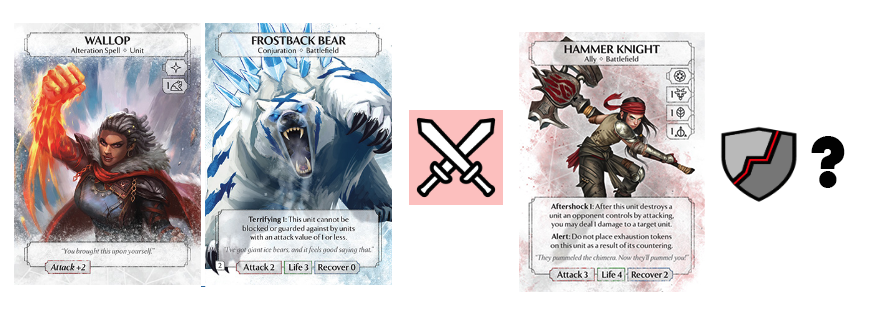
The answer is usually yes, but to understand the basics of why this is (and whenever this is not the case) you need to consider your current aggressive and defensive battlefield priority.

The aim of the game is to ultimately deal damage to your opponent’s PB, but how direct that goal relates to your decision making depends on the state of the game. If guarding an attack would kill your PB, obviously you can’t do it. What about leaving you 2 away from death, easily within **[Final Cry](https://ashes.live/cards/final-cry/)** range?

**Battlefield Dominance.** This is often your default battlefield priority. The goal here is to destroy your opponents units without losing as many as yours. This will enable you to later on favourably convert your battlefield control into damage to the enemy’s PB. If you can dominate the battlefield you also prevent your opponent from executing a large plan of attack. Having powerful exhausted units that refresh at the start of the round when your opponent has none to match is often a good sign of who's winning a game of Ashes.

[![sword-clash (1).png](https://wiki.ashes.live/uploads/images/gallery/2024-02/scaled-1680-/sword-clash-1.png)](https://wiki.ashes.live/uploads/images/gallery/2024-02/sword-clash-1.png) **Battlefield Dominance Attack**

To play this priority aggressively, you should always make attacks against your opponents units, never their PB. Try to match your attack and costs against enemy units as efficiently as possible. Kill their 2 cost **[Winged Lioness](https://ashes.live/cards/winged-lioness/)** with your 1 cost **[Seafoam Snapper](https://ashes.live/cards/seafoam-snapper/)** and you just gained a 1 dice battlefield advantage.

[![checked-shield (1).png](https://wiki.ashes.live/uploads/images/gallery/2024-02/scaled-1680-/checked-shield-1.png)](https://wiki.ashes.live/uploads/images/gallery/2024-02/checked-shield-1.png)**Battlefield Dominance Defence**

Defensively you should guard the largest swing in attack and efficiency as possible. Your opponent just attacked with a 4 attack [**Frostback Bear**](https://ashes.live/cards/frostback-bear/) against your [**Hammer Knight**](https://ashes.live/cards/hammer-knight/)? Guard that attack and you just took a massive amount of damage out of the equation of battlefield dominance. Even if the damage you take is high and you’d rather have avoided the efficient opportunity for your opponent in the first place (the subject of the next combat tip) it still might be the right play.

On this flip side, if battlefield dominance is your aggressive priority you want to make it as awkward as possible when your opponent chooses to guard. Don’t over commit with a large attack against a low health unit. Your opponent may surprise you and guard the attack anyway.

**PB Damage.** Take everything you’ve learned about battlefield dominance and flip it on its head.

[![sword-clash.png](https://wiki.ashes.live/uploads/images/gallery/2024-02/scaled-1680-/sword-clash.png)](https://wiki.ashes.live/uploads/images/gallery/2024-02/sword-clash.png) **PB Damage Attack**

Aggressively prioritizing PB damage means calculating a good time to strike wide. If you out number your opponent’s unexhausted units, you can guarantee at least one of your attackers will make it through. Your deck may require more turns of setup but beware taking too long before swinging with everyone. You can use one PB guard to essentially exhaust a unit when they attack (forcing them to do this with **[Light Bringer](https://ashes.live/cards/light-bringer/)** is a classic aggressive move), but after that your opponent can start forcing your units into a dominance battle.

Knowing that your opponent will want to guard to protect a unit is also very important way to deal PB damage from the battlefield. Try attacking units with just a little more attack than is necessary and they may mistakenly guard the attack, falling into your aggressive plans.

![checked-shield (2).png](https://wiki.ashes.live/uploads/images/gallery/2024-02/scaled-1680-/checked-shield-2.png)**PB Damage Defence**

Defensively you should avoid guarding at all or guard only a small damage attack and start playing reactively to protect your PB’s life total. Your opponent may be caught off guard when you accept the death of an important unit but it might be worth it in the end. Attacking is risky since you’ll no longer have them as blockers. First build up a defence of couple unexhausted units so that you can make key attacks without worrying about massive counter swings against your PB.

#### **My Advice.**

My first piece of advice is to go big on your battlefield priority and make extreme plays with your guarding. If you are prioritizing dominance don’t be afraid to guard large attacks, they may win you battlefield control. If you are prioritizing PB health it can seem terrible to let your units die and not use your guard all round, or use it on a seemingly less important but less PB damaging attack, but that life total difference might be what wins you the game.

So when should you be prioritizing which battlefield goal?

Most “normal” battlefield based decks start with prioritizing battlefield dominance in round one before transitioning to defensive PB survival if their own life points get low, and transitioning to aggressive PB survival if their opponent's life points get low.

Its important to recognise that you can have a different aggressive and defensive battlefield priorities at the same time.

If your opponent’s life points drop to a low value before yours do, consider using your own health liberally to guard large attacks before pushing for the victory by aggressively swinging wide.

Some players are playing for domination almost the entire game, only attacking the PB directly when there is nothing left of their opponent’s to destroy. If you are trying to improve your standard battlefield game of Ashes, this is an excellent choice to focus on.

However, consider the following possibilities as well:

- If you are playing against a dedicated burn deck you may want to immediately prioritize protecting your PB health.
- If you are playing lots of aggressive units, you may wish to prioritize dealing PB health immediately, and even more aggressively, pair it with defensive dominance, sacrificing your own health to protect your units.
- If your opponent isn’t playing a burn plan but has access to burn cards, switch earlier from dominance to protecting your health to avoid losing while in control.
- If you’re on a slow mill plan, prioritize protecting your own PB health but try to play for battlefield dominance aggressively.
- If you are on burn plan, you want to protect your PB health but prioritize dealing your enemy PB damage at the same time.

These points of advice are up for debate and will change depending on your personal evaluation of the meta and the decks in the game. The potential for battlefield clog can also offer a unique twist to games, but I haven't covered that here.

#### **Consider Your Priorities!** 

In summary my first tip for improving your combat skills for Ashes Reborn is as follows: Each round/turn ask yourself the question “Which is my aggressive priority here, PB health or battlefield dominance?” Then also ask yourself the question, “Which is defensive priority here?”

# Combat Mastery 2 - Tips to Improve Your Decision Making in Ashes Reborn.

By Timothy Cathcart

Ashes Reborn is fundamentally a game of combat and the battlefield. Many decks attempt to win by a mechanism other than the battlefield of course, spinning down dice with **[Dream Fracture](https://ashes.live/cards/dream-fracture/)**, or burning your opponent directly with **[Chant of Revenge](https://ashes.live/cards/chant-of-revenge/)**, but even then you still need to both plan and react to what's happening on the battlefield.

For this tip of combat mastery I will be focusing on a fundamental principle of summoning and trading units in combat and how to come up on top.

### **Tip 2: Track Sources of Damage and Sequence Playing Units Accordingly**

Your opponent is playing **[Aradel Summergaard](https://ashes.live/cards/aradel-summergaard/)**[ ](https://ashes.live/cards/aradel-summergaard/)and has not used their **Water Blast** ability yet. You have a **[Hunt Master](https://ashes.live/cards/hunt-master/)** in hand and want to apply some early aggressive pressure. But first you play **[Summon Light Bringer](https://ashes.live/cards/summon-light-bringer/)**[ ](https://ashes.live/cards/summon-light-bringer/)because it's good to have options, right? Now your opponent on their turn plays **[Summon Gilder](https://ashes.live/cards/summon-gilder/).** Oh no!

This a particularly straightforward example of how sequencing matters when it comes to sources of damage and sequencing your plays. Your opponent now has both **Water Blast** for 2 damage and **[Summon Gilder](https://ashes.live/cards/summon-gilder/)**[ ](https://ashes.live/cards/summon-gilder/)for 1 damage in one turn. No doubt they will be happy to kill your **[Hunt Master](https://ashes.live/cards/hunt-master/)** with this combo of damage if you play it now.[![image.png](https://wiki.ashes.live/uploads/images/gallery/2024-03/scaled-1680-/image.png)](https://wiki.ashes.live/uploads/images/gallery/2024-03/image.png)
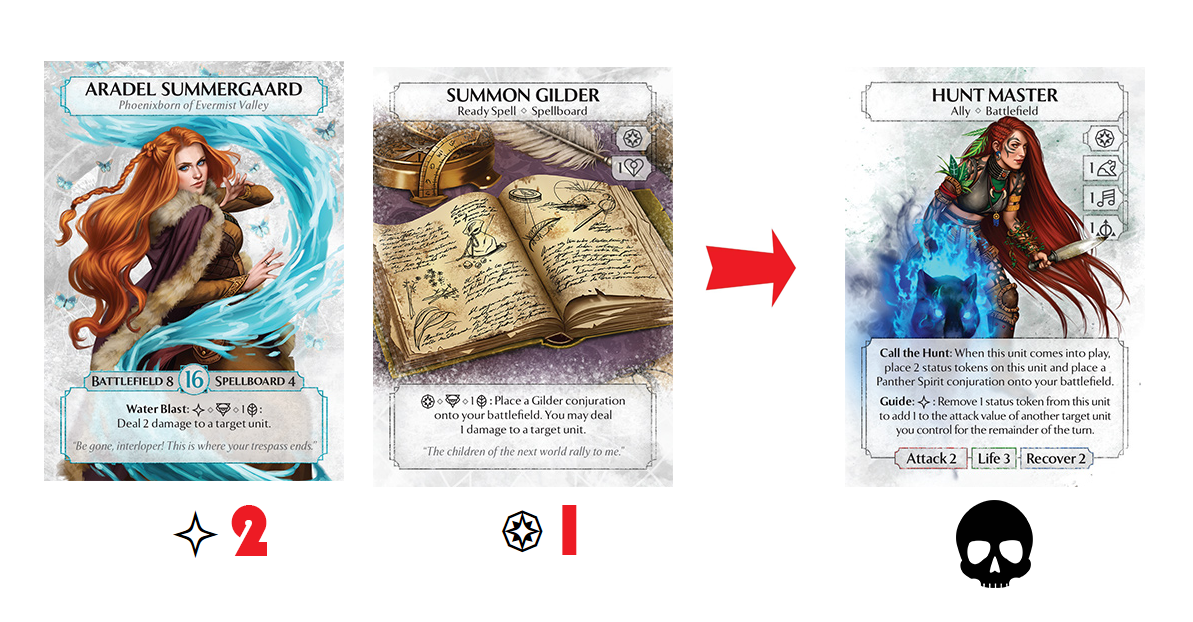
It's possible to predict that they would play the **[Summon Gilder](https://ashes.live/cards/summon-gilder/)**[ ](https://ashes.live/cards/summon-gilder/)since it's a common inclusion in **Aradel** decks. In this case you could have played the **[Hunt Master](https://ashes.live/cards/hunt-master/)** on turn 1. Then then they play **[Summon Gilder](https://ashes.live/cards/summon-gilder/)**, threatening to take out the **[Hunt Master](https://ashes.live/cards/hunt-master/) in one turn, you attack with the **[Hunt Master](https://ashes.live/cards/hunt-master/)** before they can kill it.

However this is just one example, it can be difficult to predict what your opponent is going to play and what sources of damage they have!

##### **Don't Play Into Their Source of Damage**

Ok, so it happened anyway. Now they are setup to kill anything with 3 health. But they don't know you have a **[Hunt Master](https://ashes.live/cards/hunt-master/) in hand! So simply don't play it yet, sequence playing other units first instead. Do you have a 1 health unit like **[Summon Salamander Monk](https://ashes.live/cards/summon-salamander-monk/)**[ ](https://ashes.live/cards/summon-salamander-monk/)or **[Ritualist](https://ashes.live/cards/ritualist/)?** These give you extra value from their cost, even when they die, so having one killed by a[ **Gilder**](https://ashes.live/cards/summon-gilder/) isn't the end of the world. Can you play a 2 health unit on the cheap? [**Old Salt**](https://ashes.live/cards/old-salt/) costs 2 dice so its a bad trade with the 1 dice **Water Blast** but at least you get to deal 1 damage as well from [**Old Salt's**](https://ashes.live/cards/old-salt/) ability. A 2 health for 1 dice unit like [**Jungle Forager**](https://ashes.live/cards/jungle-forager/) is hard to come by and your opponent might ignore them.

##### **Find Your Worst Case Scenario and Try To Avoid It**

The pure efficiency of **Water Blast** is hard to escape from. 2 damage for 1 dice is probably going to trade well into one of your units which costs more. However, don't give your opponent the opportunity to pick the best unit to kill with their source of damage. Want to be able to play the **[Hunt Master](https://ashes.live/cards/hunt-master/)** without it dying? First summon your [**Frostback Bear**](https://wiki.ashes.live/Frostback%20Bear). It will sad to see it die to the damage combo but then you can at least now play your **[Hunt Master](https://ashes.live/cards/hunt-master/)** more safely. And the reverse logic is true of here of course. Maybe you play the **[Hunt Master](https://ashes.live/cards/hunt-master/)** early, accepting the death blow from **Water Blast** and [**Gilder**](https://ashes.live/cards/summon-gilder/) **,** since you've decided the [**Frostback Bear**](https://wiki.ashes.live/Frostback%20Bear) surviving is more important.

By trying to avoid your worst case scenario, you leave a lot of room for your opponent to misplay. Present your opponent with targets that aren't as bad for you to lose and hopefully they'll waste their damage. And if they hold off waiting for a better opportunity? Start putting on the pressure and making attacks with the units you already have and remember, passing is a legitimate option. If your opponent has 2 dice left at the end of the round, set aside for [**Gilder**](https://ashes.live/cards/summon-gilder/) and **Waterblast** and you have 3 dice set aside for **[Hunt Master](https://ashes.live/cards/hunt-master/) consider if the outcome of playing your unit is worth it or not. After the dust settles you'll end up with a **[Panther Spirit ](https://ashes.live/cards/panther-spirit/)**and your opponent will get a [**Gilder**](https://ashes.live/cards/summon-gilder/). You may think that passing here is a good idea, forcing your opponent to either also pass or spend the **Water Blast** and **Gilder** on something else, thus enabling you to play the **[Hunt](https://ashes.live/cards/hunt-master/)[ Master.](https://ashes.live/cards/hunt-master/)** But be careful about side actions and passing! In this example your opponent will possibly **Water Blast** something and then also pass, preventing you from playing your unit before the round end. In any case try to assessing the outcome of passing. When in doubt you may have to simply accept an unideal trade.

##### **Attacks Are Sources of Damage**

Lets move away from this specific example and see how we can apply this theory to all sources of damage and sequence units accordingly.

[![image.png](https://wiki.ashes.live/uploads/images/gallery/2024-03/scaled-1680-/Xpaimage.png)](https://wiki.ashes.live/uploads/images/gallery/2024-03/Xpaimage.png)
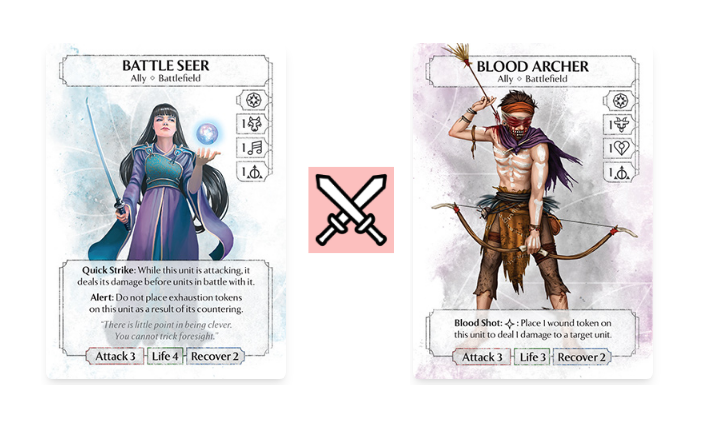
When understanding your opponent's sources of damage its super important to consider what is available to them next turn. If your opponent has a **[Battle Seer](https://ashes.live/cards/battle-seer/)** in play then don't play your [**Blood Archer**](https://ashes.live/cards/blood-archer/), their attack and your life total is a match made in heaven! However remember that it unusually takes a whole turn to summon something before your opponent can attack with it. They have a **[Summon Winged Lioness](https://ashes.live/cards/summon-winged-lioness/)** book, waiting to be triggered? Feel free to summon your **[Mirror Spirit](https://ashes.live/cards/mirror-spirit/)** anyway. They might summon the **[Winged Lioness](https://ashes.live/cards/winged-lioness/)** to take it out, but then you'll have a turn to attack first with the **[Mirror Spirit](https://ashes.live/cards/mirror-spirit/)** against whoever you want!

Attack with units that are about to become the negative side of an efficiency equation so that your opponent gets less value from taking them out. Avoid summoning units if you can see your opponent has an answer for them on the battlefield already.

On the flip side, you want to setup as a few different answers to take out your opponent's cards with efficient trades. If you only have sources of 1 damage in your hand and on the battlefield you'll struggle to deal with a large knight your opponent might play. Mix it up with different attack and damage values to give yourself options and put your opponent in a bind!

Of course, its inevitable that your opponent will get some efficient trades (unless you are absolutely crushing them on the battlefield). The key is to avoid the worst case scenarios and sequence your units to make that efficiency difficult for your opponent.

##### **Your Guard Is a Resource Not an Excuse To Badly Sequence**

##### **[![guarded.png](https://wiki.ashes.live/uploads/images/gallery/2024-03/scaled-1680-/guarded.png)](https://wiki.ashes.live/uploads/images/gallery/2024-03/guarded.png)**

A mistake I used to make a lot is to play whatever units I felt like, knowing that I could just guard the first attack I didn't want to go through. However while this approach to using your guard can work for playing an extremely aggressive deck that immediately giving up battlefield control, for most decks its a trap to use your guard so liberally in the round.

Each round is a series of attacks, some better for one player than another and you can only cancel one efficient trade with your guard. Just one! If your opponent has an **[Ancestor Spirit](https://ashes.live/cards/ancestor-spirit/)** on the battlefield and you summon a 2 life unit like[ **Emberoot Lizard**](https://ashes.live/cards/emberoot-lizard/), sure you might be able to guard the inevitable attack the next turn from the **[Spirit](https://ashes.live/cards/ancestor-spirit/)** against your **[Lizard](https://ashes.live/cards/emberoot-lizard/),** but now you can't guard anything else, maybe an even better attack for your opponent later in the round! Instead, try to leave summoning the [**Emberoot Lizard**](https://ashes.live/cards/emberoot-lizard/) and take out the **[Ancestor Spirit](https://wiki.ashes.live/Ancestor%20Spirit)** first with a different unit or source of damage.

#### **My Advice.**

In summary my advice is to constantly assess your opponent's sources of damage when deciding how to sequence your unit plays. Try to predict what sources of direct damage they might have in hand and what attacks they have available on the battlefield. Avoid playing units with life totals that nicely match sources of damage your opponent currently has available. Attack with units you already have in play before they get taken out by an efficient source of damage.

Its an impossible task to perfectly sequence your units in a way that prevents any of them from getting taken out by your opponent's attacks and removal. However your should aim to sequence your unit plays to make it as difficult as possible for your opponent to get the most out of their damage sources.

# Every Single Phoenixborn - Ninja's Tier List and Guide

Recently I've completed my ten wins on Ashteki with every phoenixborn in the game. I thought I'd share my thoughts on each one, how powerful I think it is, strengths and common combos.

### **A** Tier

#### **Hope**

[![image.png](https://wiki.ashes.live/uploads/images/gallery/2024-05/scaled-1680-/JfXimage.png)](https://wiki.ashes.live/uploads/images/gallery/2024-05/JfXimage.png)
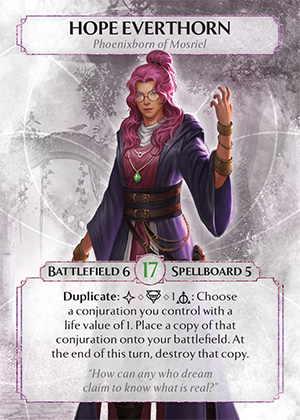
**How to Win: Duplicate** is unbelievable value. You should definitely be using it every round to apply pressure with key 1 life conjurations especially those that have 2 or more attack. Combo this aggression with **Void Pulse** to take out enemies and either hit face or control the battlefield.

**Deck Styles:** You generally want to max out **Void Pulse** damage so swarming and playing lots of cheap units is a good plan. Taking out a 3 or 4 health unit can be amazing value, but don't get too greedy and wiped by card like **Nature's Wrath**. Start your deckbuilding by choosing what 1 life conjurations you can duplicate. You can utilize your giant spell board to insure you still have multiple different 1 life units you could duplicate, should your opponent take one of them out. **Duplicate** and **Void Pulse** together do make for a pretty aggressive package, so an aggressive attacking deck strategy will work well here.

**Common Combos:** What makes Hope so powerful and my number 1 PB is the flexibility they provide with **Duplicate**. Common targets for the ability are **Shadow Hound, Vampire Bat Swarm** and **Light Bringer. Shadow Hound** is the most expensive conjuration with 1 life so it makes sense you get a lot of value from duplicating it. **Vampire Bat** has a great on destruction ability you can trigger and **Light Bringer** can really help with your aggressive strategy, forcing your opponent to attack when it's least beneficial and then hitting back hard when they exhaust their units.

**Proven Competitive Lists:**

Carl's LKA V Winning Shadow Hounds deck: **[https://ashes.live/decks/50100/](https://ashes.live/decks/50100/)**

Killercactus's Collection 2023 Top 4 Aggro Burn deck: **[https://ashes.live/decks/share/8534a00b-f6ff-487d-acbd-90cbf4742ab6/](https://ashes.live/decks/share/8534a00b-f6ff-487d-acbd-90cbf4742ab6/)**

Brian B's Pod II Top 2 Shadow Hounds PACT deck: **[https://ashes.live/decks/share/975e32d4-cea7-4b2e-b2d8-ef7f540078ec/](https://ashes.live/decks/share/975e32d4-cea7-4b2e-b2d8-ef7f540078ec/)**

**My Best Homebrew: [https://ashes.live/decks/44410/](https://ashes.live/decks/44410/)**

Helping me get my 10 wins with Hope is this **Shadow Hound** deck which combines the time dice **Fighting Spirit** spellboard package with classic Hope **Shadow Hounds**.

With so many 1 life units to choose from I have a lot of options during the game. Every card I draw helps me build up my spellboard with focus effects, so quite often I duplicate the **Wishing Wing** instead of the **Shadow** **Hound,** depending on if there is a juicy target to stalk and kill. Build up your **Fighting Spirit** with tokens and hit your opponent with a big attack, using some combination of **Void Pulse, Accelerate,** and **Stand Still** to ensure your opponent cannot block the beatdown. Just be careful to avoid getting clogged, always leave a battlefield slot open for a **Seafoam** **Snapper** to eat something or a conjuration to duplicate into!

#### **Harold**

[![image.png](https://wiki.ashes.live/uploads/images/gallery/2024-05/scaled-1680-/Kl9image.png)](https://wiki.ashes.live/uploads/images/gallery/2024-05/Kl9image.png)
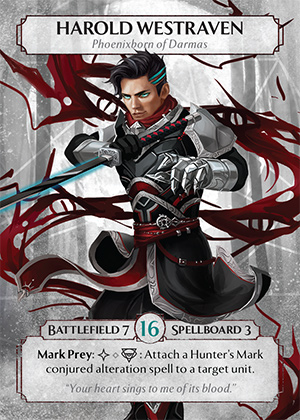
**How to win:** Harold is the master of controlling the battlefield, and outvaluing your opponent in combat. **Hunter's Mark** is versatile and can be used in several different ways to ensure victory. First you can use it against high life enemy units to trade efficiently. Put the **Hunter's Mark** on an opponent's 4 life knight unit and attack with literally any 2 attack unit to take them out. There's usually nothing the opponent can do as every round **Hunter's Mark** allows you to go up at least 1 dice in combat every round.

Another combination is to use direct damage to take out the enemy with the mark. Any main action direct damage in particular can be used with **Hunter's Mark** on the same turn to take out a 2 health unit.

Trying to taking out a large enemy unit with a big attack usually means the opponent guards with their PB, using their life as a resource. **Hunter's Mark** can be used to deny that play so try putting large attack units and combos into your Harold deck, knowing that you can use the large attacks without fear of PB guarding.

**Deck Styles:** Harold is amazing at dominating and "winning" the battlefield, so your focus should be on what to do with that control. Stack your deck full of knights or burn cards, just remember you have to actually win at some point by attacking your opponent's PB once you have control of the battlefield.

**Common Combos:** There are many cards which combo with **Hunter's Mark. Old** **Salt** is already a great value proposition of a body and a ping damage made even better when combined with **Hunter's Mark. River Skald** can seem like overkill but allows you to discard 2 cost cards for 4 damage or take out something with annoying **Root Armor.** Use **Hunter's Mark** and knights with combat kill effects like **Sonic Swordsman** to ensure those effects get triggered.

**Proven Competitive Lists:**

Carl's Collection 2023 Winning PACT deck: **[https://ashes.live/decks/share/3a12679a-bfab-4847-a9ec-cbdc58bcbdf0/](https://ashes.live/decks/share/3a12679a-bfab-4847-a9ec-cbdc58bcbdf0/)**

Killercactus's Pod I Top 2 PACT deck: **[https://ashes.live/decks/share/236d8dd9-44b7-4875-9be9-4224cc3c75e4/](https://ashes.live/decks/share/236d8dd9-44b7-4875-9be9-4224cc3c75e4/)**

Brian B's Collection 2023 Top 2 PACT deck: **[https://ashes.live/decks/share/6600553b-6cc7-4a2d-870d-e27d31f4103a/](https://ashes.live/decks/share/6600553b-6cc7-4a2d-870d-e27d31f4103a/)**

The Treatment's Pod II Top 4 Spindown deck: **[https://ashes.live/decks/share/763330d1-ff15-4889-aa8e-d8fd49fac398/](https://ashes.live/decks/share/763330d1-ff15-4889-aa8e-d8fd49fac398/)**

**My Best Homebrew: [https://ashes.live/decks/43621/](https://ashes.live/decks/54172/)**

Helping me get my 10 wins with Harold is this knight heavy battlefield control deck. The key card of the deck is **Glory Aspirant** which can be used to pull out **Light Swordsman**, **Silver Paladin** or **Sonic Swordsman**. In round 1 the deck usually plays double **Sonic Swordsman**, by pulling the second copy from the deck with the **Glory Aspirant. Sonic Swordsman** is a nasty combination with Harold's **Hunter's Mark** ability. Your opponent may have some way to play around it but once you play the second copy of **Sonic Swordsman** and combo it with **Pride** late in the round your opponent should be in real trouble. Ideally your 3 dice cost knights heal damage and survive for round 2 and the game snowballs into your control. There are a lot of powerful options in the deck as well, **Light Swordsman** can pressure a Phoenixborn guard by attacking something with 2 life. **River Skald** can pitch one of your many costly cards like **Silver Paladin** for massive damage and then **Shepard of the Lost Souls** can bring it back, or vice versa. **Chant of Transfusion** and **Old Salt** is as good here as any deck, moving the damage with a side action from **Old Salt** to take out enemies and heal in one go. Finally I like playing **Mirror Spirit** as a possible threat, not necessary summoned every round, but if the battlefield clogs up enough via **Sonic Swordsman** exhausts, it suddenly becomes worth it to summon.

#### **Rin**

[![image.png](https://wiki.ashes.live/uploads/images/gallery/2024-05/scaled-1680-/f6oimage.png)](https://wiki.ashes.live/uploads/images/gallery/2024-05/f6oimage.png)
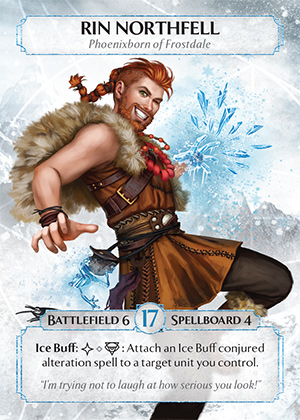
**How to win:** Winning with Rin is all about using his **Ice Buff** ability on the unit which benefits the most from it. Changing a 2 life unit to a 3 life unit can have the largest impact since placing your unit outside of double ping removal range can make a big difference. An already tough unit to take out with 3 or more health like a knight becoming even more difficult to kill can also work well.

In general **Shattering Fist** is a much more powerful removal card than the more situational and expensive **Rin's Fury** which can admittedly catch an opponent off guard attacking with a knight, since it's rarely played. Note the side action cost for this event and get your **Ice Buff** or other disposable alteration out early so that you have the option to shatter an enemy whenever is best. A good move to exploit this side action destruction can be attacking a 4 life knight unit with a 1 attack ally. If your opponent doesn't guard the single damage then the extra 3 from shattering fist is enough to destroy their 3 dice investment and make them regret their decision.

**Deck Styles:** With superior unit health and a powerful removal spell Rin is best suited for controlling the battlefield to his advantage and converting that control to PB damage later. I find Ice Buff** is generally more powerful when combined with higher health units, so focusing on making kills without losing your units in the attack can give your opponent very awkward combat math to deal with. However there are also some 1 life units with powerful effects that usually don't get triggered since they die so quickly, you might want to consider building around buffing them instead.

**Common Combos:** The main reason Rin is in my A tier of PBs is how **Shattering Fist** combines with **Adaptodon** for amazing round 1 value. The downside of **Shattering Fist** removing an alternation turns into a positive since you can trigger **Adaptodon's** **Adapt** ability again, and conjure another **Adaption** alteration. Altogether this can combine for 5 direct damage and a 2/2 unit just for 3 dice, split up however is most useful.

Other common combos are units that benefit from the extra 1 life. **Frostback Bear** is already a great value proposition that can get even harder to remove with 4 life instead of 3. **Ruin Dweller** is an example of a 2 dice summon that is often the target of removal, so getting it up to 3 health is great protection against direct damage. **Shadow Spirit** often doesn't get to even trigger its spindown effect before dying to 1 direct damage so 2 health might just be enough to see it actually attack. It's worth mentioning **Ice Golem** as an obvious choice for the **Ice Buff** to trigger the additional life from **Skin Morph,** but even so the investment of 3 dice into a large unit can be underpowered, so I don't recommend this unit unless you're fine with playing something janky.

**Proven Competitive Lists:**

Fred's LKA II Winning Adaptodon Deck: **[https://ashes.live/decks/49763/](https://ashes.live/decks/49763/)**

Chaos Theory's GenCon 2023 Winning Forstback Bear Deck: **[https://ashes.live/decks/38694/](https://ashes.live/decks/38694/)**

Carl Diaz's LKA VII Top 4 Battlefield Deck: **[https://ashes.live/decks/share/467f6072-73e8-4f9d-a7ab-c36584974d77/](https://ashes.live/decks/share/467f6072-73e8-4f9d-a7ab-c36584974d77/)**

MBauer's LKA I Top 4 Spindown Deck: **[https://ashes.live/decks/48695/](https://ashes.live/decks/48695/)**

MBauer's LKA IV Top 4 Spindown Deck: [**https://ashes.live/decks/share/662608d1-a5c2-4511-8986-68c2ca458e41/**](https://ashes.live/decks/share/662608d1-a5c2-4511-8986-68c2ca458e41/)

Ninja's LKA II Top 4 Adaptodon Deck: **[https://ashes.live/decks/48880/](https://ashes.live/decks/48880/)**

**My Best Homebrew: [https://ashes.live/decks/48880/](https://ashes.live/decks/48880/)**

Helping me get my 10 wins with Rin and Top 4 at LKA2 is this extremely fun to play big beastly deck of large units and alterations.

Use the now classic Rin combo of **Adaptodon** and **Shattering Fist** to blast your opponents units in round 1. Then tactically decide which of your four summons best suits the **Ice Buff** in any given round. With 8 dice every round spent on summons the rest of the deck is full of situational actions and alterations. Pump value into your 2 dice beasts by giving them just the right amount of attack, or extra ping to dominate the battlefield. Don't worry to much about losing your large units, just make your opponent waste energy and attacks to take them out!

#### **Odette**

[![image.png](https://wiki.ashes.live/uploads/images/gallery/2024-05/scaled-1680-/Pyyimage.png)](https://wiki.ashes.live/uploads/images/gallery/2024-05/Pyyimage.png)
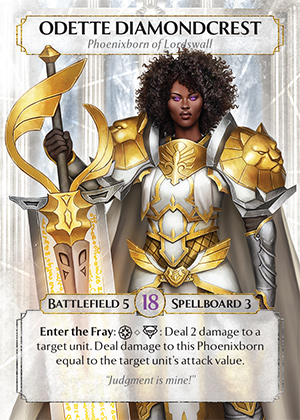
**How to win:** That sword isn't just for show! Odette brings consistent destruction down upon the enemy. **Enter the Fray** is the bane of every 0 attack 2 life unit out there, and can also be used aggressively against anything that needs taking out asap regardless of damage to PB. It doesn't get more removal than simply destroy an unit than Sword of Virtue**, the ultimate send off for any high health enemy.

My advice, if you suspect a 0 attack unit will get played, like the **Raptor Hatchling** or **Ruby Cobra** then hold off on your **Enter the Fray**, but don't be afraid to use your PB health as a resource and take out that 2 life **Winged Lioness** or pesky **Adaptodon**. Between PB guarding, **Enter the Fray** and destroying a unit with **Sword of Virtue** you should be able to establish control of the battlefield quickly, just make sure you have a plan to convert that battlefield control into big PB damage in later rounds before all that **Enter the Fray** damage adds up.

**Sword of Virtue** is 2 dice for removal, so if your opponent plays a 3 dice knight round 1 its a fantastic trade for you. However what if they play all cheap units round 1? By also playing a large unit yourself you can make the most of the sword's flexibility, take out their knight, or refresh your own.

**Armor of Valor** is great value over the course of the game, so you may wish you consider play it over **Sword of Virtue,** especially in round 1 where it will get the most value over the course of the game. Now your PB life total wont take quite the same hit from enter the fray so you can use it even more liberally than usual. Just don't overplay the **Armor of Valor**, if your opponent summons a 0/2 like **Ruby Cobra** it might still be the right play to **Enter the Fray** on them, wasting their 1 dice summon for free. Playing the **Armor of Valor** will potentially slow down your game plan a little compared to round 1 **Sword of Virtue,** so consider having a plan B strategy for victory in case your opponent plays very passively, walling up with defencing units and refusing to attack you.

**Deck Styles:** With the ability to take out key enemy units round after round Odette is the perfect home for combo decks that require protecting specific special units. Combo **Enter the Fray** with side action damage and you can take out most threats before they can attack. By sacrificing your PB health you can establish control of the battlefield, so even if you don't play big unit combo consider running high attacks units that can convert that battlefield control into enemy PB damage.

**Common Combos:** Bypass decks are a common combo with Odette, starting with the cornerstone bypass card **Frostback Bear.** Take out their units with attack high enough to block your fearsome ursine friend, and leave the rest to scramble as you hit their PB. Unit Gaurd summons can make things even more awkward to navigate for your opponent, like **Turtle Guard** or **Butterfly Monk.** With only 3 spell board slots you have to make those summons count!

Then there is the question of what units will benefit most from protection and **Sword of Virtue** refreshing. **Realm Walker** is always a frustrating threat for your opponent if you can keep it alive long enough. **Massive Growth** or **Wallop** can turn your **Frostback Bear** or other attacker into a unit worthy of attacking multiple times.

There is a possible specific combo with Odette and **Shining Hydra** you may wish to consider. Use **Enter the Fray** on the Hydra while it has 1 attack, then give it **Massive Growth** while you use **Regenerate Heads** to heal the damage. With just a 2 card combo your **Shining Hydra** will end up as a 7 attack **Terrifying 2** unit, quite possibly enough to win the game with multiple attacks against your opponent's PB health.

**Proven Competitive Lists:**

Brian B's LKA VIII Winning Silver Paladin Deck: **[https://ashes.live/decks/share/21181aa6-f6e1-455e-b9cd-4e870404fe5f/](https://ashes.live/decks/share/21181aa6-f6e1-455e-b9cd-4e870404fe5f/)**

Mbauers' LKA VIII Top 4 Spindown Deck: **https://ashes.live/decks/share/3b0d553e-fd22-4e55-a4d7-4241ffbdc89c/**

Clu's SB LCQ Winning Realmwalker Deck: **[https://ashes.live/decks/share/dfda61e5-a82a-4dd2-9f91-1506b3b97775/](https://ashes.live/decks/share/dfda61e5-a82a-4dd2-9f91-1506b3b97775/)**

Shadowfire's Phoenix Pod I Top 4 Battlefield Deck: **[https://ashes.live/decks/share/32f91b2c-1ec6-42f4-b304-4a703ac1279d/](https://ashes.live/decks/share/32f91b2c-1ec6-42f4-b304-4a703ac1279d/)**

**My Best Homebrew: [https://ashes.live/decks/37819/](https://ashes.live/decks/37819/)**

Helping me get 10 wins with Odette and first place at the Sunhold Webcam Tournament is my personal variation of the bypass deck, with **Steadfast Guardian. Root Armor** on the Guardian can make it very difficult to deal with, and if they deal incremental damage **Sword of Virtual** refresh can be devastating.

Use the classic combo of **Shining Hydra**, **Enter the Fray** and **Massive Growth** to close out the game. To add consistency to the deck, **Polarity Mage** can pull either **Root Armor** or **Massive Growth** from the discard. Use **Light Bringer** to make your opponent attack awkwardly into the armoured **Steadfast Guardian**. You can even play **Call To Action** in response to get another attack out of your bypass Bear or Hyrda. A fun unexpected trick unique to this version of the deck is to play the **Massive Growth** onto the **Steadfast Guardian** if you need to. This can really put your opponent in a bind.

Finally, when it comes to closing out the game don't forget those charm dice! Using a charm dice power to reduce an enemy unit's attack below the terrifying threshold of my bear has won me several games!

#### **Tristan**

[![image.png](https://wiki.ashes.live/uploads/images/gallery/2024-06/scaled-1680-/image.png)](https://wiki.ashes.live/uploads/images/gallery/2024-06/image.png)
**How to win:** Tristan's 1 basic side action **Magnify** ability is a bit like Hope's **Duplicate** with slightly less flexible aggressive power and more about specific combos with units. Nevertheless, getting the most of out Tristan is usually also about playing aggressively, you want to be able to proactively unitise your ability every round. **Tsunami Shot** is quite possibly the best unique in the game, with the flexibility to take out whatever combination of enemies you want. Don't be afraid to use it on enemy 4 health knights, it still trades nicely with 2 dice against their 3. Whatever you decide to hit with the 4 deathly arrows, make sure to destroy your opponents units before they have exhausted them, for maximum value.

**Deck Styles:** Start your deck building by choosing which unit or units you can combo with **Magnify**. You can diversity you spell board with multiple summons that trigger from the ability, but committing to a single unit having a backup for the dice spend can also work out well. With the second largest battlefield in the game, you can afford to go extremely wide with your units. Just beware the board wipe, and make sure to take whatever aggressive opportunities you have.

**Common Combos:** For an instant swarm of fish, **Prism Tetra** is a classic staple of Tristan decks. With magnify on all 3 of them, the 6 attack for 3 dice can be an efficient attack, just keep in mind this locks you into a super aggressive strategy since the fish don't stick around from round to round. **Ruby Cobra** can supplement or form the backbone of a Tristan deck. The extra attack and mill combine for something fairly high value, especially if you boost it situationally to attack into 2 health units, or combo the **Magnify** with a second, 1 health unit. **Vampire Bat Swarm** and **Raptor Herder** are common options for simply boosting the attack or your wide swings. **Frost Frog** can be an interesting option to magnify and exhaust a troublesome blocker impeding your aggro progress. **Frostback Bear** offers something completely different from the other attack boosting options, powerful bypass, since your opponent is far less likely to have a 3 attack unit than a 2 (especially if you focus on killing them!).

**Proven Competitive Lists:**

Brian's LKA III Winning Agro 0 Attack Deck: **[https://ashes.live/decks/share/4a01dae3-5bed-4458-ac0b-7097b940231a/](https://ashes.live/decks/share/4a01dae3-5bed-4458-ac0b-7097b940231a/)**

Carl's LKA IV Winning Agro Burn Deck: **[https://ashes.live/decks/share/96baba07-63a1-48bb-97f1-c8772eee9210/](https://ashes.live/decks/share/96baba07-63a1-48bb-97f1-c8772eee9210/)**

**My Best Homebrew: [https://ashes.live/decks/53361/](https://ashes.live/decks/share/46d51139-0a0b-40ae-aab2-fb70cfce4ef5/)**

Helping me get my 10 wins with Tristan is this pretty straightforward and extremely aggressive deck. **Magnify** the **Prism Tetra** and throw in a **Vampire Bat Swarm** if needed to hit your opponent hard and fast. Play **Sleeping Widows** when they board wipe you for even more attackers. **Guilt Link** is perfect for trading your exhausted fish for their... not useless unit. The burn in the rest of the deck can close out the game while you never stop applying pressure with attacks.

The key here is not to wait for a perfect swarm attack opportunity. The moment you can trigger any of your group tactics you should swing, otherwise a single **Nature's Wrath** can set you back significantly. Keep the **Tsunami Shot** for anything that smells like a unit with alert, like a 4 health 3 dice knight, which may otherwise be a problem for our go wide plan.

#### **Dimona**

[![image.png](https://wiki.ashes.live/uploads/images/gallery/2024-10/scaled-1680-/image.png)](https://wiki.ashes.live/uploads/images/gallery/2024-10/image.png)
**How to win:** Dimona has a lot of moving parts and working out how to sequence your attacks and mounts can be tricky. Promoting an exhausted ally into the **Empyrean Mount** is a pretty sweet deal, but you need to get an exhausted ally that doesn't die to damage or a combat trade. Allies with exhaust abilities, or quickstrike can help you out here. Understanding the strange details of the combat phase can help you get the most out of your **Empyrean Mount.** Since it forces a unit to block instead of using stalk to prevent guarding it can be used in combination with other units attacking. It's also rather unusually for a summon has recover 3 which means trading into something smaller and leaving it wounded can force your opponent into really awkward plays to either get rid of it or allow it to heal up.

**Divinity Mount** is a pretty crazy card and can win you games with aggression and damage. The side action summoning is key to taking out your opponent's board at the most inopportune time. By playing **Take to the Skies** and then immediately attacking, you can quite often take out an unexhausted 1 life unit on your opponent's board. You really want to hit your opponent's life total with the **Divinity Mount** and avoid trading. To do this you can sequence the dragon to attack at the end of the round, combo it with the **Empyrean Mount** which will deal with 1 blocker, and prioritize killing anything with more than one 1 life before the dragon arrives.

On the other hand, **Rayward Knight** is not a particularly strong card, though it does have some limited uses. For a knight, 3 attack and 3 life isn't a great statline without a super powerful ability. Recurring allies from the discard into your deck can be useful to combat a a very particular problem, running out of allies, and the 3 basic cost can help avoid meditations against fatigue decks as well, so it can be a worthy include for **Fallen** decks which may have a problem running out of allies.

**Deck Styles:** Dimona's options are pretty aggressive, and her decks tend to follow. You want to play quite a hefty number of allies to guarantee the **Empyrean Mount** has a target that hasn’t been removed by your opponent. **Divinity Mount** is extremely powerful, but it can also lock you into a very specific play pattern of all out aggression, trying to take out enemy 2+ lifers and hitting your opponent’s life total hard. Quick tip here, in a pinch you can even exhaust Dimona without a valid target to set it up for the **Divinity Mount** the next turn. It’s obviously unideal since you don’t get a **Empyrean Mount,** but with a committed dragon strategy and no available allies to mount it might be the right play in some circumstances.  
Alternatively, a more control style of play is possible with Dimona. **Empyrean Mount** can provide a lot of value if it trades into the right units, and forcing the block with **Battlemaster** can deny your opponent the PB guard that usually gives them a leg up on the battlefield.

**Common Combos:** Combining **Dimona** with **Summon Fallen** creates an entire deck archetype. The theory here is that Dimona forces your opponent to choose between two problems, either take out your units and fuel the **Fallen** engine or allow them to quickly trigger the **Empyrean Mount** and **Divinity Mount** chain. If your opponent miscalculates may end up with both anyway!

When it comes to mount targets for the **Empyrean Mount,** there are a few common options worth concidering. The ally needs to be exhausted which changes things a little from the usually unexsausted mount. **Light Swordsman** can become exhausted without dying by attacking something with **Quick Strike**. **Raptor Herder** or **Ptera Herder** can go wide enough with swings to avoid dying when they attack, something **Light Bringer** can also help you with. **Rose Fire Dancer** is an interesting pick for a more control style deck. <span style="font-size: 11.0pt; line-height: 107%; font-family: 'Calibri',sans-serif; mso-ascii-theme-font: minor-latin; mso-fareast-font-family: Calibri; mso-fareast-theme-font: minor-latin; mso-hansi-theme-font: minor-latin; mso-bidi-font-family: 'Times New Roman'; mso-bidi-theme-font: minor-bidi; mso-ansi-language: EN-GB; mso-fareast-language: EN-US; mso-bidi-language: AR-SA;">Consider</span> spamming enough 1 cost units in general as a potential solution.

Once you have the **Empyrean Mount** or **Divinity Mount** you may wish to get more value out of it. Unexhaust cards like **Call to Action** or **Adrenaline Rush** can give you a powerful double swing, especially with the dragon, and since they are conjurations, **Resummon** also works.

**Proven Competitive Lists:**

Ebfritz's LKA VII Winning Dragon Aggro Deck: [https://ashes.live/decks/share/93d5e825-291d-4ee7-af8a-2dd3536dc73f/](https://ashes.live/decks/share/93d5e825-291d-4ee7-af8a-2dd3536dc73f/)

Nosuchmethod's Phoenix Pod II Winning Fallen Deck: [https://ashes.live/decks/share/9fc800f1-92ff-4947-8cca-fc7b44a762bb/](https://ashes.live/decks/share/9fc800f1-92ff-4947-8cca-fc7b44a762bb/)

**My Best Homebrew: [https://ashes.live/decks/57775/](https://ashes.live/decks/57775/)**

Helping me get my 10 wins with Dimona is this go wide version of Dragon Aggro. The aim here is to spam **Raptor Herder** as much as possible, a classic architype of itself. Then, after swinging wide with all your units, play down the surprise summon **Mirror Spirit** who should come out pretty large. Throw in another classic, the **Chant of Transfusion** and **Old Salt** combo and you should be able to get a lot of removal value in later rounds. Hopefully with enough allies getting played and replayed with **Shepard of Lost Souls** you should be able to summon the **Empyrean Mount** and then drop the **Divinity Mount** at the last minute of the round. Get your opponent's life total low enough and you can finish them off with **Final Cry** and **Sympathy Pain.** Regardless, keep the aggression up and keep constantly attacking, hopefully this deck can get it done.

#### **Astrea**

[![image.png](https://wiki.ashes.live/uploads/images/gallery/2024-05/scaled-1680-/LzWimage.png)](https://wiki.ashes.live/uploads/images/gallery/2024-05/LzWimage.png)
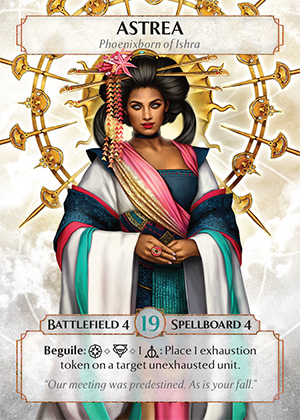
**How to win: The combination of Astrea's consistent and removal-like **Beguile** and the ultimate destructive power of **Judgment** makes her my top rated slow control style PB. Use **Beguile** on anything that looks like key threat, a 3 dice knight ally perhaps, or an important expensive conjuration. Even if you don't actually use **Beguile**, the threat of it can prevent your opponent from overcommitting on a single unit. Nothing entirely wipes the board quite like **Judgment** does, so play slowly, and punish your opponent from overcommitting on controlling battlefield.

**Mark of the Goddess** can also be a nasty surprise, even if its hard to justify giving up even 1 of your **Judgments.** What seems at first like a downside of the card, burning your opponent instead of destroying a unit, can be amazing value for 1 dice if your opponent is foolish enough to leave a high attack unit as their only unexhausted unit.

**Deck Styles:** Unlike previous PBs so far in this tier list the key to success for Astrea lies beyond the battlefield, using her control tools to prevent your opponent from gaining a large advantage while you burn, mill, or combo your opponent to death. Astrea can give you a lot of time between board wipes and slowing down your opponent with **Beguile**, you just have to make the best use of that time to seize victory.

**Common Combos:** With a small battlefield her as main weakness make sure to pack ping or AOE cards like **Nature's Wrath.** It might seem like overkill with **Judgement** in your back pocket but you'll want to wait for a better moment to play the almighty obliteration than when your opponent simply plays a **Raptor Herder.**

**To Shadows** can combo in the same turn with **Beguile** for a 2 dice removal of any unit. **Chant of Revenge** and **Frostbite** can provide a slow burn engine to work with Astrea's slow game plan, **Abundance** or other ready spell mill cards can work well with a slow mill plan. **Orchid Dove** works well with a **Judgment** wipe as well as being a mill staple, and **Shimmer Wing** can give you the card draw you need for the big wipe.

Using **Strengthen** but on your opponent's unit for a big **Mark of the Goddess** hit is a great fun combo, though **Strengthen** itself is generally a large dice investment so you'll want to maximize the value it provides even when you don't have **Mark of the Goddess**.

**Proven Competitive Lists:**

Ninja's LKA I Winning Burn Deck: **[https://ashes.live/decks/53108/](https://ashes.live/decks/53108/)**

**My Best Homebrew: [https://ashes.live/decks/53108/](https://ashes.live/decks/share/a2fdc696-68c5-43fd-9c86-1998f77982aa/)**

Helping me get 10 wins with Astrea, first place at LKA I tournament and top 4 at LKA V is this slow burn control deck.

Use **Ritualist** in round 1 to setup the **Chant of Revenge** burn engine. Every card in this deck is extremely important, either burn or something to discard for **Judgment,** so don't be disappointed when you never get to trigger **Ritual Flames** on your **Shimmer Wing,** its just there for the card draw!

Between **Frostbite** in later rounds, recurring **Fire Archer** with a ceremonial dice power and **Chant of Revenge**, you should be able to close out any game that lasts long enough, the trick is not to lose the battlefield too badly while you drip feed damage.

Use **Judgment** at a crucial moment just after your opponent has control of the battlefield! If you've still got blockers and **Beguile** you can hold out for a long as possible for resetting your opponent's progress.

Finally once your opponent is within lethal burn range you can go for the kill. Completely abandon the battlefield in favour of burn cards like **Sympathy Pain** and **Final Cry,** to finish off your opponent before they can attack your life point with the units they've foolishly invested time and dice to play.

### **B** Tier

#### **Maeoni**

[![image.png](https://wiki.ashes.live/uploads/images/gallery/2024-05/scaled-1680-/5N1image.png)](https://wiki.ashes.live/uploads/images/gallery/2024-05/5N1image.png)
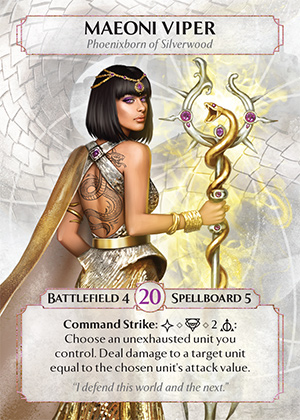
**How to win:** There are two main flavours of Maeoni, split between classic combo builds for exploiting the best conjuration in the game **Silver Snake** with the goal of turning it into a game winning attacker, and less tried and tested alternative strategies with **Venom Strike** or some other exploitation of Maeoni's **Command Strike** ability.

With **Silver Snake** employed on the battlefield you can make your goal a multi stage plan: protect, grow and then finally strike. Use allies with Unit Guard to protect your snake from getting killed early while it has no attack. Then use direct damage and removal, or even something like stalk attacks, to take out enemy units and stack those status tokens high on your snake buddy. Finally when they are big enough, the snake can attack with a fearsome total.

**Command Strike** can be used in combination with the **Silver Snake** as well. Once you have enough tokens your snake's attack value will kill whatever you desire and fuel the growth of your serpentine monster even more. Just be careful of **Fate Reflection**!

**Deck Styles:** With the classic Maeoni combo deck you can grow your snake to a massive attack value and then use bypass tools to hit your opponent's PB life total. Most games of ashes reborn are a back and forth of PB guards and incremental damage, but with a big enough snake 2 or even 1 attack can be enough to clinch victory.

Alternatively you can focus less on comboing the destructive power of the snake and build a more well rounded battlefield deck. With only a couple enemy deaths the **Silver Snake** is an amazing value proposition on its own with 4 life for only 2 dice. Your opponent may overspend resources removing the snake threat before they realize you have backup options for victory.

Instead of waiting for your snake to grow, **Command Strike** can also be used in conjunction with units that already have high attack, so consider adding a 3 dice knight ally to your first five for example.

Finally you can go in a completely different direction and focus on the less traditionally powerful **Venom Strike** unique action card, spamming out Charm Dice across your opponent's battlefield before burning and milling them. Spam those Charm Dice as early as possible in the round and avoid actually killing their units with a more passive game plan.

**Common Combos:** Maeoni isn't my favourite PB, in part because I find the tried and tested cards that work so well with her **Silver Snake** don't leave as much room for the creative deckbuilding Ashes is known for. **Gilder** is an amazing conjuration for both protecting the **Silver Snake** with unit guard, slamming direct damage into enemies and even more status tokens for the snake when the Gilder dies. **Explosive Growth** is also almost a must in any snake deck, the multiplication factor can provide your snake with insane amounts of attack. Finally **Hypnotize** is usually the go to bypass combo card to guarantee your massive attack is the game winning move.

**Proven Competitive Lists:**

Kaile's SB5 Winning Bypass Combo Deck (Old): **[https://ashes.live/decks/share/de331ca9-2626-4615-82d3-4ec1c7558776/](https://ashes.live/decks/share/de331ca9-2626-4615-82d3-4ec1c7558776/)**

Carl's SB3 Winning Bypass Combo Deck (Old): **[https://ashes.live/decks/share/751e31fd-1c5b-4b01-8a2e-f96d241dd709](https://ashes.live/decks/share/751e31fd-1c5b-4b01-8a2e-f96d241dd709)**

**My Best Homebrew: [https://ashes.live/decks/53294/](https://ashes.live/decks/53294/)**

Helping me get 10 wins with Maeoni is this divine heavy take on the classic snake deck. It's got the usual suspects of **Summon Gilder, Explosive Growth,** and **Hypnotise** to feed the **Silver Snake**, power it up and then bypass for victory.

Additionally **Royal Charm** is a nasty combination with **Silver Paladin** which can be recurred with **Glory Aspirant** and **Shepard of Lost Souls.** After killing something to feed the snake with the **Silver Paladin,** 4 attack is perfect to combine with **Command Strike.**

This deck is quite tricky to play, keep an eye on your dice and avoid running out of cards in the round by spending incorrectly. The key to success here is to try and predict your opponent based on their dice spread. If they are running 2+ divine dice themselves be wary of your opponent playing their own **Silver Paladin** to eat your snake. You can get away with summoning your **Silver Snake** later in the round. If your opponent has an illusion or time dice power side be wary of a **Fate Reflection** and keep back your command strike combo in reserve or spend your dice elsewhere. Finally, don't forget to use your royal charm dice before the end of the round, don't pass early without putting it on an enemy unit, or you'll be stuck with only 9 dice to spend next round.

#### **Coal**

[![image.png](https://wiki.ashes.live/uploads/images/gallery/2024-06/scaled-1680-/CNOimage.png)](https://wiki.ashes.live/uploads/images/gallery/2024-06/CNOimage.png)
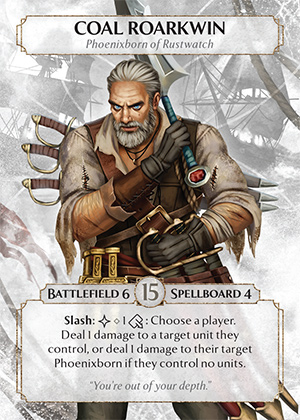
**How to win:** Coal is often times a tricky to play yet has to potential for a very high damage ceiling if you become master of the ping damage. **Slash** is an oddity amongst the PB abilities, costing a card instead of a dice and being repeatable during the round. To win with Coal the question often becomes how to get the most opportunities and value out of your slashes, without milling yourself to fatigue with card draw, or running out of cards in hand to actually play with your dice. Either you need to be a little more conservative than you might expect, slashing at key moments to remove 1 life enemies, or alternative go for the win quickly with Coal, spamming **Slash** as much as possible before running out of a deck becomes a problem.

In general main action direct damage pairs nicely with the additional side action **Slash.** You always want to be spending your resources on killing enemy units before they have a chance to exhaust for any value. **One Hundred Blades** is generally the superior option **Final Stand** and can nicely to combed with slash to simultaneously take out 2 and 1 life remaining units. Nonetheless, I like **Final Stand** as a nasty surprise for taking out an expensive unit when your opponent thought they were somewhat safe.

**Deck Styles:** There are two main ways to deck build around Coal in my opinion. To best use the **Slash** ability you going to need cards, so one way to build your deck is around a card drawing engine. The sheer amount of dice-less direct damage can be extremely hard for your opponent to deal with. Alternatively with a more expensive spell board of conjurations you can **Slash** more with the 5 cards you draw every round, since you already have something to spend your dice on.

The side action nature of **Slash** means you can play a strange mixture of aggression and control with Coal. Take over the battlefield and destroy your enemies by flinging cards at them, but also use the windows of opportunity your slashes open to attack the enemy PB. If the game is a close one with both players low on health, Coal can put pressure on early in the round by dumping their hand at the opponent and swinging an attack in for the win.

**Common Combos:** There are a few different options for extra card draw in a Coal deck, but **Wishing Wing** has the highest potential, since the more tokens you stack on it, the more cards you draw. You can include whatever parts you want of the entire time dice ready spell token support package. **Time Hopper** and **Tidal Crab** to add extra tokens, **Seafoam Snapper** to ensure the **Wishing Wing** dies and you get the card draw when you need it, and **Fighting Spirit** as a payoff for all your units inevitably dying. Even with only one source of extra tokens or the focus 2 effect on its own card, **Wishing Wing** can be enough card draw for a lot of **Slashing.**

**Abundance** on the other hand offers a very different kind of card draw, one that strangely leans Coal into mill. Without this card playing for fatigue damage seems like an odd choice for Coal, since you might **Slash** your way out of a deck faster than you can mill your opponent, but the consistency of **Abundance's** extra 2 cards per round is a hard opportunity to pass up so you might as well also try to leverage the potential burn damage if your opponent runs out of a deck and you can get all 3 copies into play.

**Fester** is another common card worth mentioning. The side action slash followed up instant death can be the cheapest removal in the entire game, and a worthy inclusion in any Coal deck.

**Proven Competitive Lists:**

Mbauers' LKA V Top 4 Battlefield Control Deck:  **[https://ashes.live/decks/share/ddade9ae-5036-4292-93b0-04ee5d7ad688/](https://ashes.live/decks/share/ddade9ae-5036-4292-93b0-04ee5d7ad688/)**

Brian's SB Worlds 2022 Top 2 Wishing Wing Deck **[https://ashes.live/decks/share/759bff2a-1634-4b67-a663-2073ff8a1558/](https://ashes.live/decks/share/759bff2a-1634-4b67-a663-2073ff8a1558/)**

Mbauers' SB Worlds 2022 Top 4 Spindown Deck: **[https://ashes.live/decks/share/cf330532-27e3-445f-aa05-0364f36cdb75/](https://ashes.live/decks/share/cf330532-27e3-445f-aa05-0364f36cdb75/)**

**My Best Homebrew: [https://ashes.live/decks/share/96dc4827-514c-449c-9ec5-6bed9ac9ae24/](https://ashes.live/decks/share/96dc4827-514c-449c-9ec5-6bed9ac9ae24/)**

Helping me get my 10 wins with Coal is this tricky but incredibly fun wound token deck. Use **Tidal Crab** and **Wishing Wing** for some classic Coal card draw ammunition. Then in later rounds, the spell board and allies are so expensive that you should be able to toss quite a few cards away from hand for **Slash.** With only 2 time dice just make sure to summon the **Wishing Wing**  first before the **Tidal Crab**!

Combo **Infuriate** on the **Dread Wraith** with **Flute Mage** for multiple attacks. **Adept Duelist** can be key for removing your opponent's annoying **Root Armor** and **Slash Fester** for anything else large enough to be a threat. **Blood Brawl** is the key to the deck, between **Dread Wraith** attacking or blocking an enemy unit, **Old Salt** and **Phoenix Attendant** you should be able to set up a nasty 3+ damage wipe on your opponent, and finish the stragglers with a **Slash.**

#### **Jessa**

[![image.png](https://wiki.ashes.live/uploads/images/gallery/2024-06/scaled-1680-/oYSimage.png)](https://wiki.ashes.live/uploads/images/gallery/2024-06/oYSimage.png)
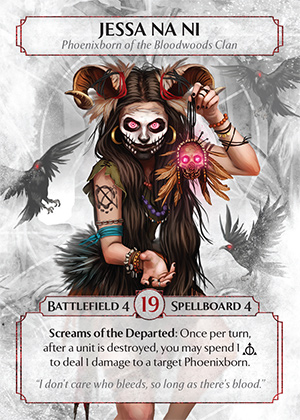
**How to win:** Jessa's **Screams of the Departed** offer a strange inversion of most PB abilities which usually help you establish control of the battlefield or empower the rest of your deck. Instead **Screams** offer a way to close out the game, adding inevitability to your strategy. The key is to identify when and how much to **Scream**, too early and your opponent will covert their battlefield advantage into victory, too late are you'll struggle against an opponent with a different powerful PB ability that's helping them win the game.

**Fear** is a fantastic removal card which can even avoid your opponent's on death triggers as a bonus. The downside of killing your own unit can be turned into an advantage with your own cards that trigger on death. **Playtime** in contrast is a generally much less powerful card but for a more prison focused blood puppet deck is a great inclusion. 1 dice for 1 **Blood Puppet** is the normal ratio for your summoning book which isn't that amazing value. Avoid deliberately killing the unit you attach this card to and play it on a fairly large unit, locking down down the board and frustrating your opponent.

**Deck Styles:** The ratio of 1 dice for 1 burn **Screams of the Departed** provides isn't as good as the best dedicated burn cards you can play in Ashes Reborn. There's 2 ways to deck build around this fact, focus on your deck providing a means to control the battlefield and use **Screams** to finish off your opponent in a close game once their health drops low, or go all in on burn, spending your dice in later rounds not only on more efficient burn cards but also on **Screams,** for a big burst of direct PB damage.

Besides the burn Jessa always provides to finish off your opponent, a great number of styles are available. You can play super aggressively and try to hit your opponents life total as quickly as possible, though you'll need to focus on bigger units like 3 dice cost knights, since your battlefield of 4 prevents you from going wide. You can alternately play prison, with blood puppets or even a kneel deck. In general your plan is to slow the game down enough for your **Screams** to eventually win the game. If you really play your prison cards right your opponent might have leftover dice each round while you've spent yours on **Screams**.

Whichever deck strategy you play, don't **Scream** too early! You'll want to avoid any in round 1 for example while you setup your board, which will put you at a disadvantage vs an opponent with a powerful ability they get to use while yours is irrelevant. However, stabilize in time and **Jessa** can make it look easy, screaming your way to victory.

**Common Combos:** Chants are often used in conjunction with **Fear,** since you'll be killing your own units. **Chant of Revenge** is the common choice, and you can double down with **Ritualist** round 1 for maximum burn. As well as **Fear** you can also run **Blood Chains** or **Reclaim Soul.** These cards will ensure you don't get clogs as well as triggering your chant engine. Since you're slowing down the game and can't afford to play too aggressively mid round with such a tiny battlefield, **Butterfly Monk** or **Turtle Guard** are often used to try to survive while you **Scream.** Then of course there is the usual duo of hyper efficient burn cards, **Sympathy Pain** and **Final Cry** often included to match Jessa's general burn victory plan.

Alternatively you can try to get maximum puppeteering with all three **Playtime, Summon Blood Puppet** and **Blood Puppeteer.** Mix in **Chant of Transfusion** to remove wounds from your opponent's puppet "friends" and some self sacrifice tools to ensure your **Puppeteer** actually dies at the right time.

**Proven Competitive Lists:**

Brancus' LKA IV Top 4 Burn Deck: **[https://ashes.live/decks/share/25601f86-829b-4652-a5e2-6fff91982a55/](https://ashes.live/decks/share/25601f86-829b-4652-a5e2-6fff91982a55/)**

Ebfritz's LKA IV Top 4 Burn Deck: **[https://ashes.live/decks/share/5343b4de-910e-4789-a151-c21e9a695969/](https://ashes.live/decks/share/5343b4de-910e-4789-a151-c21e9a695969/)**

Brancus' LKA II Top 4 Burn Deck: **[https://ashes.live/decks/share/43a5002a-9510-44e9-9105-1244c9439e39/](https://ashes.live/decks/share/43a5002a-9510-44e9-9105-1244c9439e39/)**

**My Best Homebrew: [https://ashes.live/decks/37164/](https://ashes.live/decks/share/eab26f3d-5da3-4e7f-a24a-288404049a07/)**

How much burn can you burn? The answer is yes. Helping me get 10 wins with Jessa is this slightly silly and a little evil version of Jessa burn. Other decks take time to setup and use **Chant of Revenge** or something else to gain board control. Bah, who needs any of that stuff where you are burning your opponent all the time every time!

Start with the **Light Bringer** book and then play **Hunt Master**. The goal here is you then summon the **Light Bringer**, force them to attack (which you guard) and then hit their PB with everything you've got. After the goal is simple, survive and **Scream**!

In round 2 you'll obviously draw 1 copy of **Meteor** and all the burn spells. Wipe the board at exactly the right time just before your opponent swings for damage and finish them off with some burn and also some more burn. **Law of Fear** also works to slow down your opponent from actually achieving anything while you spend everything else on burn. Bonus points if your opponent is playing a low life total PB like Coal, it might be a short game.

#### **Leo**

[![image.png](https://wiki.ashes.live/uploads/images/gallery/2024-06/scaled-1680-/Klsimage.png)](https://wiki.ashes.live/uploads/images/gallery/2024-06/Klsimage.png)
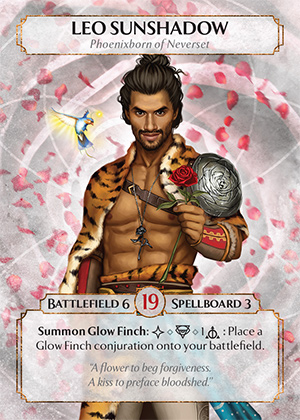
**How to win:** The **Glow Finch** is an extremely high value unit, a basic dice sink to provide flexibility to your other cost, often sought after unit guard and when it dies you're actually pretty happy since you get to mill 2 cards and summon it again next round. The key to getting the most out of the **Glow Finch** is therefore in 2 part, the cheap and easy guard and the mill.

**Anguish** is an interesting card, since you might think its also a mill card of sorts, forcing your opponent to discard cards and lose dice. In reality your opponent usually simply cannot afford to lose those dice and cards, so **Anguish** actually ends up being a fairly powerful burn card instead! This puts Leo on a strange third trajectory. If things weren't confusing enough for Leo,   
**Gifted Rose** represents another potential line of play, making key big attacks you really want to hit their target, essentially Harold's amazingly powerful **Hunter's Mark** (he is the number 2 PB in the list for a reason) but at a cost of 1 dice.

Its worth noting here that neither unique card is particularly powerful compared to other PBs, the value of Leo is mostly in his **Glow Finch.** Some players will even build decks with neither card included if they don't suit the deck.

**Deck Styles:** With all these different powerful yet different elements deckbuilding for Leo can be tricky but rewarding. The most obvious place to start is the 2 mill you get from the **Glow Finch**. With an all out mill list you can also use the **Finch** to protect your other mill units. Slow the game down enough and your opponent will eventually (or quickly with what they call **Turbo Mill**) lose to fatigue. Alternatively you can focus on the unit guard of **Glow Finch,** with the mill an incidental nicety if the game turns into a longer slog. Control the battlefield with **Gifted Rose,** and play big key attackers you know you can protect and hit hard with. Finally with **Anguish** you can even play a strange mill burn hybrid. After all, what is fatigue damage if not burn that takes a while to kick in?

**Common Combos:** If spamming the **Glow Finch** is your kind of thing, then consider the common inclusion of **Generosity** to summon it more than once per round. If your opponent refuses to kill the **Finch** or perhaps even more annoyingly exhausts it, **Redirect** or **Natures Wrath** can be nice ways to ensure it dies anyway and you can resummon it.

Charm dice in general are a good fit for Leo mill decks, with the usual suspects of **Farewell,** **Rile the Meek, Flock Shepherd** and any combination of the 0 attack charm summons for your spell board. **Abundance** can also work well if your goal is to mill your opponent as quickly as possible.

For getting value out of **Gifted Rose** the same logic here applies that it did for Harold's **Hunter's Mark.** Units like **Sonic Swordsman** that benefit from ensuring their attacks don't get guarded can be a nasty combo.

**Proven Competitive Lists:**

Brian's LKA VI Top 2 PACT Battlefield Deck: **[https://ashes.live/decks/49061/](https://ashes.live/decks/49061/)**

Brian's LKA IV Top 2 Mill Deck: **[https://ashes.live/decks/50977/](https://ashes.live/decks/50977/)**

Carl's Gifted Rose Deck (LKA VI Top 4 by Alfred): **[https://ashes.live/decks/share/7f174d8d-e0ba-460b-abff-911a40ac82c4/](https://ashes.live/decks/share/7f174d8d-e0ba-460b-abff-911a40ac82c4/)**

Killercactus' LKA I Top 4 Turbo Mill Deck: **[https://ashes.live/decks/share/bb7aaf92-5dc0-454e-9d93-3ced8d865833/](https://ashes.live/decks/share/bb7aaf92-5dc0-454e-9d93-3ced8d865833/)**

**My Best Homebrew: [https://ashes.live/decks/46398/](https://ashes.live/decks/46398/)**

Helping me get my 10 wins with Leo is this 0 attack spam deck, pumping out enough units in round 1 to give anyone trouble!

After summoning all your 0 attack units in round 1, play **Gates Thrown Open** to do it all again! you'll lose a few units to attacks of course, but hopefully not before you mill your opponent with a **Glow Finch** guard. Time it right and you can summon **Shimmer Wings** back to back, threatening the **Eternity Flame**. After banging their head against your wall, the opponent will run out of cards from hand and deck and have no option but to start attacking fatigue damage.

#### **Saria**

<span id="bkmrk--14" style="font-weight: normal;"></span>

[![image.png](https://wiki.ashes.live/uploads/images/gallery/2024-06/scaled-1680-/LvJimage.png)](https://wiki.ashes.live/uploads/images/gallery/2024-06/LvJimage.png)

**How to win:** With a massive life total of 20 Saria is going to be in the game for a while, and threaten some explosive power and some subtle power while doing so. In most cases you want to play with Seaside Raven** one of the best summons in the game. Your opponent will inevitably try to play around their units getting eaten, but the threat alone can be powerful. And of course, given the option snaking on a lovely 2 health 2 dice unit doesn't get much sweeter with **Prey**. For later rounds, **Willpower** is just an incredibly high value removal card, you don't even really need to deck build around, just play it early in the round to take whatever you feel like off the board. **Hearts Pull** is where things get a little tricky since on the face of it mill 1 and draw 1 for 1 dice is pretty good but not exactly what you need every round. Should your opponent pass before you, is a really nice side action ability to trigger before passing yourself, just like a frog dice power.

**Deck Styles: Seaside Raven** is a powerful unit on the battlefield, but often you have to wait for the right time to play it. **Hearts Pull** also leans into a more long term plan with incidental milling. I find therefore Saria usually suits a control style of gameplay, not so extreme to give up control of the board, but something that is happy to pass early in the round and force your opponent to make mistakes. Having 3 basic sinks with **Seaside Raven** is something you can utilize to play a more particular dice spread without leftover awkward dice and nothing to spend them on.

**Common Combos: Seaside Raven** offers some fun combos to get the best value from the super powerful prey ability. **Body Inversion** can be used to swap the stats of a low attack unit and feed them to the hungry bird. **Resummon** can get you double the bird each round. Attacking with quick strike often leaves the **Seaside Raven** alive for resummoning and if your opponent kills the **Raven**, at least you can summon it next turn and get the **Prey** effect again.

**Proven Competitive Lists:**

Ninja's LKA III Top 2 Burn Deck: **[https://ashes.live/decks/49140/](https://ashes.live/decks/49140/)**

Carl Diaz's LKA VIII Top 2 Paladin Deck: **[https://ashes.live/decks/share/896fd751-f0ab-49fd-944f-fa0d702f034e/](https://ashes.live/decks/share/896fd751-f0ab-49fd-944f-fa0d702f034e/)**

Ninja's LKA VIII Top 2 Battlefield Mill Deck: **[https://ashes.live/decks/share/a3f53845-740d-445a-ab21-504cc2ea4b84/](https://ashes.live/decks/share/a3f53845-740d-445a-ab21-504cc2ea4b84/)**

Mbauers' LKA III Top 4 Control Deck: **[https://ashes.live/decks/share/5298a54a-da73-4656-a84e-8c14f3e67885/](https://ashes.live/decks/share/5298a54a-da73-4656-a84e-8c14f3e67885/)**

Mbauers' SBI 2022 Top 4 Mill Deck (Old): **[https://ashes.live/decks/share/c560530f-be57-4a60-a59f-3b49b7cf67ed/](https://ashes.live/decks/share/c560530f-be57-4a60-a59f-3b49b7cf67ed/)**

**My Best Homebrew: [https://ashes.live/decks/49272/](https://ashes.live/decks/49272/)**

Helping me get my 10 wins with Saria is this hybrid mill battlefield deck with tons of removal. Each type of threat has an answer, **Farewell** and **Willpower** can take care of large units, **Seaside Raven** and **Ice Trap** can eat mid-range units like nothing else can, and between **Ruby Cobra** and the ping damage from **Adaptodon, Enchanted Violinist** and **Return to Soil** you've got something for 1 life units as well. Should you need to, you can lean into bypass with **Clashing Tempers** to take out blockers for an attack, or the classic **Wallop** on a **Frostback Bear.**

The idea here is that while destroying your opponents units and trying to control the battlefield, you're also milling your opponent slowly, so a long game can benefit you as well as your opponent goes to fatigue. Don't focus on mill too much though, the priority here is battlefield control. If you can afford to get a cheeky **Heart's Pull** in before passing in a round, all the better but don't feel like you have to use the ability if you can spend your dice elsewhere.

#### **Xander**

[![image.png](https://wiki.ashes.live/uploads/images/gallery/2024-07/scaled-1680-/image.png)](https://wiki.ashes.live/uploads/images/gallery/2024-07/image.png)
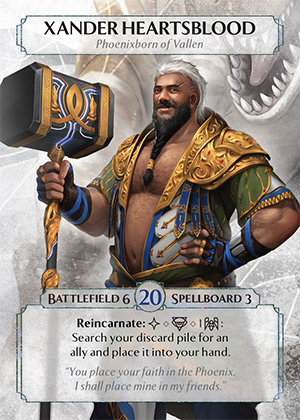
**How to win:** Another Phoenixborn with maxed out life points of 20, Xander can outlast a lot of damage, and the recursion of **Reincarnate** make him somewhat mill resistant as well. They key then for Xander is to play the long game, a nasty counter pick against burn and mill, but with a semi-one sided battlefield wipe **Earthquake**, unlike other Phoenixborn Xander doesn't have to rely entirely on alternative win conditions or strange play styles to win, he can play the battlefield pretty effectively.

**Reincarnate** isn't something you want to incorporate into your first five, its just too inefficient. Instead you can build your deck around a key ally, and bring it back when it dies, using **Reincarnate** as the ultimate backup plan. If that ally is important enough to your strategy, then your opponent will get frustrated when they see it return, even though it cost an extra dice. **Reincarnate** also allows you to leave the ceremonial dice type behind without losing out on ally recursion, something that's worth considering when deckbuilding. **Earthquake** is a super powerful card to be able to rely on to wipe your opponent of cheap swarming enemies as well as a large unit. Consider running units with **Armored** or simply higher life totals that 1 to survive the damage and make the wipe even more one sided. Try to time the **Earthquake** to hit something big enough with the 4 damage and watch out for a illusion or time power side showing in your opponent's dice pool, they may have first fived **Fate Reflection** against you.

**Deck Styles:** Since Xander's power is quite generic, with excellent stats and resistant to both mill and burn strategies, he plays best with a solid plan B and a pivot depending on matchups. Against a PB trying to mill you out to fatigue damage, you can focus on reducing your meditations, putting on battlefield pressure the while game, and recurring allies with **Reincarnate.** A key **Earthquake** might be enough to secure you the battlefield. Against a burn deck you can focus on pumping out as much attack as possible, with big units and the extra time your high health affords you in the matchup. Your plan B needs to be pretty solid however, since against the powerful battlefield focused PB like **Harold** and **Rin**, you may struggle to obtain an edge. Instead, you can develop your own plan B alternative win condition incrementally, while not giving up too much battlefield presence.

**Common Combos:** For an insane amount of survivability, **Heal**, **Butterfly Monk** and/or the classic PACT **Phoenix Attendant** and **Chant of Transfusion** combo can be used to heal your life points. Just make sure you actually have a plan to somehow win while surviving damage. **Frostback Bear** or **Turtle Guard** can work well with Xander since a unit with 3 health can thrive in an **Earthquake** rich environment. If you do run a bunch of high health units that can survive the **Earthquake, Blood Brawl** can be a powerful follow up the next turn.

**Proven Competitive Lists:**

Ninja's LKA VI Winning 0/2 Fatigue Deck: **[https://ashes.live/decks/share/7c8802d7-585b-4a26-9317-e96fbed9593c/](https://ashes.live/decks/share/7c8802d7-585b-4a26-9317-e96fbed9593c/)**

Brancus' LKA V Top 2 Burn PACT Deck: **[https://ashes.live/decks/52072/](https://ashes.live/decks/52072/)**

**My Best Homebrew: [https://ashes.live/decks/share/491775c3-d59f-407e-978d-943c2297ee43/](https://ashes.live/decks/share/fcf0c2a3-60ab-4209-ae9b-87fc8a905d6b/)**

Helping me get my 10 wins with Xander and win LKA VI is this removal heavy 0/2 mill list. Each of the 3 summons have 0 attack and 0 health, so they can benefit from **Flock Shepherd's** protective abilities. Try to sequence the **Flock Shepherd** after you have a **Gilder** in play, who then should be able to protect you from at least 1 lethal attack to the **Flock Shepherd**. Later in the game, you can recur the **Flock Shepherd** with **Reincarnate,** which can be very annoying for your opponent if they are expending a lot of effort to kill it the first time.

**Shimmer Wing** can put a lot of pressure on your opponent to swing at units, which can save you in the long game. You generally want to attack promptly with **Ruby Cobra** for the mill, unless your opponent only has an alert unit don't be too precious about lining up the perfect attack, you don't want to have the **Ruby Cobra** attacked itself. **Farewell** is as powerful as ever, don't waste it on a low health unit if you can help it, taking out a 4 health knight for 4 dice is definitely worth it for the 4 mill. The more you can keep your 0/2 around for the next round the more likely you can pull off a nasty **Rile the Meek,** 2 damage is acceptable to kill one or 2 key enemy units, 3+ damage from **Rile the Meek** and you are having a wonderful time.

0/2s work well with **Earthquake** but there isn't much strategy here, just value, since your 2 health units won't die from the **Earthquake.** Finally its worth considering using Reincarnate on **Rose Gardener** if you don't draw into it. Spam cultivate side actions until you have enough class sides for a big **Farewell** without eating into your own deck.

#### **Koji**

[![image.png](https://wiki.ashes.live/uploads/images/gallery/2024-08/scaled-1680-/8XTimage.png)](https://wiki.ashes.live/uploads/images/gallery/2024-08/8XTimage.png)
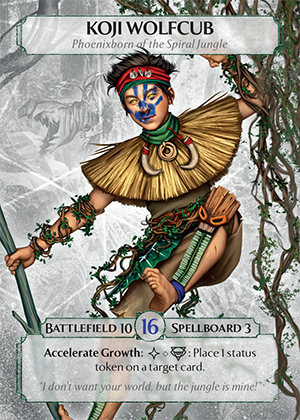
**How to win:** The boy wonder of ashes is all about status tokens and having a massive battlefield. **Accelerate Growth** is free, often the sign of a good PB abilities, and can pump out a token every round wherever it is needed. With 10 battlefield (the largest in the game) you basically don't have to worry about getting clogged or stuck in an awkward battlefield prison, so feel free to ditch those self-sacrificing cards in favour of spamming lots of cheap units without a care in the world. Your starting point for exploiting Koji is to work out what will best benefit from status tokens, and building your deck around those cards. **Wolfpack Leader** provides an inbuilt beneficiary for the **Accelerate Growth,** but only use it to get an extra **Pack Wolf** if the tokens run out and you won't hit the conjuration limit. Even without any extra tokens, the **Wolfpack Leader** is fantastic value and a worthy inclusion in the first five. **Lick Wounds** is a less obviously powerful option, but does provide the flexibility of even more status tokens from Koji becoming unexhausted, or a unit swinging twice in the round.

**Deck Styles:** Koji's big problem is his low life point value at only 16, going aggro can be difficult without dying first. Nevertheless, one option for Koji is to fully unitize his large battlefield and swarm the field. For this strategy I'd recommend attacking often, and don't let your battlefield of unexhausted 1 life units build up and get decimated by a **Nature's Wrath**. Another option for Koji is to focus on the status token combo. Find a card to really exploit with status tokens, and pack the removal, protection and control tools to ensure that it happens.

**Common Combos:** You can't talk about Koji without talking about the specific cards he can add a status token to. Having a few of these cards in your deck to exploit is the key to success. The most powerful is the **Indiglow Creeper** who has no in built way of getting status tokens, but rockets in value every time you trigger the **Luminous Seedling's Blossom** ability and turn it into 2 **Brilliant Thorns.** With a large, swarming deck, **Hunt Master** can be topped up, turning your **Accelerate Growth** into an extra free attack. Sticking a status token on Guilt Link** provides a sneaky guaranteed kill, and with Koji you'll probably have a unit you don't mind dying lying around somewhere. Just don't do it if it looks like your opponent will attack and give you the token anyway. **Mirror Spirit** and **Wishing Wing** gain attack from status tokens, as does the **Emberoot Lizard**, so may be worth including. Then you can all the other status token support cards, like the ever valuable **Guilder** or ultimate spam unit the **Time Hopper**.

A different direction to take Koji is to combo with **Fallen,** the slow moving ultimate value engine that's perfect for his massive battlefield. You could also consider a **Prism Tetra** build for similar reasons, even the janky but fun **Radiant Leviathan** has a sort of a home with Koji.

**Proven Competitive Lists:**

Carl's Phoenix Pod II Top 4 Creeper Deck: **[https://ashes.live/decks/share/c22685b7-610a-459c-a6f0-9c1cbef390b7/](https://ashes.live/decks/share/c22685b7-610a-459c-a6f0-9c1cbef390b7/)**

Ninja's SB LCQ Top 4 Creeper Deck: **[https://ashes.live/decks/share/c22685b7-610a-459c-a6f0-9c1cbef390b7/](https://ashes.live/decks/share/c22685b7-610a-459c-a6f0-9c1cbef390b7/)**

**My Best Homebrew: [https://ashes.live/decks/55382/](https://ashes.live/decks/55382/)**

Helping me get my 10 wins with Koji is this classic **Indiglow Creeper** list that's all about cracking open those seeds! Everything is centred around the creeper. The **Gilder** keeps the **Luminous Seedling** alive and gives it a token upon death. The **Tidal Crab** is the ultimate token dispensing machine for the **Seedling**.

If your opponent refuses to counter the **Creeper**, use **Seeds of Aggression** with your exhausted **Creeper** and take it out along with an enemy. **Fate Reflection** can protect your **Seedling** from direct damage effects like annoying **Odette** and **Aradel.** Then, should you still have extra tokens, stick them on the **Wolfpack Leader** or the **Hunt Master.** Build up wave after wave of **Brilliant Thorns** and outvalue your opponent to death on the battlefield!

#### **Echo**

[![image.png](https://wiki.ashes.live/uploads/images/gallery/2024-09/scaled-1680-/image.png)](https://wiki.ashes.live/uploads/images/gallery/2024-09/image.png)
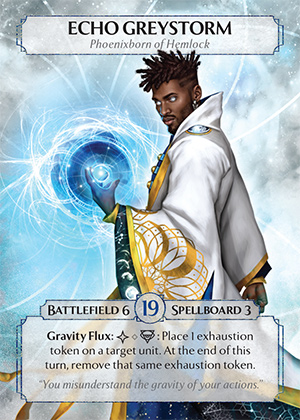
**How to win:** Echo is all about those nasty blue exhaustion tokens, and manipulating them to your benefit. A good Echo play can leave your opponent feeling helpless, since you're taking away their ability to use their units effectively!

**Gravity Flux** is a combo ability, having no value on its own (since the token only lasts for that turn), but having value when combined with different main actions. The most straightforward combo you have available to you is to turn any attack into a counter-less quick strike-esque attack. **Gravity Flux** an enemy unit and then swinging for the kill will be enough to make your opponent Phoenixborn Guard early, or accept a one sided unit death that would normally get to trade with your unit.

**Chaos Gravity** has the amazing potential value of 3 total exhaustion tokens, the key to getting the best value from it is to build up a battlefield state that benefits from the token shift part of the card. First you want a powerful unit to remove an exhaustion token from. That can ideally be a three dice knight like **Sonic Swordsman** but it can also be something a little less powerful like a 2 dice summon **Winged Lioness** or **Ruin Dweller** ect. Your opponent will no doubt have something worth exhausting, unless they are in real trouble. Moving 1 exhaustion token from a unit to another unit controlled by the same player, is where your deck could actually benefit from weaker units. Working towards a battlefield with 2 exhausted powerful units and 1 weak 1 dice ally like **Fire Archer** can produce ultimate value from your unique, but it can be tough to setup. Keep an eye out for the same setup on your opponent's board, keeping a weak enemy unit alive can be worth it, to switch their exhaustion token with your opponent's knight!

**Deck Styles:** Echo decks are usually a unique kind of aggressive control. You want units that are worth unexhausting, so that means beefy units that can survive an advantageous attack or combo with **Gravity Flux.** You can try to trade out the battlefield in a traditional manner, swinging for the win when you have dominance, or you can focus on bypassing your opponent's units altogether. An Echo with a top of round swing is very scary, since you can simply remove a blocker from the equation using **Gravity Flux!** This can make end game battlefield maths go very well for the king of blue tokens, since you can also leave an enemy unit left alive the round before.

**Common Combos: Chaos Gravity** has a few common combinations with powerful knights that get value from attacking. **Sonic Swordsman** and **Realm Walker** stand out as the best attack trigger units in the game, **Realm Walker** in particular can be downright oppressive, but the 3 life total makes them very vulnerable to removal. **Hunt Master** provides a great target for **Chaos Gravity** double exhaustion with the **Panther Spirit. Light Bringer** is great in any deck, and can be particularly good in Echo to force the battlefield into the exhaustion heavy game state you want. Once everything is exhausted, **Mirror Spirit** is a common inclusion to benefit from all the blue tokens.

There are also a few card specific common combos for **Gravity Flux. False Demon** can ping something before it has a chance to act. A counter intuitive but very powerful combo is possible with **Kneel** by using **Gravity Flux** on your own unit. Because it already has a fake exhaustion token it won't be effected by **Kneel,** leaving everything else but your unit exhausted once the turn ends.

**Proven Competitive Lists:**

Apple Sith's Phoenix Pod I 2023 Top 4 Battlefield Bypass Deck: **[https://ashes.live/decks/share/f3e93161-df95-4c47-93dd-06da4806549b/](https://ashes.live/decks/share/f3e93161-df95-4c47-93dd-06da4806549b/)**

Carl's SB March 2022 Winning Battlefield Bypass Deck (Old): **[https://ashes.live/decks/share/0f614f1e-6402-41a1-90bc-14826b74a6b4/](https://ashes.live/decks/share/0f614f1e-6402-41a1-90bc-14826b74a6b4/)**

**My Best Homebrew: [https://ashes.live/decks/56292/](https://ashes.live/decks/56292/)**

Helping me get my 10 wins with Echo is this control heavy battlefield bypass deck, which aims to setup a powerful board state and convert that control into massive damage attacks to your opponent.

**Wallop** is the key card here, the goal is to attach it to something you can then unexhausted with **Chaos Gravity** or   
**Flute Mage.** Combo **Gravity Flux** with a **False Demon** summon, or if your opponent has a 2 life unit, force a nasty non-trade with **Gravity Flux** and one of your many attackers like **Frostback Bear.** Wait for the end of round to get the most attack on a **Mirror Spirit** (if you really need the extra status token you can also do a cheeky **Gravity Flux** combo here as well.)

If the opportunity arises and you think you can dodge the removal, this deck can use bypass to deal massive amount of damage with **Beast Mage, Frostback Bear,** one of the alternation cards like **Clashing Tempers,** and unexhaustion from **Chaos Gravity** or   
**Flute Mage**. But it can also win by just trying to control the battlefield instead, converting those attacks into dead enemy units.

### **C** Tier

#### **Aradel**

[![image.png](https://wiki.ashes.live/uploads/images/gallery/2024-09/scaled-1680-/WVximage.png)](https://wiki.ashes.live/uploads/images/gallery/2024-09/WVximage.png)
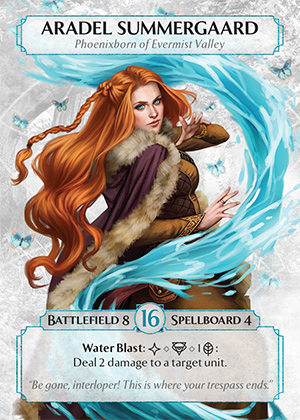
**How to win:** Aradel threatens powerful and efficient removal. You always want to use her **Water Blast** ability every round, taking out an enemy unit the moment it gets played before it can provide any value. 2 damage is simply more damage than usual for 1 dice, and if you combo it with other, main action direct damage you can maximize your opponent's loss.

Unfortunately Aradel's lack of super strong unique card holds her back and in my C tier. **Blue Jaguar** can provide combo value to bypass your opponent's units, but the stats of 1 attack and 2 life for 2 dice are bad for even a non-unique. **Rejuvenate** has much greater potential in my opinion, unlocking the aggressive power of your conjurations. Once it's powered up with tokens, 1 dice for an unexhausted is definitely a good value proposition, just still not that mind blowing compared to other PB uniques.

**Deck Styles:** Since getting the most out of **Water Blast** is key to success, Aradel usually suits a battlefield control style of play. By removing a key enemy unit of your choice every turn, you can put a dampener on whatever would otherwise give you the most trouble of your opponent's spellboard. Controlling the battlefield this way could be the setup for a bypass combo deck, swinging over the heads of your opponent's exhausted units, or it could be something more straightforward, dominating the feild until you have a large attack. Key large attacks in general I think work well with Aradel, since **Water Blast** can be used to take out a key defender before hitting your opponent's PB directly.

**Common Combos:** When your opponent plays a 2 dice, 2 life unit on the field for you to **Water Blast**, you're in for a good time, and up 1 dice on your opponent already when you give them the almighty slap. However, why stop there? Main action direct damage like **Summon Guilder** is an extremely common combo with Aradel, since you can take out a 3 health unit in one go if the opportunity arises. Even something less straightforward like **Natures Wrath** or **Seeds of Aggression** can combo with **Water Blast** and get you to 3 damage.

**Blue Jaguar** can combo with other bypass tools like **Frostback Bear**. For bypass to work you'll need a big hit to your opponent's life total. **Massive Growth** in a classic to turn your **Frostback Bear** into a massive bear. **Exhortation** is the ultimate bypass combo dream and with the right setup can do crazy amounts of damage. Mirror Spirit can also explode into game ending damage land with **Explosive Growth**. Surprise your opponent's last blocker with a **Stand Still** or **Crescendo** and you might just be able to close out a game from nowhere.

**Rejuvenate** has a bunch of interesting potential targets. You can build your whole deck around **Indiglow Creeper** as one example. Using Aradel and **Rejuvenate** allows you to attack twice with the initial **Creeper,** assuming your opponent refuses to counter it (often the right more versus the annoying summon). As a backup, attacking twice with a 3/2 **Brilliant Thorn** is pretty powerful as well. **Ruby Cobra** is a 1 cost unit your opponent often has trouble dealing with efficiently soo will often have the chance to attack more than once. With the right combo of damage or **Infuriate, Dread Wraith** can be a high value conjuration to attack with more than once, and if **Iron Rhino** wasn't such a janky investment of so many dice it could work well too.

**Proven Competitive Lists:**

Brian's LKA II Top 2 Creeper Deck:[ https://ashes.live/decks/49769/](https://ashes.live/decks/49769/)

**My Best Homebrew:**[ https://ashes.live/decks/38905/](https://ashes.live/decks/38905/)

Helping me get my 10 wins with Aradel is this dinosaur filled deck of big monsters. The plan here is to mount as many times as possible and simply use a constant attack of heavy hitters to take over the battlefield. **Archasaurus Mount** and **Cerasaurus Mount** have plenty of targets with all the 1 dice allies that have an on enter ability like **Fire Archer** and **Anchornaught.** Use **Butterfly Monk** to protect your big units and **Shepherd of Lost Souls** to recur your opponent's removal of your cheap allies. Aradel's 8 battlefield should allow you to spam as many units as you need, and the **Water Blast** will remove something mathematically problematic for your big dinos. Finally, when your opponent is low on life, you have quite a few ways of closing out the game, with **Frost Bite** burn, **Archasaurus** gigantic 2 bypass, **Cerasaurus** overkill or even just a wide swing with **Raptor Herder**.

#### **Noah**

[![image.png](https://wiki.ashes.live/uploads/images/gallery/2024-09/scaled-1680-/Y3Dimage.png)](https://wiki.ashes.live/uploads/images/gallery/2024-09/Y3Dimage.png)
**How to win:** Noah is a tricky character to play against, since he can disrupt your spellboard plans with his **Shadow Target**, denying you a key summon each round. Understanding how to exploit this ability the most requires you to think about how your opponent will respond. In round 1 against Noah you'll most likely overload your hand with more cards than you can afford, to offset the lost spellboard slot. You might also keep your most important summon for later in the round, hoping Noah will waste the **Shadow Target** on the first book you play out. So when playing as Noah himself you can keep these strategies in mind. Consider not using the **Shadow Target** in round one, you'll still have disrupted their initial plans. Consider waiting, and trying to assess if the spellboard card they played is good enough to **Shadow Target.** Maybe the best is yet to come, and more expensive spellboard summons will be more disruptive to cancel. Keep the enemy guessing and it will be harder for them to play around your annoying ability.

**Summon Masked Wolf** is a hard card to justify even though it's a unique. The book tax makes the first time you summon a wolf cost 2 dice, not really worth it for the 2 attack 1 life stat line that usually only costs 1 dice in the ashes card pool. The focus effect is fantastic but the cost here is pretty bad as well since you're paying an extra dice again to play the second and third book! If you get through all that initial cost however there are some powerful swings you can make, utilizing the side action combo to spam out a bunch of units. Focus on trades and with a clear battlefield and the first turn of the next round you can potentially pump out an wide attack out of nowhere for the win. The side action summon of the **Masked Wolf** also prevents them from being weak to direct damage removal like Frog dice power or **Forked Lightning**, since you summon and attack with them in same turn the moment a nice target for the attack appears.

**Shadowblade** on the other hand is great value. Dealing 2 damage for 1 dice is pretty good and the fact that its a reaction spell makes it even better since your opponent can't safely attack with 1 health units without potentially leaving themselves vulnerable. The 2 card draw is a nice additional benefit and allows you to deck build with slightly cheaper cards than usual, knowing you have the draw into more cards to play.

**Deck Styles**: Noah typically leans into aggressive trickster explosive attack decks or long term fatigue decks. **Shadow Target** can mess with your opponents plan, but doesn't necessarily give you a mathematical advantage in trades and winning the battlefield. Aggressive decks will therefor have to maximize your opponent's inability to summon the perfect answer for your threat, perhaps by summoning lots of 1 health units and preventing suppressing sources of single damage, or playing big knights and using **Shadow Target** anything with high attack. Fatigue focused decks will use **Shadow Target** to force their opponent to play cards from hand, instead of rely on their spellboard. It's a subtle way to mill someone, but in the late game in particular your opponent being unable to summon something can be crippling once they run out of other options.

**Common Combos:** There are a few possible common deck packages to use with Noah but they are less about combos and more about having a deck archetype that suits his style of play. In fast aggro decks, the classic status token summoning package of **Time Hopper, Wishing Wing** and **Fighting Spirit** can be put to good use, since Noah can potentially draw into even more books with **Shadowblade.** Accelerate can combo off with **Summon Masked Wolf, Time Hopper, Fighting Spirit** or even **Immortal Commander**, allowing you to suddenly attack with a massive army out of nowhere.

For fatigue deck and long terms plans, you'll need some way to accelerate your opponent to the end game with no deck, where **Shadow Target** can start really causing problems. Spindown cards like **Shadow Spirit** and **Dream Fracture** can provide pressure on your opponent to meditate, or you can go all in on illusion dice powers with **Reimagine** and **Keepsake**. **Abundance** is always worth considering when playing mill, along with the charm staples like **Orchid Dove**, **Farewell** and **Three-Eyed Owl.**

**Proven Competitive Lists:**

Lark's Phoneix Pod I Winning Spindown Deck: [https://ashes.live/decks/47953/](https://ashes.live/decks/47953/)

**My Best Homebrew: [https://ashes.live/decks/47953/](https://ashes.live/decks/47953/)**

Helping me get my 10 wins with Noah is this fatigue spindown deck. The starting point of this deck is an **Abundance** deck that doesn't start with **Abundance** in the first five. Instead this deck aims to draw into it as end game damage, once your opponent is decked out. With **Magic Syphon** and the extra spindown effects of cards like **Dreamlock Mage** and **Hollow** you can put pressure on your opponent's deck without meditating your own spells. Then, without fuelling your opponent's plan an allowing them to draw lots of cards in the early game, use **Abundance** to finish off their deck and start dealing game winning direct damage.

#### **James**

[![image.png](https://wiki.ashes.live/uploads/images/gallery/2024-11/scaled-1680-/GShimage.png)](https://wiki.ashes.live/uploads/images/gallery/2024-11/GShimage.png)
**How to win:** Getting the most out of James and his **Convene With Souls** ability requires an understanding of the subtle economics of allies and card draw in ashes reborn. Essentially, allies are generally more aggressively powerful than summons, and cheaper allies can be more cost effective than expensive allies. With 10 dice to spend per round, a theoretical swarm of 10 allies can do insane amounts of statistical damage. With 3 dice you could summon 3 allies with a combined 6 attack and 3 life total compared to the classic 3/4 stat line of a 3 dice knight. There are downsides of course, namely the vulnerability to direct damage and the possibility of self clog. James solves the latter issue at least with a big battlefield size of 7.

Compared to his ability, James's uniques are slightly less exciting. At first glance **Vengeance** is a terrible value proposition, giving you a measly 1 attack per each destroyed unit, and many decks justifiably ignore it as an option. It can however be used as a finisher for an agro deck to get that last bit of damage through to your opponent by sacrificing already exhasuted units before the loss of board control matter in the next round. **Soulfire** is a super solid card and for most the obvious better choice. With a deck full of allies you shouldn't have much difficulty triggering for the full 3 direct damage each time, a much better ratio than you can get from non-unique spells.

**Deck Styles:** Tutoring out units with more than 1 life can start to get a little too costly for poor James's health, which means **Convene With Souls** lends itself naturally to 1 life units. Finding the unit you want to play is a combination of flexibility and exploiting power. With multiple options in your deck you can flexibly pick the right unit for that round. Alternatively while deckbuilding you want to include units that are worth tutoring, often to play the same unit over and over again, hyper focusing on one particular strategy.

James doesn't really have as large a life total as he seems, that 19 goes down to 16 if you trigger your ability every round for 3 rounds for example. Most 1 life units that are worth exploiting are very aggressive, so James tends to lend himself to very aggressive decks in general, usually swarm of some kind.

**Common Combos:** Building a James deck is all about picking the units you will tutor with his ability. There are quite a few contenders from 1 life units to spam. **Raptor Herder** and **Ptera Herder** give you a lot of statistical value for 1 dice. The first **Light Swordsman** might be guarded, but every one you play after that in the round gets subsequently more likely to make a super nasty one sided trade. **Fire Archer** is as ever good option for racing your opponent's life total. **Shepherd of Lost Souls** is a common choice for James, not just to tutor but to play and spam even more units.

**Proven Competitive Lists:**

Kaukomieli's SB4 Top 4 Swarm Agro Deck (Old) [https://ashes.live/decks/share/d5b4da3b-1e68-4fef-8b46-469186f5762a/](https://ashes.live/decks/share/d5b4da3b-1e68-4fef-8b46-469186f5762a/)

**My Best Homebrew: [https://ashes.live/decks/58304/](https://ashes.live/decks/58304/)**

Helping me get my 10 wins with James is this puppet control deck with some classic chant of transfusion exploitation. With chant of transfusion, removing the puppets will be even harder than usual since you can move any wounds they place on the puppets. Additionally, side action chant removal can free up a slot in your opponent's board for a new puppet! But it's not just all about the puppets here, since sometimes you opponent will have a nasty counter to eat them. Try to force a guard from your opponent and then then use the Light Swordsman to play and then attack on the same turn, using quick strike with brutal lethality on a 2 life enemy unit. Spam out damage with the Old Salt classic PACT combo or use the chants with the Phoenix Attendant instead for massive healing. And who doesn't love 1x fire archer to close out a close game. However things are going, there are quite a few targets for James to convene with and pivot to the right strategy for the game state.

#### **Lulu**

[![image.png](https://wiki.ashes.live/uploads/images/gallery/2024-11/scaled-1680-/JkUimage.png)](https://wiki.ashes.live/uploads/images/gallery/2024-11/JkUimage.png)
**How to win:** Lulu has an odd combination of abilities and uniques. You really need to be exploiting value from both to keep up with other Phoenixborn. **Bolster** offers both a status token and extra attack to a unit, followed by a possible direct "ping" damage of 1 from **Spark.** That means Lulu is setup to work well with a unit that desires status tokens and aggressive swings. Even better if the unit can survive the attack and use the **Spark** ability. **Phoenix Barrage** is a great action card with excellent efficiency and damage. The flexibility to take out 2 enemy units or choose the same unit twice means you shouldn't have too much trouble finding a good window to play this expensive removal. Some part of that dice efficiency is contained within the burn damage however, which means you're going to want to compliment this **Phoenix Barrage** with either an aggressive deck on the battlefield, or an indirect burn heavy strategy. **Stamina Burst** is a trickier card to get value from, and most players second pick for unique but not to be discounted. With enough targets to benefit from the double **Spark** in a single round, the damage can start to pile up. Give the first player token to your opponent and you can set yourself from 2 top of round swings in a row as well, a fun aggressive option exclusive to Lulu.

**Deck Styles:** Bolster works well with an aggressive style of control, where key attacks get boosted into lethal range. Phoenix Barrage fits a burn style deck very well and can even be played as the control tool of a very slow deck. Stamina Burst on the other hand can be extremely aggressive, and reward the domination of the battlefield with a top or round attack you normally wouldn't have. My advice for playing Lulu is to first pick the unit or units that will most benefit from **Bolster** and build from there.

**Common Combos: Emberoot Lizard** is an extremely common card to pair with Lulu and the **Bolster** ability. It can be a little slow to get off the ground with a 1 basic cost book tax, but after that, the value from all the ping and attack damage is pretty powerful. **Wishing Wing** is another fairly common choice to benefit from the status token. **Beast Mage** and **Beast Warrior** are a great choice to pair with **Stamina Burst,** since you can ensure the first player token goes to your opponent and unlock the full potential of your transforming allies.

**Proven Competitive Lists:**

Carl's SB 6 2022 Top 4 Agro Deck (Old) [https://ashes.live/decks/24193/](https://ashes.live/decks/24193/)

Bparousis' SB5 2021 Top 4 Bypass Deck (Old) [https://ashes.live/decks/share/5b5eff96-07b9-442d-91dc-a7fcec8d096c/](https://ashes.live/decks/share/5b5eff96-07b9-442d-91dc-a7fcec8d096c/)

JK007's SB5 2021 Top 4 Burn Deck (Old) [https://ashes.live/decks/share/05fedc01-e746-475a-ae67-6e060c4b1520/](https://ashes.live/decks/share/05fedc01-e746-475a-ae67-6e060c4b1520/)

**My Best Homebrew: [https://ashes.live/decks/58380/](https://ashes.live/decks/58380/)**

Helping me get my 10 wins with Lulu is this card draw focused burn deck. The goal is to establish early pressure against your opponent with aggressive attacks from cheap units, before swapping to a defensive line of play and burning your opponent while avoiding death yourself. The **Wishing Wings** combo nicely with **Bolster** for aggressive plays. The **Seafoam Snapper** can eat your own **Wishing Wing** to prevent clog and draw cards, or you can time it without an exhausted unit if you'd prefer. **Shimmer Wing** is also a key point of dice efficiency. With all that card draw, you should hopefully be able to draw into all the burn cards in the deck in later rounds to close out the game while your opponent it still trying to deal with your cheap units.

#### **Orrick**

[![image.png](https://wiki.ashes.live/uploads/images/gallery/2024-11/scaled-1680-/gcZimage.png)](https://wiki.ashes.live/uploads/images/gallery/2024-11/gcZimage.png)
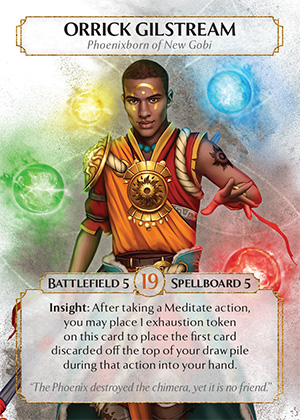
**How to win:** Orrick has a lot of utility power and a win condition. **Insight** is an extra card draw, and filtered from your meditations no less. If you only meditate once per turn over the first few turns of the round you can essentially pick a card to draw from the first few on top of your deck with. **Concentration** gives you an extra card and flexible dice fixing, but at the cost of a basic, not great value if you ignore the win condition of **The Awakened State.** The key to success with Orrick therefore is to exploit the value of card draw and create a board state where the extra dice your spending on **Concentration** won't lose you the game. If you can stall out the game long enough, the immense value of **The Awakened State** will usually be enough to grant you victory, its getting there without dying that's the problem.

**Deck Styles:** Orrick has an in built win condition and playing him usually feels a bit like playing a fatigue deck, but without the fatigue. Most decks will be extremely defensive, trying to slow down and control the battlefield with a wall of passive units. Prison is a common, archetype, going a step further and trying to exhaust your opponents units entirely, preventing them from even playing anything new once their battlefield slots are all filled. This gives Orrick all the time in the world to spend dice on card draw and **Concentration**, while your opponent can only watch as you gain enlightenment.

**Common Combos:** To enable the prison playstyle of Orrick, **Kneel** is a common card to play, totally exhausting the battlefield. When you don't have top of round to play **Kneel, Safeguard** can be played the round before. This means when your opponent would be able to swing at you with all their units for the win, it's a pointless endeavour, and the next turn you can exhaust their entire board. It's tricky to time, since you need your opponent to be forced to pass immediately after you play the **Safeguard**, but if you can pull it off the multiple **Kneels** at the start of the round are a brutal prison.

Defensive units like **Turtle Guard** and **Butterfly Monk** are also common in Orrick. The dice efficiency of **Turtle Guard** in particular gets better the longer the games goes on after you pay the initial book tax of one basic in the first round.

**Proven Competitive Lists:**

Lark's LKA 3 Top 4 Puppet Chant Prison Deck [https://ashes.live/decks/49894/](https://ashes.live/decks/49894/)

**My Best Homebrew: [https://ashes.live/decks/48492/](https://ashes.live/decks/48492/)**

Helping me get my 10 wins with Orrick is this summon focused deck that aims to spam out as many 1 life units as possible, overwhelming the opponent with efficiency. The down side to having so many 1 dice power side summons is offset by Orrick's abilities. **Insight** can draw you back the first book that you meditate and **Concentration** will fix your dice to pay for those power sides. Make sure not to get clogged and leave space for your **Seafoam Snappers** to free up a battlefield slot by eating the **Wishing Wings.** Don't spend too many dice on **Concentrations** even if you draw them, the inevitable win condition will trigger eventually and until then you want to summon as many units as possible. Its a bit of an extreme deck but for may matchups there is little your opponent can do to handle your endless high attack summons.

#### **Rowan**

[![image.png](https://wiki.ashes.live/uploads/images/gallery/2024-12/scaled-1680-/image.png)](https://wiki.ashes.live/uploads/images/gallery/2024-12/image.png)
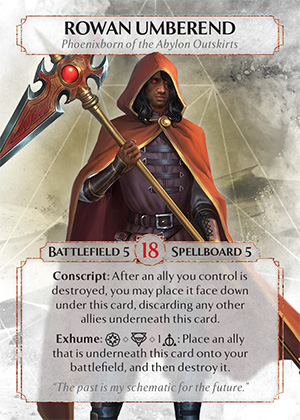
**How to win:** Rowan has a win condition built into his character, but a less straightforward path to getting there than others and once you arrive it can even then be tricky to pull off a win. Still, there are few things as fun as summoning a massive **Reborn Chimera** sooner than your opponent expects and slamming it into your opponent's face over and over again.

The main goal is to draw **Discovery** as soon and as often as possible without losing control of the game. This can make Rowan one of the less consistent PBs out there, since luck can keep those precious **Discovery** card away from your hand, but there are a few ways to mitigate the problem. First avoid a lot of meditations, or have some way of pulling a spell card from the discard if you do meditate away a **Discovery**. You may also want some extra card draw to give you more chances of pulling **Discovery**. **Red Raindrops** do make up for the luck of the draw by being pretty good value for dice, even before you combo and bring out the **Reborn Chimera.** 1 dice for 1 damage isn't that bad at all even if it happens at the end of the round. The dice discard effect can also be offset by all the cards you are drawing to find **Discovery**. The main problem is fitting all of this into a deck that can survive long enough without any additional PB ability or unique to help you turn the tide of the battle.

Exhume seems almost entirely unrelated to **Rowan's** long term plan but is a fairly good ability none the less. Include enough allies that trigger well from the ability and you don't have to worry too much about clog.

**Deck Styles:** Choosing a style for Rowan is usually about the speed you want to find and play **Discovery** cards. With a dedicated plan to draw lots of card and include **Discovery** in your first five, you could summon the **Reborn Chimera** as early as the end of round 2, but you might have spent to many cards and dice in the process that despite the presence of the big beasty you'll still be quickly overwhelmed. On the other hand, take too long and incidentally play **Discovery** whenever is shows up and you might find that the game is over before you reap the benefits of your investment.

You can also focus on reaping the benefits of the **Reborn Chimera** once it actually shows up. It can only normally attack once, but with the right cards you can use it over and over again in the same round. With many approaches to Rowan I can't say I know which is the best style but a good starting point is to pick a tempo for your **Discovery** game plan and build around it, either max out on card draw and getting the most out of the **Reborn Chimera,** or invest more in traditional battlefield control tools and summon the **Reborn Chimera** when the **Discovery** cards naturally decide to show up in a longer game.

**Common Combos:** To combo with **Exhume** you have many options, some more common than others. Its hard to get better value than the on enter effect of **Silver Paladin** just keep in mind you just might have problems triggering it in round 1 if your Paladin likely survives. **Crypt Guardian** is another great choice for a 1 dice unit exhaust on tap. **Knowledge Seeker** is a common combo to draw 1 of 3 cards from the top of your deck, its not amazing value for 1 dice normally but can be exactly what you need to find the next **Discovery**. **Rising Horde** can be awkward to play and have killed in the first place, but the 2 fallen for 1 dice is a pretty great cost ratio.

**Era's End** is almost an auto include in any Rowan deck. Triggering the damage from your **Red Raindrops** or resummoning a dead **Reborn Chimera** can be combined with the burn damage of cards like **Ruin Dweller.** For card draw there are a few options, but **Generosity** is the go to classic for options that usually benefit your slow game plan more than your opponents.

Once you have the **Reborn Chimera** actually in play, unexhausting it with cards like **Call to Action** can net a lot of value. Additionally since you'll get it back anyway, sacrificing it with cards like **Blood Chains** and **Reclaim Soul** is a common strategy.

**Proven Competitive Lists:**

Redentor's LKA 9 Top 2 Paladin Deck: [https://ashes.live/decks/57301/](https://ashes.live/decks/57301/)

Carl's SB Pod Qualifier Top 4 Deck (Old): [https://ashes.live/decks/share/67d80e97-a4f3-4a8f-9cd0-ccd95d178249/](https://ashes.live/decks/share/67d80e97-a4f3-4a8f-9cd0-ccd95d178249/)

**My Best Homebrew: [https://ashes.live/decks/share/00d7e018-a372-4e1e-be9c-d1861a96dcc7/](https://ashes.live/decks/share/00d7e018-a372-4e1e-be9c-d1861a96dcc7/)**

Helping me get my 10 wins with Rowan is this prison mill variation of Rowan control. Stall out your opponent with the classic mill prison of **Kneel** and a wall of **Orchard Doves** and **Shimmer Wings.** Don't be too worried about **Shimmer Wings** not triggering, you can setup a burn win late game and force awkward attacks but they get taken out most of the time and that's ok. To help protect them and to further your prison stall, **Emperor Lion** can fish out law of fear from your deck every round and really slow down the game. **Abundance** will not only draw you into discovery but also finish out your opponent when they run out of a deck. Prioritise the discoveries for this deck, with all the card draw you should hopefully be able to summon the **Reborn Chimera** sooner rather than later and start smashing your opponent before walling up again. The real killer for this deck are meditations, since ideally you don't want to lose any spell board cards or too many discoveries. Use **Recollect** to specifically pull back either **Abundance** or **Summon Orchard Dove** since you need all 3 to trigger your crucial focus effects.

### **D** Tier

# Red Rains

This collection focuses on the PvE version of Ashes.

# Beginners Guide to Red Rains Campaign

[Abominable Adventure: The Red Rains Campaign Guide for Ashes: Reborn](https://jaysonsethlindley.medium.com/abominable-adventure-the-red-rains-campaign-guide-for-ashes-reborn-bbd486cb557f "ImpossibleGerman's Guide to Corpse of Viros")

# Guide for The Bloodwoods Queen against The Corpse of Viros

<p>By Archivist</p>

<p id="bkmrk-top">While all 6 of the Phoenixborn in the Master Set are interesting, <a href="https://ashes.live/cards/jessa-na-ni" target="_blank">Jessa Na Ni</a> catches a lot of players' attention. And for good reason; you don't often see her theme in fantasy games, and very rarely do you get to play the blood-wielding villain.</p>

But if you've tried playing her deck, either in PvP or against the Corpse of Viros (or any other Chimera), you're probably wondering how it is she's supposed to win.

Well, while I can't give you a lot of guidance for playing her deck in PvP, this guide should give you some help in fighting the Corpse of Viros. I'm going to go through this under the assumption you have the bare minimum to play: the Master Set and the Corpse of Viros PvE expansion, and have at least read the rules, even if you don't understand the finer details. This guide is going to focus on her Master Set deck ([The Bloodwoods Queen](https://ashes.live/decks/7688/ "The Bloodwoods Queen")), not the one in the Corpse of Viros expansion. Lastly, since the rules in the Red Rains campaign expect you to modify your deck for any game other than Standard level 1, I will mostly address navigating Standard Level 1.

<p style="text-align:center;">
  <img src="https://cdn.ashes.live/images/cards/jessa-na-ni.jpg" width="100" height="140" alt="Jessa">
  <img src="https://cdn.ashes.live/images/cards/corpse-of-viros-1p-standard-1.jpg" width="100" height="140" alt="Corpse of Viros" />
  <br/>
  <span style="text-align:middle; font-size:12px;">Staring contest in 3...2...1...</span>
</p>

##### Starting off

All the official Chimeras place a heavy emphasis on the battlefield, since none of them have any action or reaction spells at this time. The Corpse of Viros, being our first Chimera, also doesn't have alterations or conjured aspects, making its gameplay somewhat straightforward. This means that the main part of our strategy needs to be maintaining a solid position on the battlefield. Unfortunately, the Bloodwoods Queen deck is weak at this.

Jessa herself is strong in PvP because her ability skips over the field and hits the opposing Phoenixborn (if you're new to card games, that type of effect is often called "burn"). That's extremely valuable when the opposing Phoenixborn has 15-20 life, but much less valuable against a 30 or higher life Chimera. Additionally, her 4 battlefield is the smallest battlefield any Phoenixborn can have, and her spellboard, also at 4, doesn't even get filled by her deck. In her favor is her high life, at 19 - just shy of the Phoenixborn maximum by 1.

<figure style="float: left; padding-right: 5px;">
  <img src="https://cdn.ashes.live/images/cards/blood-archer.jpg" width="200" height="280" alt="Blood Archer">
  <figcaption style="text-align: center; font-size:12px;">The backbone of your fight</figcaption>
</figure>
<p>Her deck has four units: <a href="https://ashes.live/cards/blood-archer/" target="_blank">Blood Archer</a>, <a href="https://ashes.live/cards/blood-shaman/" target="_blank">Blood Shaman</a>, <a href="https://ashes.live/cards/living-doll/" target="_blank">Living Doll</a>, and the summonable <a href="https://ashes.live/cards/blood-puppet/" target="_blank">Blood Puppet</a>. Taking a quick look, you'll see that the only one with any attack value is the Archer; he forms the core of Jessa's strategy, both with his ability and combat values. Blood Shaman is usually going to be a target of one of your own sacrificial spells (like Fear), but he's also useful as a one time blocker. Living Doll is one of the ways Jessa can throw damage straight to the Chimera, but the Doll's ability will be lower priority in most cases. The Blood Puppets are where things get strange. The summon book says you can place it on "target player's battlefield," and in PvP, you will often place them on your opponent's field. Here, though, you're more likely to place it on yours, to eat an attack from the Chimera. Once you get the timing right, the Puppets will always be destroyed before their ability damages Jessa.</p>

Next are the spells. [Fear](https://ashes.live/cards/fear/ "Fear") is your secondary removal behind the Archers, mainly because you only get 3 of them, and the Archers can be brought back using the ceremonial dice power. Ideally, you will use Fear with the Shamans, to regain 2 life (1 from the Shaman's recover value, and 1 from his ability), but the Dolls and the Puppets can also be used in a pinch. Archers should only be used if there is nothing else and you absolutely need to use one.

[Final Cry](https://ashes.live/cards/final-cry/ "Final Cry") is just a burn spell. At 1 die, it's efficient, and they will help you win, but if you have to choose between it and playing a unit, go for the unit. [Redirect](https://ashes.live/cards/redirect/ "Redirect") is a way Jessa survives longer - but note that using Redirect does not change the source of the damage, so hitting a Shaman with the redirect does not count as using "a spell, ability, or dice power you control," and you don't get the benefits of Blood Ritual 1.

She comes with 1 alteration spell: [Undying Heart](https://ashes.live/cards/undying-heart/ "Undying Heart"). This should be played on a Blood Archer, if able, to get them into hand faster after they are destroyed. Granting them 1 additional life also lets them use Blood Shot 1 more time before dying, which is a nice perk.

This leaves her spellboard, of which we've already gone over 1 card ([Summon Blood Puppet](https://ashes.live/cards/summon-blood-puppet/ "Summon Blood Puppet")). [Blood Transfer](https://ashes.live/cards/blood-transfer/ "Blood Transfer") is difficult to use in Red Rains due to being a side action, but if you can use it to preserve an Archer by sacrificing something less important, then you should.

Then there's [Cut the Strings](https://ashes.live/cards/cut-the-strings/ "Cut the Strings"). The rules say we can replace 3 cards with up to 3 copies of [Channel Magic](https://ashes.live/cards/channel-magic/ "Channel Magic"). So replace all 3 Cut the Strings with Channel Magic. Cut the Strings is mostly for opposing alterations, and the Corpse has none, making it a card you'll never want to see. Channel Magic, even if you don't like it, will always do something, so is better.

The rules also say you can mix and match Phoenixborn unique spells, but I'm excluding Playtime because I regard it as part of the Corpse of Viros deck, not the Bloodwoods Queen deck. I also personally feel that Fear is the superior unique for fighting the Chimera, since it is not removed when the Ultimates trigger.

You are also allowed to change any of your 10 dice for any other dice, but I find that the mix of 5 ceremonial and 5 charm works well enough for Jessa's base deck. Maybe going to 6 ceremonial and 4 charm works fine, too, but anything beyond that and I think you'll struggle to pay costs.

##### The First Five

The first five cards recommended in the rulebook for the Master Set are Blood Shaman, Blood Transfer, Fear, Living Doll, and Summon Blood Puppet. I feel this is about as bad a set up as you can get against the Chimera, because it only removes 1 aspect, and ensures an Ultimate at the end of round 1. You also only use 7 dice in that hand, leaving the remaining 3 for either Screams or dice powers.

As such, my recommendation for the first five is Summon Blood Puppet, Blood Shaman, Fear, Blood Archer, and Undying Heart. While this also uses only 7 dice, the intent is to get the Blood Archer killed and returned to your hand via Heart, then replay him. Ideally, this will result in all 4 aspects being cleared in round 1. More likely, you'll get 3, with a Blood Archer in play for the start of next round. To play this opener, you need 2 ceremonial power sides (don't forget that Blood Shaman can raise a die 1 level if you kill him with Fear), 2 ceremonial class sides, and 3 charm class sides. This leaves your last 3 dice as 1 ceremonial and 2 charm to pay for basic costs.

<p style="text-align:center;">
    <img src="https://cdn.ashes.live/images/cards/summon-blood-puppet.jpg" width="100" height="140" alt="Summon Blood Puppet">
  <img src="https://cdn.ashes.live/images/cards/blood-shaman.jpg" width="100" height="140" alt="Blood Shaman">
  <img src="https://cdn.ashes.live/images/cards/fear.jpg" width="100" height="140" alt="Fear">
  <img src="https://cdn.ashes.live/images/cards/blood-archer.jpg" width="100" height="140" alt="Blood Archer">
  <img src="https://cdn.ashes.live/images/cards/undying-heart.jpg" width="100" height="140" alt="Undying Heart">
  <br/>
  <span style="font-size:12px;">My recommended first five</span>
</p>

##### The Corpse of Viros

If you're playing by pre-constructed aspects, the Corpse of Viros has 2: Fury and Shadow. Each one has certain aspects that are trouble, and I tend to break them down into the following categories.

Grunts: these aspects are ones that you can hit last. None of the aspects will make you happy to see them, but these are the least troublesome if left alone for a while. For Fury, this is Rampage and Whiplash. I'd put Constrict and Regenerate in here for Shadow. Whiplash falls into here due to its ability only triggering once; while that once can be devastating, it doesn't quite push it into the other categories for me.

High priority: these aspects are ones you should focus resources into removing, or they will quickly kill whichever Phoenixborn you're using, and Jessa is no exception. In my opinion, the high priority targets for Fury are Frozen Fear, Hunting Instincts, and Firebelly. For Shadow, it's Dark Descent and Stormcall.

Annoying: this is kinda where everything else goes. They're more obnoxious than the grunts, but not demanding of attention like the high priority aspects. Fury has only one here, Iron Scales, while Shadow has two: Lurk and Glare.

<figure id="bkmrk-%22just%22-annoying" style="float: right; padding:5px;">
  <img src="https://cdn.ashes.live/images/cards/lurk.jpg" width="200" height="280" alt="Lurk">
  <figcaption style="text-align: center; font-size: 12px;">"Just" annoying</figcaption>
</figure>
<p>If you're wondering why Lurk is in the "annoying" group, it's because I view it primarily as a rules check: do you understand the interaction between exhaustion and abilities? If you do, then Lurk's threat diminishes the more used to losing units you get. If you don't, then here's the interaction: exhausted units' abilities are treated as having no effect, unless they're in a yellow or green box (ie, Iron Scales and Stormcall). This means that after Lurk is exhausted, it can be targeted by abilities like Blood Shot, Throw, or the natural dice power. Or, attacked, like any other aspect. Even before Lurk is exhausted, it can be hit by cards that affect units without specifically targeting them (Mist Typhoon and One Hundred Blades do this - this kind of card is often called an "area of effect," or "aoe" spell). So while a Root Armored Hammer Knight or Blood Archer will still survive a Lurk attack and be able to counter, it isn't the only way to kill the aspect. Sequencing your turns in preparation for a Lurk is also generally a good strategy; you usually want to see as many of the Chimera's cards as you can before you run out of your damage sources, so holding onto a single damage effect until late in the round becomes pretty natural.</p>

Moving on to apply Jessa's strategies to handling the Corpse's aspects, we see that the high priority aspects are comprised of 3 aspects with 3 life, and 2 with 2. Of them, I'd say that Frozen Fear and Dark Descent are the highest priority, with Firebelly and Stormcall being next, then lastly Hunting Instincts. The reason for this ordering is that both Frozen Fear and Dark Descent will take massive chunks out of Jessa, and both can be difficult to block and kill effectively - Blood Archer is it for Frozen Fear, and you need at least 2 units to block the Descent. Firebelly will simply eat your units, and also cut down on the number of Blood Shots you get in a round. Since that's a large chunk of your damage to aspects, you want to avoid that as much as possible. Stormcall will eat through Jessa's life surprisingly quickly; one might not seem like a lot, but once there's two out, you start feeling the burn really quick. Hunting Instincts is a threat due to its 4 damage and Red Rain token generation - both of these can hurt Jessa's small board immensely if not handled promptly.

Ideally, you'll be attacking exhausted versions of the 2 bloods with your Archers. However, putting the Archers in front of them (when able) to counter is more reliable, even with losing your Archer as a result. You can often see when this is going to happen, so try to Blood Shot the Archer down to 1 life remaining to get the maximum benefit of the 3 dice you spent for him. Speaking of, those 1 bloods make great Blood Shot targets....

Blurriness in priority happens when you get to Lurk and Whiplash. Blood Shot can take them out with a mere 1 activation, and reduce the number of tokens the Chimera will get at the end of the round, so it might not be a bad idea to do that when you can't get a kill on a 2 life aspect, either due to a lack of main actions, or not having enough Blood Shots left in the round.

The grunts are somewhat of a "when you get to them" set. Your Archers will eventually get around to them, but it will take some time, or a bit of luck in revealing nothing else of higher priority.

##### When to scream and (Final) Cry

Before the round gets underway, count the dice you'll need to get a defense set up. If you have 1 or 2 dice left over, you have room to use Screams of the Departed or Final Cry. In my experience, you'll really only use Screams two or three times the entire game, and usually in the last round, when you're trying to push enough damage through to win. Final Cry is a little stronger, since it does 2 damage for 1 die, but you'll still probably find yourself holding onto it until near the end of a round, as that's when you'll have a better idea of how much defense you need.

##### Plan ahead

Due to Blood Shots, Pain Links, and meditations, The Bloodwoods Queen is very side action heavy. You need to try to predict what dice you'll need early so you can get your meditation out of the way early in the round, and not feel like you need to meditate mid-round instead of doing something that affects the field more directly, like using Pain Link so your Living Doll will survive the next attack.

##### Rules Clarifications

The Bloodwoods Queen has a few rules quirks that can be easily missed by newer players. There's the aforementioned Redirect interaction (or lack thereof) with Blood Shaman, which is even in the official FAQ.

Then there's Jessa's ability and Final Cry. Her ability is a "triggered" ability, not a "reaction ability," which, for Ashes, are two separate things. This does mean that you can use both Screams of the Departed and Final Cry (or Redirect) in the same turn. However, it must be in the Player Turns phase of the game - if the Chimera triggers the Ultimate during the Recovery Phase, you can neither activate Jessa's Screams nor play Final Cry, regardless of your dice, as the Recovery phase is not the Players Turns phase. Similarly, Redirect can't be used during the Recovery phase.

The Blood Puppets also provide some interesting interactions. Since you can play them to any battlefield, you can very easily end up with one on the Chimera's field. Fortunately, the rules for handling it are very simple: it's just a conjuration on the Chimera's field. Since it doesn't have defender, it doesn't block for the Chimera or guard for other aspects. If it is attacked, the player attacking it can determine whether or not it counters, as players make all decisions for the Chimera. A Puppet attacks the opposing Phoenixborn if it is the leftmost aspect and the Chimera takes an attack action (usually, this is Jessa, but if you're playing multiplayer, it could wind up on a field opposing a different Phoenixborn). As a conjuration, it is not an aspect, so does not count for adding Red Rains tokens during the Recovery phase, but that also means it doesn't count against the Chimera's Threat. It is theoretically possible to have the Chimera have all 5 Blood Puppets on its field, as well as the full threat of aspects. Lastly, the timing for the Blood Puppet's damage is after the Chimera has added Red Rains tokens - which means that the Ultimate would trigger before the Puppet would deal damage for a round.

##### Moving past Standard 1

<figure style="float:right; padding: 5px;">
  <img src="https://cdn.ashes.live/images/cards/corpse-of-viros-1p-standard-2.jpg" width="200" height="280" alt="Corpse of Viros" />
 </figure>
<p>Okay, that's a lot! But Jessa's deck is not a simple deck to pilot, so a lot needs to be said. Below here is a sample round 1 I've played using the base deck, with the changes I've listed above (Channel Magic and first five), but before that, what about games 2 and 3 of the campaign?</p>

Fortunately, the base set gives a lot of good cards to pull from, and most of the cards in the Corpse of Viros player deck will also bolster Jessa's game. It really depends on which direction you want to take her in. For more allies, you'll want to look at Coal and the Corpse's deck. For better summons, Aradel has two that can be brought in, but Noah's False Demons are a good choice, too. Until you get expansions, Aradel's deck is the only one with an importable "area of effect" card (Mist Typhoon) which Jessa can make use of. There's a surprising amount of usefulness in the cards, despite having so few by name.

Just as a note, Root Armor does not stop a Blood Archer from placing the wound on himself due to Blood Shot. This is due to what step the damage prevention of Armor 1 affects: deal damage (Root Armor triggers here) -&gt; place wounds (Blood Shot starts here for the Archer). This can be found on page 16 of the Master Set's rulebook. Root Armor will, however, stop Firebelly from dealing any damage to him.

After that, it's entirely up to you what to do. Done with the game? Okay, hope you had fun! Want more? There's lots more, including more Chimeras (that also come with another player deck)! Either way, best wishes.

<br/>
<hr>
<br/>

##### Example game (vs Fury)

First five: Blood Archer, Blood Shaman, Fear, Summon Blood Puppet, Undying Heart

Starting roll: 4 charm class, 1 charm basic, 1 ceremonial power, 3 ceremonial class, 1 ceremonial basic.

I opt to go first, but it doesn't much matter. Usually, I have the Chimera go first so I am more likely to have main actions near the end of the round. This matters more when the Chimera has more aspects.

With my roll, I don't need to meditate at all, so no side actions there. I lead with playing the Puppet book to my spellboard.

The Corpse rolls 11 (raise 1 die) and reveals a Whiplash. That's good for me.

I summon the Blood Puppet to my field; I want it to soak an attack, early if needed.

The Corpse rolls another 11 and reveals a Hunting Instincts. That's 2 power sides from his behavior alone, so I'm a little lucky none of the actual rage dice rolls have been power sides.

Back to me, I play the Blood Shaman. It's at risk from Whiplash, but Hunting Instincts and Iron Scales would hit the Puppet, and Frozen Fear would be unblockable. If I need to, I'll guard with Jessa to make sure I get the Fear to hit what I want.

Chimera rolls a 1, and reveals Frozen Fear.

So, I have 2 high priority targets. I think I'm going to Fear the Instincts, and use the Archer to block the Frozen Fear. This gives me the least number of red rains tokens, and since I'm not using Screams this round, I don't mind Jessa getting exhausted.

On my turn, I play the Archer and put a Heart on him. Yes, he's going to die because he'll Blood Shot the Whiplash and block the Frozen Fear, but putting the Heart on him makes sure that a "reveal and attack" with a second Frozen Fear doesn't kill him. It also puts less strain on my main actions, because the Heart will send him directly to hand, whereas returning him with a ceremonial power will also require a meditation and another side action to actually use the dice power.

The Chimera rolls a 9, causing me to lower 2 dice. Since Blood Shaman is going to raise only 1 die up 1 level, I opt for the ceremonial class and a charm class. I need to meditate anyways thanks to this roll. It then reveals an Iron Scales.

This doesn't change what I'm doing much; I'll get to the Scales later, when it's exhausted. So, I Blood Shot the Whiplash, preventing it from attacking my Archer. Then, even though Jessa isn't wounded, I use Fear, sacrificing Shaman to hit the Instincts. That's 3 total damage to the Chimera so far. I raise a charm die to class to reduce the number of cards I need to meditate later.

The Corpse makes its first attack: Frozen Fear. I block with the Archer (remember, he's supposed to die in round 1 so I can replay him).

I could choose to not block, and just take the damage. But then I have to rely on the Archer not being guarded when he attacks the exhausted Fear. I also then need to make sure I have enough mains to hit the Iron Scales with Blood Shots. Both are valid routes, but that one will likely end with Jessa wounded and 1 aspect left untouched. This should end with, at worst, 1 aspect left with 1 wound. The best case scenario for both is a Blood Archer that recovers all wounds at the end of the round. In one case, he'll have an Undying Heart on him, and I'll have dice left for using Screams once or twice.

Resolving the battle puts the Archer back into hand. I need to meditate to get the power needed to replay him (and lose a Fear - that's unfortunate), so that's my side action for the turn. I replay him.

The Scales takes out the Puppet.

On my turn, I use Blood Shot on the Scales, then attack it. The Chimera rolls a 4 for the guard, so the Iron Scales is out.

And that ends the round - the Corpse of Viros has taken 7 damage and has no aspects left, Jessa has taken none, and has a Blood Archer who recovers the 1 wound and is fresh for the next round.

Hopefully, that sample gives you a good idea of what to expect from the first five and how to adjust. Thanks for reading!
<figure style="text-align:center">
  <img src="https://cdn.ashes.live/images/cards/final-cry.jpg" width="200" height="280" alt="Final Cry" />
</figure>

# Guide for The Shadows of Viros against The Corpse of Viros

<p>By Archivist</p>

<p id="bkmrk-top"><a href="https://ashes.live/cards/noah-redmoon/" target="_blank">Noah Redmoon</a> does a fantastic job of looking the part of the evil, sword swinging wizard. Which is good, because he very much is, if you look into his lore (which can be found elsewhere on this wiki). You also might have noticed that he's labeled as the "Phoenixborn of Viros" on his card, which means that he and the Corpse of Viros share a stomping ground. But, "there can be only one" and if you're struggling with Noah fighting the Chimera invader, hopefully, this article will help.</p>

<p>My assumption with this is that you only have access to the Master Set and the Corpse of Viros. This guide will only specifically cover the <a href="https://ashes.live/decks/7690/" target="_blank">Shadows of Viros deck</a>.</p>

##### Preface: rules interactions

<figure style="float: right; padding-left: 5px;">
  <img src="https://cdn.ashes.live/images/cards/stormwind-sniper.jpg" width="200" height="280" alt="Lurk">
  <figcaption style="text-align: center; font-size:12px;">Lurk isn't the only Concealed unit</figcaption>
</figure>
<p>The Shadows of Viros has a few rules interactions that you need to understand before proceeding. The first one is around Noah's ability, Shadow Target. The Corpse of Viros - and all other Chimera so far - has only 1 Ready Spell: the Ultimate. The rules for an exhausted Ultimate are in the Chimera rulebook on page 12, or the Red Rains rulebook on page 17. Of importance to note is that this happens before red rains tokens are placed during the Recover phase.</p>

<p>Another interaction is that of Firebelly and <a href="https://ashes.live/cards/summon-sleeping-widows/" target="_blank">Summon Sleeping Widows</a>. As per the rules on page 17 of the Master Set rulebook, playing Summon Sleeping Widows after the Red Wrath 1 ability has triggered means that the new Sleeping Widows are not affected by the ability, and will stay around.</p>

<p>Stormwind Sniper is the last card that has any sort of tricky rules interactions, and he has several. The easiest one is that the Chimera counts as a Phoenixborn for the purposes of Ambush 1. The remaining interactions regard Concealed. If the Sniper is exhausted, Concealed is no longer in effect, as per rules on page 15 of the Master Set rules (or page 19 of the Red Rains rules). While unexhausted, however, abilities like Dark Descent do not affect the Sniper, nor does Whiplash, and attackers will skip over him and go to the next unit, or the Phoenixborn (Noah) if there are no other units (Red Rains, page 16). In contrast, Stormwind Sniper will be affected by the Firebelly ability regardless of exhaustion, as it does not target the Sniper.</p>

##### Starting Off

The Corpse of Viros plays everything to the battlefield, boasting a solitary ready spell, and no conjurations or alterations. His base form is just aspect units from either of its two Aspect decks. This means it puts a heavy emphasis on the battlefield, but the Corpse does have a fair number of abilities that target the opposing Phoenixborn's life total directly (often called "burn" if you're new to card games).

The Shadows of Viros is in a somewhat unique position compared to the other Master Set decks, as all of its units have a 2 attack value. However, most of the units in it are fragile, like with The Mist Guardian (Aradel), and it shares many of the same vulnerabilities.

One of those vulnerabilities is Noah's low life. At 16, he's just a mere 1 life point higher than the lowest allowed for a Phoenixborn, and he doesn't boast any healing in his original deck. This puts him in a position of needing to guard infrequently, which, fortunately, is just fine. His ability, Shadow Target, is situational in both PvP and PvE; more often than not, you'll find yourself not using it against a Chimera, but when you do, it can stave off an Ultimate for just long enough to prepare for what happens after that Ultimate resolves.

In a stark contrast to The Bloodwoods Queen, The Men of Iron, and The Corpse of Viros player deck, Noah's ceremonial package is rather light on allies, bringing just the <a href="https://ashes.live/cards/stormwind-sniper/" target="_blank">Stormwind Sniper</a>. He is a decent ally for his cost, not outstanding, but thanks to his Concealed, can make for some interesting play lines, such as blocking a Dark Descent while he's the only unit on the field.

<figure style="float: left; padding-right: 5px;">
  <img src="https://cdn.ashes.live/images/cards/false-demon.jpg" width="200" height="280" alt="False Demon">
  <figcaption style="text-align: center; font-size:12px;">Better than he looks</figcaption>
</figure>
His other units are conjurations, which fits more in line with illusion, even if the <a href="https://ashes.live/cards/sleeping-widows/" target="_blank">Sleeping Widows</a> are a ceremonial reaction. And, while he has a whopping 13 conjurations - the second most of the Master Set decks, behind Aradel - only two of those are spellboard conjurations, which means he's only capable of reliably producing two units a round. This, combined with the fact that the <a href="https://ashes.live/cards/masked-wolf/" target="_blank">Wolves</a> and Widows have only 1 life, make Noah struggle in rounds 2 and later. Ironically, their fragility means that there's very little reason to guard them. Most of the time, you're better served letting them counter and die than you are trying to protect them.

<a href="https://ashes.live/cards/false-demon/" target="_blank">False Demon</a> bears special mention here. The Nightmare 1 ability has a lot of utility in picking off wounded or 1 life aspects. Using its ability is somewhat circular; if you're doing well, then you'll have no trouble finding a target for it, making it easier to keep doing well, but if you're struggling, then the ability will often do nothing, and you'll lose the False Demon before you get a chance to do anything else with it.

His remaining spellboard cards are utility cards. <a href="https://ashes.live/cards/resummon/" target="_blank">Resummon</a> works well with False Demon to serve as a heal, an exhaustion removal, and an additional trigger for Nightmare 1, but that's the peak Noah can do with it before he imports cards. Given how many of Noah's conjurations are 2/1/0s with no abilities, more often than not, you're simply removing the exhaustion for 2 class die - which is slightly more expensive than the "standard" 1 class, 1 basic costs to unexhaust. <a href="https://ashes.live/cards/small-sacrifice/" target="_blank">Small Sacrifice</a> works as a way to deal a single damage, which is very useful, but unless you hit a False Demon, you're trading your unit for that 1 damage, which is not ideal. If you must use it that way, try to plan so that the unit is exhausted first, maximizing the value of the dice spent to get that unit.

Beyond his spellboard, he brings two actions spells: <a href="https://ashes.live/cards/bound-soul/" target="_blank">Bound Soul</a> and <a href="https://ashes.live/cards/sleight-of-hand/" target="_blank">Sleight of Hand</a>. Bound Soul is very similar to the ceremonial dice power, but suffers from a lack of targets in the base deck. Due to this, it is possible that you'll draw a Bound Soul before you ever see a Stormwind Sniper. Sleight of Hand is often considered a bad card, but in Shadows of Viros, it helps Noah to get the cards he actually wants, since he will likely be looking for more units or more removal. Two dice for it is a hefty price, but for Standard 1, it will work.

Speaking of, his removal is actually pretty strong. <a href="https://ashes.live/cards/shadow-strike/" target="_blank">Shadow Strike</a> is a reaction that will take out most aspects for a single die, and <a href="https://ashes.live/cards/fade-away/" target="_blank">Fade Away</a> is similar, but slightly harder to use since it won't trigger until after the Chimera has placed red rains tokens for the round. Shadow Strike should absolutely be used to handle problem aspects when you draw it.

##### Channel Magic and Shadowblade

Let me be very clear: there is no easy choice on these.

You should absolutely run all 3 <a href="https://ashes.live/cards/channel-magic/" target="_blank">Channel Magics</a>, the question is what cards to pull from them. Jayson, in his article, calls out Resummon, Sleight of Hand, and Bound Soul, stating "None of those three cards are gonna win the game for you, and Noah is going to be best with all 3 copies of Channel." He's not wrong, and I'd personally like to add Fade Away to that list due to the Ultimates clearing them out before they trigger.

Here's where my preference comes in. I actually think Bound Soul and Sleight of Hand are fine in the deck, if you shift your first five away from what's listed in the core rulebook. I'll get to my preferred first five after talking about Shadowblade, but for now, it's sufficient to say I don't think either of these cards are the best choice to cut. No, for me, the best cards are Resummon #3, because you will never use it (and probably won't use Resummon #2 for anything other than playing it to your board as a main action stall turn), and 2 of the Fade Aways. Yes, Fade Away is amazing when it triggers. But it has to trigger, and the higher in difficulty you go, the harder it gets. Noah's Shadow Target isn't good enough to make Fade Away reliable.

Alright, so what about the <a href="https://ashes.live/cards/shadowblade/" target="_blank">Shadowblade</a>/Masked Wolves mix? This is another tough one, and I think this one is more a matter of preference. Shadowblade is absolutely amazing removal, and it draws you cards as a perk. But in Shadows of Viros, it fights for your other reactions' opportunity windows, and also takes away from Noah's ability to produce units to the field. Both of these are detrimental in my eyes, but I also see the value in having it, as I'm less likely to pull it in the campaign than I am the Wolves. My recommendation is to have at least 1 Summon Masked Wolf, and then have it be your call how many more you include. I typically either run all 3, or run 2 and 1 Shadowblade. Since Noah can't control when he'll draw Summon Sleeping Widows or additional spellbook cards, having more books in the deck for the first go is of higher importance to me.

##### First Five

The Master Set rulebook suggests Small Sacrifice, Summon Masked Wolf, Summon False Demon, Sleight of Hand, and Resummon as the starting first five. This makes sense in terms of setting up the spellboard, but I find it to be a bit awkward against the Corpse, as you're relying on Sleight of Hand to draw into your other needed cards. This can lead to situations where you see Bound Soul before you draw any of the Stormwind Snipers, or draw multiple Resummons without enough units to Resummon. It also consumes 9 dice (10, counting Shadow Target) while only providing you with 2 units to block with - all the Chimera units deal at least 2 damage, so you won't even have a chance to Resummon. This would actually mean you're only using 8 dice (7 if you don't Shadow Target), but I don't trust the 3 new cards to give you the right outlets for those remaining dice.

All these issues lead me to adjust the first five by two cards: first, swap Small Sacrifice for Stormwind Sniper, and second, swap Sleight of Hand for Summon Sleeping Widows. This gives you 5 units in round 1, with 3 main actions (more if you attack) to stall out the Chimera so your False Demon can be your Resummon target. It also consumes all 10 dice without a single power side, and you don't really need Shadow Target round 1, barring unlucky rolls. It also provides you with a target for any Bound Souls you draw into; something I mentioned earlier as a potential issue with Noah's deck.

<p style="text-align:center;">
    <img src="https://cdn.ashes.live/images/cards/summon-masked-wolf.jpg" width="100" height="140" alt="Summon Masked Wolf">
  <img src="https://cdn.ashes.live/images/cards/summon-false-demon.jpg" width="100" height="140" alt="Summon False Demon">
  <img src="https://cdn.ashes.live/images/cards/summon-sleeping-widows.jpg" width="100" height="140" alt="Summon Sleeping Widows">
  <img src="https://cdn.ashes.live/images/cards/stormwind-sniper.jpg" width="100" height="140" alt="Stormwind Sniper">
  <img src="https://cdn.ashes.live/images/cards/resummon.jpg" width="100" height="140" alt="Resummon">
  <br/>
  <span style="font-size:12px;">My recommended first five</span>
</p>

##### The Corpse of Viros

<p>The Corpse of Viros has 2 aspect groups meant for preconstructed play: Fury and Shadow. Each one has certain aspects that bring trouble, and I tend to break them down into the following categories. If you've read my other guides, note that Noah's breakdown is a little different than the other Phoenixborns'.</p>

<p>Grunts: these aspects are ones that you can hit last. None of the aspects will make you happy to see them, but these are the least troublesome if left alone for a while. For Fury, this is Rampage and Whiplash. I'd put Constrict and Regenerate in here for Shadow. Whiplash falls into here due to its ability only triggering once; it's basically a single unit removal that sticks around to remove another one.</p>

<p>High priority: these aspects are ones you should focus resources into removing, or they will quickly kill whichever Phoenixborn you're using, and Noah is more fragile than most. In my opinion, the high priority target for Fury is Firebelly. For Shadow, it's Dark Descent and Stormcall.</p>

<p>Annoying: this is kinda where everything else goes. They're more obnoxious than the grunts, but not demanding of attention like the high priority aspects. All of Fury's two bloods are here, while Shadow has two: Lurk and Glare.</p>

<p>I feel the need to call out that Lurk's placement is due to the rules interactions it has. Since you should be familiar with how Concealed and exhaustion work thanks to the rules section above, you've probably realized that things like Small Sacrifice and Nightmare 1 can take out an exhausted Lurk with no issues. And, since your units are disposable, letting it hit an exhausted leftmost unit is no big loss. Now, you don't want to leave it unblocked very often, as it takes a mere 4 hits to down Noah, but it's still not a big threat.</p>

<figure style="float: right; padding-left: 5px;">
  <img src="https://cdn.ashes.live/images/cards/firebelly.jpg" width="200" height="280" alt="Firebelly">
  <figcaption style="text-align: center; font-size:12px;">The worst thing to happen</figcaption>
</figure>
<p>What is a big threat is Firebelly. Only False Demons will survive the ability, and they'll die when they block (but it's worth the block, barring circumstances where you'll lose if you do). The only upside to Firebellies is that they are great for putting Widows into play, but really, all the Chimera's attacks are good at that, since Noah's units are so fragile. If you see a Firebelly late in the round, it can be worth using Shadow Strike on it to make sure you have units for the next round. That 1 "wasted" damage is a better loss than losing the game because you have no units available following the Firebelly's attack.</p>

<p>Next in line is probably Dark Descent, then Stormcall, then it's down to the annoying ones like Hunting Instincts, Glare, and Iron Scales, with Frozen Fear and Lurk taking up the rear before you get down to the grunts. The Descents will cause issues since Noah has very few units until you get his spellboard running, or luck into a lot of Widows, but you still don't really want to see them. Stormcall eats through Noah's sparse life total, and Channel Magic can only mitigate so much of that.</p>

Hunting Instincts places fourth on the list due to adding red rains tokens that accelerate the Corpse into the 1 and 2 damage Ultimates. These tend to wipe Noah's board clean, and, unsurprisingly, you don't want that.

Everything else, you'll get to.

Handling these aspects is almost entirely a matter of blocking or attacking, then using the 1 damage effects from Nightmare and Small Sacrifice to clean up. You only have 3 Shadow Strikes, with no guarantees you'll draw any of them (but with Sleights and Channels, you have a good chance), so combat is your most reliable source. When able, use Small Sacrifice and Resummon on False Demons; this preserves your units as long as possible while still dealing that damage.

A key strategy in a lot of illusion decks is to go for your opponent's exhausted units. Shadows of Viros is no exception, but you want to be strategic about which units of yours you exhaust and when. I alluded to it before, but if you see a Lurk about to attack an unexhausted unit, there's no reason to not exhaust that unit before the Lurk attacks, even if you're just attacking the Corpse itself (while it has no Defenders). Get value where you can; my typical advice for campaigns is "try to spend 1 die per blood, or 1 die per 2 unit damage" so if you can make your units punch up, do so. And don't be afraid to lose any of them. Shadows of Viros is a lesson in disposable units.

Related to targeting your opponent's exhausted units is giving the opponent the opportunity to exhaust their units. I find that one way to do this is to have the Chimera go first in the game. While it isn't foolproof, it does give you a better chance of controlling the end of round 1 and setting up for a strong round 2.

##### Round 2 and beyond

As mentioned before, a lot of Noah's difficulty comes from surviving past round 1. Due to the high unit volume I've assembled in the first five for round 1, you should be able to make it into round 2 with 1 or 2 units left on Noah's board, and this is crucial, since, also as mentioned before, he only has 2 reliable units per round. You can ceremonial power a Sniper back into hand, and should if needed, but you also want to get his Summons onto his spellboard as fast as you can. You'll likely never use the Wolves' focus ability, but having another 2/1 for 1 class is still useful enough. The rest, then, becomes a matter of managing the damage output you have and bleeding the Chimera down.

Once you've beaten Standard 1, you have a lot of good options for imports. If you want allies, all 3 of the other ceremonial decks have good ones to pull, and the Corpse of Viros player deck also has a good spellboard card in Chant of Transfusion (most likely replacing Small Sacrifice, since you have to pay attention to spellboard size). Even Saria's deck has good allies, but they're more 1 life units, so you don't fix your Firebelly vulnerability there. For more conjurations, you can look to Aradel's deck, but they, too, are 1 life units. On the other hand, they make building your board back easier, and removing 1 wound here and there is also helpful. And Root Armor can help almost any unit it gets placed on; Firebelly won't damage a Sniper with an Armor, and he'll survive any of the 2 attack aspects. Massive Growth can also make one of your units much bulkier, letting it tank a Lurk and something else (but you'll probably want to kill the Lurk with a ping damage instead of the Massive unit, so don't counter). There's a surprising amount of options.

Below here, I've included a sample round 1 using the deck and first five modifications above (so, 3 Channel Magics in, with 2 Fade Away and 1 Resummon removed - not that you see it with only 1 round). Other than that, best wishes!

<hr>

##### Example game (vs Shadow)
First five: Summon Masked Wolf, Summon False Demon, Resummon, Stormwind Sniper, Summon Sleeping Widows

Cost requirements: 4 illusion class sides, 4 ceremonial class sides, leaving 2 basics (1 illusion, 1 ceremonial)

Starting roll: 1 illusion power, 2 illusion class, 2 ceremonial class, 5 basics (3 ceremonial, 2 illusion)

I want to shift the tempo in the game to having Noah play a little more reactive than proactive, so I opt to pass turn 1. While this does give the Chimera 1 power side, it also gives me a bit more control over the game, since I want options for False Demon, and at this point, Noah has life to spare. The Chimera opens with a power side and an 8, forcing me to lower 2. I opt for the illusion power, since I only need class, and one of the ceremonial class. I need to meditate anyways, this is just one more card.

And I get a Stormcall right off the bat.

This shifts my plan; normally, I'd want to hold the Sniper for later, but I want something to ensure I kill the Stormcall if it happens to attack. This means I play him now, resulting in the first damage of the game. I also meditate 4 cards from my deck: Shadow Strike, Summon Masked Wolf, Sleight of Hand, and Fade Away give me 3 ceremonial power and 1 illusion power. This should be enough to last me through any more spin downs and still get me the dice I need.

Noah takes 1 from the Stormcall, then has to lower 2 more dice due to a 9 roll. I opt for 2 ceremonial, before the Chimera reveals a Lurk.

Back to my turn, I use the illusion basic to play Summon Masked Wolf to my spellboard, and follow it with Summon False Demon.

Noah takes the second damage from Stormcall, and the Chimera gets a red rains token. It then rolls a power side and an 8, so there go my other two power sides, and it reveals a Dark Descent. This is looking to be a tough fight. I play the Resummon, and summon a Wolf using my side action and the Summon Masked Wolf spell I played on my last turn. I do that here despite the Dark Descent because of probability; I'm guessing that the Stormcall will attack before the Dark Descent, which means the Wolf will counter the Stormcall and die before the Dark Descent can attempt to exhaust anything. The last aspect could be another Dark Descent, and the Corpse could roll a "reveal and attack," but I'm gambling on the probabilities of both of those happening being low.

The Chimera rolls a basic and a 10, so spins that basic into the 3rd power side, before revealing a second Dark Descent. Well, I was half right; it didn't attack yet.

Again, this is off to a very rough start; I think Noah's going to take a bit of damage. Looking at what I have available, it looks like I can deal 14 total damage, and need 9 to clear the board. Unfortunately, the pair of Dark Descents is going to remove 2 of that in the best of cases.

Scenario 1: The Wolf is attacked by the Stormcall, and both die. I could Widows there. Then, the Lurk would attack a Widow on the next turn, killing it and leaving me with the Sniper and a Widow on the field. I could then play the False Demon to kill the Lurk, and have 3 blockers for the Dark Descents - and the Widows would be exhausted by the first one, while I block with the Sniper. Next would be using Resummon on the False Demon to remove the exhausted Descent, and the second Descent would then attack into said False Demon, killing it and staying alive at 1. This would leave Noah with an empty board.

Scenario 2: I let the Stormcall take out the Wolves, and skip the Widows for now. This forces the Lurk to attack Noah (which is probably fine), and the Sniper can then block the first Dark Descent, at which point, I could Widows. That means the first Descent is at 1, the second Descent only exhausts the 1st Widows instead of discarding it, and I still have the False Demon and Resummon available - which would let me use the unexhausted Widows to block the second Descent. At this point, before using the Demon or Resummon, there's 3 aspects with 1 life left, and, after I play the False Demon, I would have 1 unexhausted unit capable of attacking twice, thanks to Resummon. This would give me a chance to clear out the Chimera's board - and Nightmare 1 on the Demon would trigger twice, too.

I'm opting for scenario 2, so my sequence is to pass my next turn, let the Stormcall and Wolf kill each other. The Chimera didn't spin up any dice on my pass because all aspects were revealed.

Lurk attacks, and Noah's taken 5 damage. I pass main again.

Dark Descent attacks, but since its ability has no valid target, I don't exhaust anything. The Sniper blocks, and the Descent is heavily wounded. I use Summon Sleeping Widows here, dropping myself down to 1 ceremonial class, 2 illusion class, and 1 ceremonial basic.

On my turn, I play the False Demon using an illusion class and the ceremonial basic and kill the exhausted Descent. It's higher priority than the Lurk. I have 1 ceremonial class and 1 illusion class dice left - enough for the Resummon. Even if they were both basics, I have the space to meditate again.

Now, the second Descent attacks, exhausting my leftmost Widow. The other Widow blocks, because I want the Demon for Resummon. I could use the Demon to block and then Resummon the Widow, but this way, I'll have both the Widow and the Demon going into next round, so it's the better choice. It also gives me that chance to use Nightmare 1 again.

After that attack, it doesn't matter which one the Demon goes for; I have two attacks to get around the Chimera's guard. And if it does guard, I destroy the higher priority aspect (the Descent) with the Resummon. Regardless, I go for the Descent with the attack, and - the Chimera guards. Well, now it's taken 6 damage, and on my next main, I Resummon the Demon to kill the Descent and deal 2 more damage, for a total of 8. The turn after, the Chimera fails to guard the Lurk.

At the end of the round, I have a Widows and a Demon, with Noah at 5 wounds and the Corpse at 10 wounds and a single red rains token. But that's also half of the Chimera's high priority aspects out of the way.

Thanks for reading, and may your games go well!
<figure style="text-align:center">
  <img src="https://cdn.ashes.live/images/cards/shadow-strike.jpg" width="200" height="280" alt="Shadow Strike" />
</figure>

# Guide for The Goddess of Ishra against the Corpse of Viros

<p>By Archivist</p>

<p>If you've looked at Jayson's guide, or been on the Discord at all, you've probably heard that <a href="https://ashes.live/cards/astrea/" target="_blank">Astrea</a>'s original deck is one of the hardest decks to pilot against the Chimera. That's entirely true. As such, this guide is for those brave souls who want to make a go of it, and add the deck to your wins.</p>

<p>While Astrea does have a second unique card, this article assumes you have the bare minimum to play the Goddess of Ishra deck: <a href="https://ashes.live/decks/7699/" target="_blank">the deck itself</a>, some divine dice (or substitutes), the Master Set (for the charm dice), and the Corpse of Viros. If you also have the Blight of Neverset, the games against the Chimera become much easier thanks to <a href="https://ashes.live/cards/judgment/" target="_blank">Judgment</a>. It is, however, winnable without.</p>

##### Preface: Rules interactions

<p>The Goddess of Ishra has a few strange rules interactions with the Chimera, and one of those should be cut from your deck in favor of <a href="https://ashes.live/cards/channel-magic/" target="_blank">Channel Magic</a>s (more on that in a bit). Two others deal with <a href="https://ashes.live/cards/light-bringer/" target="_blank">Light Bringer</a>, and <a href="https://ashes.live/cards/imperial-ninja/" target="_blank">Imperial Ninja</a>.</p>

<p>For the Light Bringer, the turn after it comes into play, the Chimera must attack if able. As per rules in the Red Rains rulebook on page 15, status abilities are still resolved, then, the Chimera takes the Attack main action, as though it had no face down aspects. If the Chimera has no aspects capable of attacking (either because the face up ones are exhausted, or it has no face up aspects at all), it takes a turn as normal, rolling or passing based on the number of face down aspects.</p>

<p>Ninja is a little trickier because there's two components to it, but still pretty easy. The first one is the choice of hand or deck; as a player, you choose. Given Astrea's difficulty, it's probably easier to look at the top 5 cards (the created hand - the other component to the Ninja's complexity - as per Red Rains rulebook, page 16), and decide if there's 1 particular aspect that will be problematic coming up, or if you want to just discard 2 aspects. I personally roll the behavior die, with odd being the discard from hand, and even being discard from deck. But you choose when you play.</p>

<p>The last ones all deal with <b>Concealed</b>, on Lurk. It does not protect against <a href="https://ashes.live/cards/kneel/" target="_blank">Kneel</a> or Unit Guard (they don't target), nor Light Bringer's <b>Infatuate</b> (which targets the player), but does protect against Astrea's <b>Beguile</b>. Once Lurk is exhausted (via Kneel or attacking), it can be attacked, hit by <a href="https://ashes.live/cards/mark-of-the-goddess/" target="_blank">Mark of the Goddess</a>, or otherwise dealt with.</p>

##### Astrea's Strategies

<p>Unlike with the two Master Set decks, I'm going to focus on Astrea's deck's strategies instead of the individual cards. Individually, they're pretty abstract, and hard to understand in terms of game goals; as a strategy, they're much easier to understand.</p>

<p>One of her strategies is that of "discard from hand." Unfortunately, against the Chimera, the power of that tactic is dramatically reduced, since the Chimera never runs out of cards to play. While you can still accelerate a fatigue-based win with these plays, the strategy is definitely one of the weakest strategies that exists against the Chimera, since it doesn't have the same limitations a human player does. For example, it will never activate the side action of a <a href="https://ashes.live/cards/weeping-spirit/" target="_blank">Weeping Spirit</a>, and it doesn't care to, because it doesn't have a battlefield limit. Similarly, Imperial Ninja isn't likely to hit a singular key card that would cripple the Chimera if discarded; at best, you'll weaken it for the next round. And then there's Kneel and Beguile, neither of which cause the Chimera to play more cards from hand to have units that can attack. So this strategy is one you should ignore.</p>

<figure style="float: left; padding-right: 5px;">
  <img src="https://cdn.ashes.live/images/cards/light-bringer.jpg" width="200" height="280" alt="Light Bringer">
  <figcaption style="text-align: center; font-size:12px;">A hard card to use well</figcaption>
</figure>
<p>Her other strategy is controlling combat. Not just the outcomes, as cards like <a href="https://ashes.live/cards/royal-charm/" target="_blank">Royal Charm</a> affect, but also what can attack and when. Kneel, Beguile, and <a href="https://ashes.live/cards/devotion/" target="_blank">Devotion</a> stop units from swinging, Light Bringer forces the attack, and <a href="https://ashes.live/cards/steadfast-guardian/" target="_blank">Steadfast Guardian</a> dictates what actually gets attacked (usually Steadfast). And then <a href="https://ashes.live/cards/sun-sister/" target="_blank">Sun Sister</a> can clean up the wounds on any of Astrea's surviving units, except herself. Speaking of surviving units, <a hreff="https://ashes.live/cards/call-to-action/" target="_blank">Call to Action</a> can give one another attack, and you will have no trouble hitting the trigger condition for the reaction. Lastly, even Mark of the Goddess can be considered dictating an attack - just using an opponent's unit for the attack instead of one of hers. This strategy <i>does</i> work against the Chimera, even if the cards themselves appear quite weak at supporting it. It's also a lot harder than many of the other strategies that don't have the same level of combat control, because the decision making is more detailed and the units are on the small side.</p>

<p>Since hand denial is out, you want to put Channel Magic into her deck, replacing the near-useless <a href="https://ashes.live/cards/summon-weeping-spirit/" target="_blank">Summon Weeping Spirit</a>. While you can use the Spirits on your own side to absorb an attack every so often, overall, The Goddess of Ishra would rather have more Royal Charms and more <a href="https://ashes.live/cards/summon-steadfast-guardian/" target="_blank">Summon Steadfast Guardian</a>s than Summon Weeping Spirits, at least against the Chimera. Having the extra life point per Channel Magic drawn doesn't hurt, and probably the best thing about it is that it raises 3 dice up one level, which helps Astrea trigger dice powers more often, giving her greater control over combat outcomes.</p>

<p>As mentioned earlier, if you own Blight of Neverset, you can replace Mark of the Goddess with Judgment, and, well, no one will judge you for it. And, let's be real: if you're using Print on Demand to get The Goddess of Ishra, you probably want 3x Judgment over 3x Mark, anyways. You'll use Judgment in PvP and PvE; Mark sees much less play.</p>

<p>Lastly, Astrea's allies are limited in number; a mere 6, with no way to bring them back in deck or dice. As an option, you can swap out 1 die for a ceremonial die. This isn't something I really recommend, as she wants to minimize meditating in order to not lose Summon Steadfasts, and with a single ceremonial, you'll probably be meditating to get that power side.</p>

##### The First Five

<p>The Goddess of Ishra is somewhat of a rarity in that the strategy needed in the First Five is actually different between the Corpse's aspects. However, that difference comes down entirely to 1 card and how you spend your last few dice.</p>

<p>The base of the First Five is her two summon spells: Guardian and Light Bringer. Since both of these are key to her deck, you want a copy of each. Additionally, she does want more than just two 1 attack units, so Ninja and Sun Sister are also added to the hand. With these four cards, and Astrea's ability, that puts you at using 3 divine class dice, 3 charm class dice, and 2 basic dice. You have 2 dice left.</p>

<p>So what to do with them? There's 6 cards left you can choose from, and only 1 of them will actually cause you to use all your dice: Devotion. That does remove an attacker from your field, and Astrea really wants those early on, making it a subpar choice. The remaining cards all cost 0 or 1 die (Royal Charm is the 0 cost), but all of them also tend to further her strategy.</p>

<p>This is where the differences between the aspects comes in. Against Fury, Mark of the Goddess is effective removal against all the 2 bloods, because they all have 3 or more attack, and can be targeted before they attack. Mark of the Goddess seems a logical choice here, and that would leave you with 1 die to use on dice powers (and it'd be your choice which die, since you have 3 basic costs in that hand). Your worst case scenario, that of a triple Iron Scales opener, is fairly rare, and if you're concerned about it, you can opt for a different card.</p>

<p>Shadow is somehow more resistant to Mark - Lurk can't be hit until after it has attacked (and is better removed by a Light Bringer or Guardian attack so as to minimize damage waste), and Constrict only deals 2 damage to another unit. Which means, for Shadow, you'd be hoping for a 2 or 3 Dark Descent opening for Mark of the Goddess to work. As such, I don't feel like there is a 5th card choice that stands out from the rest. The presence of Constrict means you are likely to lose the use of something - possibly Astrea - and wind up with more "spare" dice to use on dice powers, which makes Royal Charm a risky choice. Devotion's abilities would get shut off by Constrict, but you at least still get to use the dice (and the stat increases), but, unless you rush the Devotion play, Constrict is likely to hit something else anyways. Channel Magic gives you a random card, but also probably puts you into the position of using dice powers or having "dead" dice (you could draw a Kneel you can't use well, for example). And, Kneel in round 1 is usually not a great pick.</p>

<p>This leads my preference to be Channel Magic. While having the spare die isn't ideal, one thing Astrea does want is more summons, more often. Getting 2 or even all 3 of the Steadfast Guardian summons boosts her game by a surprising amount. Even getting more Royal Charms helps her game; making her dice go further is always good, as is having additional targets for Constricts that don't take away from your removal or unit production.</p>

<p>One final option is taking a Kneel into the First Five, and then discarding it before round 1 and hoping for a random draw that's better. This gets into some rules trickery, but there are similar strategies used in PvP to get a "6th" card in the Five. In this case, since you have no way to recover the Kneel, it functions more as a "removing it from the deck so you don't draw it later" action. I don't actually recommend doing it, but you should know that it is an option.</p>

<p style="text-align:center;">
    <img src="https://cdn.ashes.live/images/cards/summon-steadfast-guardian.jpg" width="100" height="140" alt="Summon Steadfast Guardian">
  <img src="https://cdn.ashes.live/images/cards/summon-light-bringer.jpg" width="100" height="140" alt="Summon Light Bringer">
  <img src="https://cdn.ashes.live/images/cards/imperial-ninja.jpg" width="100" height="140" alt="Imperial Ninja">
  <img src="https://cdn.ashes.live/images/cards/sun-sister.jpg" width="100" height="140" alt="Sun Sister">
  <img src="https://cdn.ashes.live/images/cards/channel-magic.jpg" width="100" height="140" alt="Channel Magic">
  <br/>
  <span style="font-size:12px;">My recommended first five</span>

##### The Corpse of Viros

<p>The breakdown for the Corpse's aspects interact differently with The Goddess of Ishra than against most other decks.</p>

<p>Grunts: the aspects you can hit last. Steadfast Guardian can usually soak them and stick around for another block or guard. For Fury, this is Rampage and Whiplash. For Shadow, it's Regenerate.</p>

<p>High Priority: these aspects should take the focus of your resources, so you have a better chance of surviving. Using Beguile on one of these is perfectly acceptable, so you can destroy it without losing any of your units. For Astrea, this list is Dark Descent in Shadow, and Frozen Fear and Hunting Instincts in Fury.</p>

<p>Annoying: the catch-all for everything else. For Fury, that's Iron Scales and Firebelly, and for Shadow, it's Lurk, Constrict, and Stormcall.</p>

<figure id="bkmrk-%22just%22-annoying" style="float: right; padding:5px;">
  <img src="https://cdn.ashes.live/images/cards/constrict.jpg" width="200" height="280" alt="Lurk">
  <figcaption style="text-align: center; font-size: 12px;">Worse than usual</figcaption>
</figure>
<p>This is a bit of a different list than most other Phoenixborn, and that's somewhat due to Astrea's unique deck. Constrict and Iron Scales can be stifled by using Beguile, and then your attacks can focus on the bigger threats, while you chip away at these two with your units. If you have an empty board, you can also use a Light Bringer to force them to attack into it, essentially saving you a unit.</p>

<p>Firebelly is less of a threat here because the Guardian can get a divine die and block and kill it, and still be able to take 1 more wound, even before a Devotion. Additionally, Sun Sister can remove the wounds your units take from Firebelly's ability, preserving your units for longer. And, of course, the aforementioned Devotion can be put onto any unit to give it survivability even after blocking the Firebelly.</p>

<p>Lurk can be guarded against with the Steadfast Guardian. And then you can take it out with a Light Bringer without losing excess damage, but be careful about when that Light Bringer is played. Or, if you get somewhat lucky, you might be able to double Devotion a Guardian and block and counter the Lurk. But then you're likely to lose the Guardian and both Devotions to almost anything, even with a Sun Sister removing wounds.</p>

<p>Stormcall has trouble eating through Astrea's life, and, since she has two attackers capable of taking it out and surviving, shouldn't be much of an issue. What's more, you can slap a divine die on your other two units, and then they are strong enough to take out the Stormcall. Better still, you can time a Light Bringer to force the Stormcall into attacking when you want it to, ensuring you have a unit ready to counter and probably kill it.</p>

<p>Frozen Fear is probably your biggest worry aside from Dark Descent. Frozen Fear can exhaust Astrea, removing one of her primary ways of keeping herself and her units alive. You'll also usually want to boost a Steadfast Guardian with a divine die to be able to block it, as your allies are so few. Also, you can target it (or an Iron Scales) with a charm die to keep it from taking out an unwounded Guardian.</p>

<p>Dark Descent can also remove your units at a high rate. Astrea can have counterplay, though: if your leftmost unit is unexhausted, Call to Action can unexhaust the unit Descent would try to invalidate, but if the unit was already exhausted, Call can't do anything about it.</p>

<p>Those two are in different aspects, so if you're playing them unmixed, you'll only have one set of them to deal with per game.</p>

<p>Perhaps the most interesting thing is that, for The Goddess of Ishra, the harder aspect is actually Shadow. A lot of Fury can be handled through Beguile and careful attacks and guards, and Mark kills just about everything; Shadow removes a bit of that control due to the Dark Descents, and early Constricts can hurt Astrea more than a lot of other Phoenixborn because she is reliant on Beguile and her summons more than most of the preconstructed decks, which can get by without their Phoenixborn ability round 1. And there isn't a good First Five for her that can handle a double or triple Constrict round 1.</p>

##### Round 2 and beyond

<p>Most hands you draw in round 2 will work in some way, but you will occasionally get hit with a hand full of Royal Charms and Call to Actions, without enough units to use them on. Since Astrea plays a defensive slow game, this will still work for her, as she'll likely have multiple turns after the Chimera has finished. She'll also probably take a fair chunk of damage that round, so you should mitigate that the best you can with the Light Bringer, a well-timed Beguile, and the Steadfast Guardian. The next few rounds might be a little more strained, but they're manageable.</p>

<p>Unlike a lot of decks, The Goddess of Ishra will probably end the game in round 4, even against Standard 1. This additional round is usually a matter of cleaning up, as you should have control of the game at that point, and simply were not able to produce enough damage to the Chimera to actually close the game out in round 3.</p>

<p>This longer game closure also means the Corpse is more likely to hit phase 3 than against most other preconstructed decks. This is no big deal, as Astrea's limited battlefield is a boon here, preventing you from losing too many units to the extra Ultimate.</p>

<p>As far as deck picks, Astrea has a lot of good directions to go in, even with just the Master Set. Aradel can give her Mist Spirits and Typhoon, both of which are good at dealing that last damage needed to some aspects, even though they're not in her colors at all. Coal's Hammer Knight is a great Call to Action target, attacking an exhausted (perhaps Beguiled) unit and then unexhausting to counter another. Anchornauts are a good pick, too, as the divine power can also give them 1 attack and make them worthwhile. Noah's False Demon works well with Beguile, too, and he has Bound Soul, which could help with returning the Ninjas and Sisters. Saria can complement the fatigue plan with Enchanted Violinist, and also provide a heavy hitter in Rose Fire Dancer.</p>

<p>All in all, I recommend trying The Goddess of Ishra once or twice. She's a good way to learn to manage what seems like inferior resources in a demanding environment, and those lessons work for all other decks.</p>

# The Shuffle Bus

The Shuffle Bus played a pivotal role in driving fan-based competitive content for Ashes: Reborn from the game's launch until shortly after the final Time cycle's release in late 2022. Although the bulk of their biggest contributions were through video, Discord interactions, or competitive event commentary they also published several articles, available through their website at https://theshufflebus.com and archived here, as well.  
  
NOTE: images in this archive are currently hotlinked against the original website, and much of the formatting from the original articles has been lost! Please read follow the links to read at the original Shuffle Bus URLs for the best experience.

# Shuffle Busted: A Competitive Ashes Primer

<p id="bkmrk-originally-published" class="callout info">Originally published at <strong><a href="https://theshufflebus.com/shuffle-busted-a-competitive-ashes-primer/">https://theshufflebus.com/shuffle-busted-a-competitive-ashes-primer/</a></strong> by <strong>ShuffleBusNeil</strong>; archived Jan. 9, 2023.</p>
<p>(Maintainer's note: several of the cards referenced in this article have undergone errata changes since the initial writing, but the images displayed reflect the current printing. If something in the article doesn't make sense, it might be due to the article referring to the older version of the card. Cards that have been changed can be found <a href="https://wiki.ashes.live/books/rulebook/page/card-errata" target="_blank">here</a>.)</p>
<h2 id="bkmrk-a-phoenix-rises-agai">A Phoenix Rises Again</h2>
<p id="bkmrk-after-1%2C000-years-of">After 1,000 years of waiting the rebirth of the Phoenix is upon. Back in 2015 Plaid Hat Games produced the Ashes: Rise of the Phoenixborn expandable game system. Then, in 2019, the game went out of print after 16 expansions. This isn&rsquo;t a bad run for a game of this type, but if you&rsquo;re reading this you&nbsp; know in the year 2021 the firebird has come out of its hole and didn&rsquo;t see a shadow so we are getting the shiny, new, and rebooted Ashes:Reborn. This primer is to help you get into competitive Ashes Reborn play.</p>
<h2 id="bkmrk-a-brand-new-game">A Brand New Game</h2>
<p id="bkmrk-if-you-are-an-origin">If you are an original ashes player you will see some fundamental changes to the rules and many drastically different wordings on your favorite cards. Most of the new iterations have wildly different effects than the original printings. But don&rsquo;t be discouraged, all of the changes to the cards and rules are positive. The game is quicker, less grindy, and overall more fun. This might sound like an opinion from someone that has played less than 10 games of the original. Well it is. But I&rsquo;m also right, we&rsquo;ll go into more detail later. An extra bonus for the owners of the original printing is the upgrade kit for Reborn that you can purchase to just replace the things that changed and you can still use most of the set you already have. So go out and buy or preorder it (We are not a sponsor and do not benefit from your purchase).</p>
<h2 id="bkmrk-competitive-ashes%3F">Competitive Ashes?</h2>
<p id="bkmrk-this-article-is-assu">This article is assuming you want some insight into competitive Ashes: Reborn. For the last 6 months the Shuffle Bus has been driving through Ashes country and I have learned a lot. Ashes has a lot of differences from the average competitive card game when it comes to general theory. The biggest difference I see is that resources and resource management are almost the polar opposite of how most dueling card games function.</p>
<div class="entry-content" id="bkmrk-">
<div class="entry-content">
<figure class="wp-block-image size-large"><img class="wp-image-849" src="https://i0.wp.com/theshufflebus.com/wp-content/uploads/2021/02/ashes-reborn-header-dice3.jpg__1281x503_q85_subsampling-2.jpg?resize=750%2C294&amp;ssl=1" sizes="(max-width: 750px) 100vw, 750px" srcset="https://i0.wp.com/theshufflebus.com/wp-content/uploads/2021/02/ashes-reborn-header-dice3.jpg__1281x503_q85_subsampling-2.jpg?resize=1024%2C402&amp;ssl=1 1024w, https://i0.wp.com/theshufflebus.com/wp-content/uploads/2021/02/ashes-reborn-header-dice3.jpg__1281x503_q85_subsampling-2.jpg?resize=300%2C118&amp;ssl=1 300w, https://i0.wp.com/theshufflebus.com/wp-content/uploads/2021/02/ashes-reborn-header-dice3.jpg__1281x503_q85_subsampling-2.jpg?resize=768%2C302&amp;ssl=1 768w, https://i0.wp.com/theshufflebus.com/wp-content/uploads/2021/02/ashes-reborn-header-dice3.jpg__1281x503_q85_subsampling-2.jpg?w=1281&amp;ssl=1 1281w" alt="" width="750" height="294" data-recalc-dims="1"></figure>
</div>
</div>
<h3 id="bkmrk-dice">Dice</h3>
<p id="bkmrk-in-ashes-both-player">In Ashes both players begin their turn with all 10 dice available; never more, never less. This alters or down-right removes some staple strategies from other games. &ldquo;Ramp&rdquo; decks that try to amass more or faster resources and go over the top of their opponent don&rsquo;t exist because I can&rsquo;t get more than you fast or slow. Likewise, resource denial strategies that stunt growth or remove existing resources your opponent uses to play their cards could only exist if there were effects in the game that removed dice. We used to have both dice recursion for ramp and dice removal in Ashes 1.0 but they were too powerful or un-fun and have been removed from the Reborn pool. I don&rsquo;t think the lack of these effects is inherently good or bad, it&rsquo;s just how the game plays now and Reborn is great (see previous paragraph). We&rsquo;ll talk about the archetypes the constant dice affects differently later.</p>
<div class="entry-content" id="bkmrk--0">
<div class="entry-content">
<figure class="wp-block-image size-large"><img class="wp-image-850" src="https://i0.wp.com/theshufflebus.com/wp-content/uploads/2021/02/updated_cards.png?resize=750%2C875&amp;ssl=1" sizes="(max-width: 750px) 100vw, 750px" srcset="https://i0.wp.com/theshufflebus.com/wp-content/uploads/2021/02/updated_cards.png?resize=878%2C1024&amp;ssl=1 878w, https://i0.wp.com/theshufflebus.com/wp-content/uploads/2021/02/updated_cards.png?resize=257%2C300&amp;ssl=1 257w, https://i0.wp.com/theshufflebus.com/wp-content/uploads/2021/02/updated_cards.png?resize=768%2C895&amp;ssl=1 768w, https://i0.wp.com/theshufflebus.com/wp-content/uploads/2021/02/updated_cards.png?w=1200&amp;ssl=1 1200w" alt="" width="750" height="875" loading="lazy" data-recalc-dims="1"></figure>
</div>
</div>
<h3 id="bkmrk-cards">Cards</h3>
<p id="bkmrk-the-other-resource-i">The other resource in the game is cards. Like most games card advantage is a good thing. But there are a few caveats to that statement. Because both players draw to a full hand of 5 every round, drawing more cards than your opponent isn&rsquo;t strictly good. It is usually good, but only when you can actually deploy the important threats and answers from your hand. If we were playing Magic and I drew more cards than you, I would win a majority of the time because I am generating a big differential in resources. But if I draw more than you in Ashes and at the end of the round you just refill to 5 while I only draw 1 the differential is gone. So if you can draw and play more cards than your opponent you will probably win. The other consideration to take into account regarding drawing is the number of cards left in your pile. It is very possible to deck yourself in a game with a 30 card pile and you draw 5 every round. For the most part this is not something I take into account when deciding to make a play, draw a card, or mill a card off the pile. Obviously don&rsquo;t do it if it will kill you, but mostly the games seem to be fast enough you should take advantage of the size of your pile as a resource.</p>
<div class="entry-content" id="bkmrk--1">
<div class="entry-content">
<figure class="wp-block-image size-large"><img class="wp-image-851" src="https://i0.wp.com/theshufflebus.com/wp-content/uploads/2021/02/reborn_home.png?resize=750%2C363&amp;ssl=1" sizes="(max-width: 750px) 100vw, 750px" srcset="https://i0.wp.com/theshufflebus.com/wp-content/uploads/2021/02/reborn_home.png?resize=1024%2C495&amp;ssl=1 1024w, https://i0.wp.com/theshufflebus.com/wp-content/uploads/2021/02/reborn_home.png?resize=300%2C145&amp;ssl=1 300w, https://i0.wp.com/theshufflebus.com/wp-content/uploads/2021/02/reborn_home.png?resize=768%2C371&amp;ssl=1 768w, https://i0.wp.com/theshufflebus.com/wp-content/uploads/2021/02/reborn_home.png?w=1080&amp;ssl=1 1080w" alt="" width="750" height="363" loading="lazy" data-recalc-dims="1"></figure>
</div>
</div>
<h3 id="bkmrk-life-and-deck-size">Life and Deck Size</h3>
<p id="bkmrk-the-last-2-resources">The last 2 resources I try to take advantage of in every game of Ashes are my life total and pile size. Like I just said, any cards you can use for some advantage from your pile you should usually take advantage of. The most common example is the meditate side action, just mill yourself. Unless you know for a fact that a card in your hand or spell board is useless for the remainder of the game, just mill yourself to meditate. You can use your Phoenixborn&rsquo;s life total in a similar fashion. Use your Phoenixborn&rsquo;s guard when you can every round unless it&rsquo;s going to kill you. The only point of life that really matters is the last one. Taking 3 is almost universally better than losing a card in play. I say almost because there will be times when you need to be careful playing around with numbers that can kill you. Use your best judgement based on specific game situations, like don&rsquo;t go to 3 when your opponent has access to double natural power.</p>
<h2 id="bkmrk-archetypes%3F-what-arc">Archetypes? What Archtypes?</h2>
<p id="bkmrk-now-that-we-are-all-">Now that we are all experts on the basics of resources, I will use &ldquo;resources&rdquo; to describe general advantages in more than one category and call out the specific resources by name. Let&rsquo;s get back to those archetypes mentioned earlier. The dice situation also changes how different decks look in Ashes. Before Ashes if you asked me to define deck archetypes I would use a spectrum from aggro to control, leaving the middle to be an ill-defined pile of what I&rsquo;ll call midrange.</p>
<h3 id="bkmrk-aggro">Aggro</h3>
<p id="bkmrk-an-aggro-deck-being-">An aggro deck being one that wins by pressuring an opponent&rsquo;s resources&nbsp; early and fast, in most cases specifically pressuring the life total of an opponent. It wins by getting threats in before an opponent because those threats are cheaper/more efficient or by playing threats that bypass normal defensive strategies. In Ashes you are never really in a position to go under your opponent. If you play an efficient small unit I can take my turn to just play a bigger one. Because of the dice parity there isn&rsquo;t going to be a situation where you can play something I can&rsquo;t match right out of the gate. In fact, in most cases, the more aggressive deck wants to take most of its aggressive actions later in the round to get the best attacks for its units. Aggro decks in ashes still use efficiency and still try to apply early pressure, but due to the nature of the dice they can just play the same size units the mid-range and control decks can and will. The aggro decks in Ashes do follow the second trait in that they trend towards the units that are difficult to defend. Starting with units that are difficult to block like Frostback Bear. Or by deploying many units because they are cheap or units that make additional units. When you end up with a wider board than your opponent they simply can&rsquo;t block them all. Lastly, direct damage to the opponent falls into this category.</p>
<h3 id="bkmrk-control">Control</h3>
<p id="bkmrk-on-the-other-end-of-">On the other end of the spectrum, I would have defined a control deck as one that wins through card advantage and inevitability. The Ashes control deck takes a much more traditional look. You beat your opponent by answering their threats with answers that gain you a resource advantage. And you win the game after having stabilized the board and gained enough advantage to go on the offensive. In other games this would usually look like killing your opponent&rsquo;s threats and putting them on a low number of cards in hand that you don&rsquo;t have access to answers for. This won&rsquo;t usually be the case in Ashes because asI described above, we will just both refill to 5 and usually both have ready spells to activate. So the Ashes control deck will gain a resource advantage more often by playing answers that cost less dice than the thing they kill. Or by playing a threat that requires more dice or cards for the opponent to answer. We&rsquo;ll go into some specific examples later.</p>
<h3 id="bkmrk-mid-range">Mid-Range</h3>
<p id="bkmrk-so-in-general-i%E2%80%99ve-f">So in general I&rsquo;ve found that due to how the dice and card parity changes these archetypes almost every Ashes deck falls into the mid-range category where we trade resources from a common starting point every round and a very large advantage is rarely accumulated on either side. As an aside to this, what I would call a combo deck emerged among the community and in the Ashes International League. Through a combination of specific cards you are able to attack your opponent with a very large Shining Hydra and essentially kill them round one. This deck is aggressive but I still call it a combo deck not an aggro deck because it does one thing. If it gets to do its thing it will win, if it doesn&rsquo;t then it will lose. The powers that be have decided that is powerful enough that the cards Shining Hydra and Massive Growth have been pretty much universally restricted from a player&rsquo;s first 5 or from being played at all in the first round. I know this topic could be a whole separate article, and I did <a href="https://youtu.be/LjNC6-hVq5A" target="_blank" rel="noreferrer noopener">here</a>, but in general I think that deck doesn&rsquo;t do anything except force players to have 2 answers for a large unit in their pile and make them think about the decision to put them in their first 5. If you have strong feelings about it, please join our <a href="https://discord.gg/smG76sT" target="_blank" rel="noreferrer noopener">discord</a> and @ me. I&rsquo;d love to debate it.</p>
<h2 id="bkmrk-enough-theory-alread">Enough Theory Already!</h2>
<p id="bkmrk-so-after-all-that-lo">So after all that long winded theory let&rsquo;s talk about some more specific examples of what decks and cards are actually good in the Reborn meta. Starting with the Phoenixborn, there are 16 and some of them are great and some, well, not so great. At a competitive level I would really only play (in no particular order) Brennen, Coal, Harold, Odette, Rin, and Xander. All of them have a very powerful ability and loyalty card. Again I&rsquo;m sure this is a huge debate. Obviously there are a number that are still playable and can be competitive: Aradel, James, Jessa, Leo, Noah, and probably others based on what kind of meta you are going into, My issue with them is that either their ability or loyalty card is lackluster in some or all situations. And I&rsquo;m not saying you can&rsquo;t play any of the others, just that they are low power level. If you go to First Five Friday and want to play your casual Vikki deck, you are a man or woman after my own heart. Poor Vikki really got the axe in Reborn and now can only be one of the greatest of all time and my future wife.</p>
<p id="bkmrk-as-far-as-cards-go-i">As far as cards go I&rsquo;m going to be using my favorite metaphor for how good they are and how they function and it&rsquo;s almost on theme with the bus. There are 2 types of cards: cards that make gas and cards that need gas. Cards that make gas are cards that generate a resource advantage all by themselves. Obviously cards that need gas are the opposite, they do something when you spend resources. In general, cards that make gas are great at competitive levels in all games. Card&rsquo;s that need gas are good sometimes, but not always.</p>
<div class="entry-content" id="bkmrk--2">
<div class="entry-content">
<div class="wp-block-image">
<figure class="aligncenter size-large"><a href="https://ashes.live/cards/river-skald/" target="_blank" rel="noopener"><img class="wp-image-852 align-center" src="https://cdn.ashes.live/images/cards/river-skald.jpg" sizes="(max-width: 300px) 100vw, 300px" alt="River Skald" width="300" height="420" loading="lazy" data-recalc-dims="1"></a></figure>
</div>
</div>
</div>
<p id="bkmrk-if-you-have-been-wat">If you have been watching any of our content, or honestly just existing in the Reborn community, you know that River Skald is the greatest thing since sliced bread. This guy is a gas machine. Is he an efficient unit? Yes. Is he card advantage? Yes. Is he an answer to cards that cost way more than he does? Yes. Is he good in aggro? Yes. Is he good in control? Does he keep me warm at night? Yes. This card does it all and is my pick for number one best card in the Reborn pool. If you are playing Ashes you will see this card being played, preferably by you because otherwise you are likely getting blown out. He&rsquo;s not going to win you the game by himself, but he is going to generate a huge resource advantage regardless of what mode you play him in. Bonus points for anyone that plays him just to draw a card. Playing him and not killing something usually means you are crushing your opponent. He also has that added advantage of not really being the kind of card you can prepare for other than just make informed plays with the thought in mind that your opponent could have one. Because even if you have the Golden Veil ability it&rsquo;s probably better for you than if you didn&rsquo;t have the Veil, but you still got 2-for-1&rsquo; by a 2 dice unit.</p>
<p id="bkmrk-ok%2C-enough-about-our">Ok, enough about our lord and master Skald, some other good cards you will consistently see in competitive play are the good summon books. All the books make gas by definition, always being an X-for-1 where X is the number of times you activate the book in a game. But because your opponent will likely also have books, you want your X-for-1&rsquo;s to beat theirs. The best ones in my opinion are (in no particular order):</p>
<h2 id="bkmrk-top-tier-summons">Top Tier Summons</h2>
<div class="entry-content" id="bkmrk--3">
<div class="entry-content">
<figure><img class="wp-image-870" src="https://cdn.ashes.live/images/cards/summon-frostback-bear.jpg" sizes="(max-width: 300px) 100vw, 300px"  alt="Summon Frostback Bear" width="300" height="420" loading="lazy" data-id="870" data-recalc-dims="1" style="float:left;"></figure>
<figure><img class="wp-image-854" src="https://cdn.ashes.live/images/cards/frostback-bear.jpg" sizes="(max-width: 300px) 100vw, 300px" alt="Frostback Bear" width="300" height="420" loading="lazy" data-id="854" data-recalc-dims="1"></figure>
</div>
</div>
<p id="bkmrk-a-very-efficient-guy">A very efficient guy, 3 dice the first time, then 2 forever after. At 2 dice he&rsquo;s an insane rate.</p>
<div class="entry-content" id="bkmrk--4">
<div class="entry-content">
<figure><img class="wp-image-869" src="https://cdn.ashes.live/images/cards/summon-emperor-lion.jpg" sizes="(max-width: 300px) 100vw, 300px" alt="Summon Emperor Lion" width="300" height="420" loading="lazy" data-id="869" data-recalc-dims="1" style="float:left;"></figure>
<figure><img class="wp-image-855" src="https://cdn.ashes.live/images/cards/emperor-lion.jpg" sizes="(max-width: 300px) 100vw, 300px" alt="Emperor  Lion" width="300" height="420" loading="lazy" data-id="855" data-recalc-dims="1"></figure>
</div>
</div>
<p id="bkmrk-maybe-this-is-hubris">Maybe this is hubris because I don&rsquo;t know how many people are playing this besides myself, but recurrable 3/3 that plays Law of Domination has seemed very good to me. Less good against very wide, but still a lot of advantage for a book.</p>
<div class="entry-content" id="bkmrk--5">
<div class="entry-content">
<figure><img class="wp-image-856" src="https://cdn.ashes.live/images/cards/summon-fallen.jpg" sizes="(max-width: 300px) 100vw, 300px" alt="Summon Fallen" width="300" height="420" loading="lazy" data-id="856" data-recalc-dims="1" style="float:left;"></figure>
<figure><img class="wp-image-867" src="https://cdn.ashes.live/images/cards/fallen.jpg" sizes="(max-width: 300px) 100vw, 300px" alt="Fallen" width="300" height="420" loading="lazy" data-id="867" data-recalc-dims="1"></figure>
</div>
</div>
<p id="bkmrk-i-would-write-an-ent">I would write an entire article about my second favorite card in the game. 1/1s may seem little, but what if I make them by the bundle for 1 dice? Go ahead and read it if you haven&rsquo;t, it doesn&rsquo;t exhaust? IT DOESN&rsquo;T EXHAUST.</p>
<div class="entry-content" id="bkmrk--6">
<div class="entry-content">
<figure><img class="wp-image-857" src="https://cdn.ashes.live/images/cards/summon-gilder.jpg" sizes="(max-width: 300px) 100vw, 300px" alt="Summon Gilder" width="300" height="420" loading="lazy" data-id="857" data-recalc-dims="1" style="float:left;"></figure>
<figure><img class="wp-image-858" src="https://cdn.ashes.live/images/cards/gilder.jpg" sizes="(max-width: 300px) 100vw, 300px" alt="Gilder" width="300" height="420" loading="lazy" data-id="858" data-recalc-dims="1"></figure>

</div>
</div>
<p id="bkmrk-this-one-is-less-uni">This one is less universally good because of its dual color cost, but if you are in the market for a bunch of Archornauts, unit guards, or status counters he does the trick on the cheap.</p>
<div class="entry-content" id="bkmrk--7">
<div class="entry-content">
<figure><img class="wp-image-859" src="https://cdn.ashes.live/images/cards/summon-light-bringer.jpg" sizes="(max-width: 300px) 100vw, 300px" alt="Summon Light Bringer" width="300" height="420" loading="lazy" data-id="859" data-recalc-dims="1" style="float:left;"></figure>
<figure><img class="wp-image-860" src="https://cdn.ashes.live/images/cards/light-bringer.jpg" sizes="(max-width: 300px) 100vw, 300px" alt="Light Bringer" width="300" height="420" loading="lazy" data-id="860" data-recalc-dims="1"></figure>
</div>
</div>
<p id="bkmrk-this-is-a-weird-one%2C">This is a weird one, it makes as much gas any 1/1 book makes but if you apply some gas it does some crazy things. Setting yourself up to where your opponent has awkward attacks generates some advantage. Setting yourself up where your opponent has no good attacks generates a ton of advantage. That set up requires work, but it&rsquo;s worth it.</p>
<div class="entry-content" id="bkmrk--8">
<div class="entry-content">
<figure><img class="wp-image-864" src="https://cdn.ashes.live/images/cards/summon-three-eyed-owl.jpg" sizes="(max-width: 300px) 100vw, 300px" alt="Summon Three Eyed Owl" width="300" height="420" loading="lazy" data-id="864" data-recalc-dims="1" style="float:left;"></figure>
<figure><img class="wp-image-863" src="https://cdn.ashes.live/images/cards/three-eyed-owl.jpg" sizes="(max-width: 300px) 100vw, 300px" alt="Three Eyed Owl" width="300" height="420" loading="lazy" data-id="863" data-recalc-dims="1"></figure>
</div>
</div>
<p id="bkmrk-another-strange-one.">Another strange one. Most players, myself included will overlook this at first. But it becomes apparent very quickly that if they dont kill it, it becomes a 2X-for-1. That&rsquo;s a lot of math in your favor. Most times they will kill it, but it probably cost them more than the 1 dice you made your owl with so you are still winning on the exchange.</p>
<div class="entry-content" id="bkmrk--9">
<div class="entry-content">
<figure><img class="wp-image-865" src="https://cdn.ashes.live/images/cards/summon-winged-lioness.jpg" sizes="(max-width: 300px) 100vw, 300px" alt="Summon Winged Lioness" width="300" height="420" loading="lazy" data-id="865" data-recalc-dims="1" style="float:left;"></figure>
<figure><img class="wp-image-866" src="https://cdn.ashes.live/images/cards/winged-lioness.jpg" sizes="(max-width: 300px) 100vw, 300px" width="300" height="420" loading="lazy" data-id="866" data-recalc-dims="1"></figure>
</div>
</div>
<p id="bkmrk-another-personal-lov">Another personal love of mine. Stalk is close to the best ability on units and you get a 2 dice 2/2 with stalk.</p>
<div class="entry-content" id="bkmrk--10">
<div class="entry-content">
<figure><img class="wp-image-872" src="https://cdn.ashes.live/images/cards/ancestor-spirit.jpg" sizes="(max-width: 300px) 100vw, 300px" alt="Ancestor Spirit" width="300" height="420" loading="lazy" data-id="872" data-recalc-dims="1"></figure>
<figure><img class="wp-image-873" src="https://cdn.ashes.live/images/cards/mist-spirit.jpg" sizes="(max-width: 300px) 100vw, 300px" width="300" height="420" loading="lazy" data-id="873" data-recalc-dims="1"></figure>
<figure><img class="wp-image-874" src="https://cdn.ashes.live/images/cards/shadow-spirit.jpg" sizes="(max-width: 300px) 100vw, 300px" alt="Shadow Spirit" width="300" height="420" loading="lazy" data-id="874" data-recalc-dims="1"></figure>
<figure><img class="wp-image-875" src="https://cdn.ashes.live/images/cards/salamander-monk.jpg" sizes="(max-width: 300px) 100vw, 300px" alt="Salamander Monk" width="300" height="420" loading="lazy" data-id="875" data-recalc-dims="1"></figure>
<figure><img class="wp-image-876" src="https://cdn.ashes.live/images/cards/salamander-monk-spirit.jpg" sizes="(max-width: 300px) 100vw, 300px" alt="Salamander Monk Spirit" width="300" height="420" loading="lazy" data-id="876" data-recalc-dims="1"></figure>
</div>
</div>
<p id="bkmrk-these-i-pretty-much-">These I pretty much consider to be the same, good in go wide category that want very cheap book activations to supplement their army. Monk having the additional benefit of laughing at your opponent&rsquo;s guilt link.</p>
<div class="entry-content" id="bkmrk--11">
<div class="entry-content">
<figure><img class="wp-image-877" src="https://cdn.ashes.live/images/cards/summon-vampire-bat-swarm.jpg" sizes="(max-width: 300px) 100vw, 300px" alt="Summon Vampire Bat Swarm" width="300" height="420" loading="lazy" data-id="877" data-recalc-dims="1" style="float:left;"></figure>
<figure><img class="wp-image-880" src="https://cdn.ashes.live/images/cards/vampire-bat-swarm.jpg" sizes="(max-width: 300px) 100vw, 300px" alt="Vampire Bat Swarm" width="300" height="420" loading="lazy" data-id="880" data-recalc-dims="1"></figure>
</div>
</div>
<p id="bkmrk-%C2%A0i-put-this-one-on-t">&nbsp;I put this one on the list simply because I saw it absolutely work my fellow bus driver Jesse in one of his matches on the stream. It is an expensive rate for a 2/1, but when it&rsquo;s good, it&rsquo;s hard to beat.</p>
<h2 id="bkmrk-top-tier-ready-spell">Top Tier Ready Spells</h2>
<p id="bkmrk-books-obviously-aren">Books obviously aren&rsquo;t the only ready spells in the game and similarly they pretty much all make gas. You will see a variety of them at any level of play but there aren&rsquo;t very many that will change play patterns in a meaningful way. They are mostly utility activations. Some common ones are dice fixers (magic syphon, changing winds, stc.), some are small draw engines (augury, chant of worship, etc.) and some are small pingers (frostbite, small sacrifice, stc.) Some unique ones to watch out for are:</p>
<div class="entry-content" id="bkmrk--12">
<div class="entry-content">
<div class="wp-block-media-text is-stacked-on-mobile">
<figure class="wp-block-media-text__media"><img class="wp-image-881 size-full" src="https://cdn.ashes.live/images/cards/guilt-link.jpg" sizes="(max-width: 300px) 100vw, 300px" alt="Guilt Link" width="300" height="420" loading="lazy" data-recalc-dims="1"></figure>
<div class="wp-block-media-text__content"><br></div>
</div>
</div>
</div>
<p id="bkmrk-a-major-problem-card" class="has-normal-font-size">A major problem card for decks that function mostly with only 1 real threat at a time, but it&rsquo;s easily answered if you see it coming. See Salander Monk above.</p>
<div class="entry-content" id="bkmrk--13">
<div class="entry-content">
<div class="wp-block-media-text is-stacked-on-mobile">
<div class="wp-block-media-text__content"><br></div>
</div>
<div class="wp-block-media-text is-stacked-on-mobile">
<figure class="wp-block-media-text__media"><img class="wp-image-882 size-full" src="https://cdn.ashes.live/images/cards/law-of-domination.jpg" sizes="(max-width: 300px) 100vw, 300px" alt="Law of Domination" width="300" height="420" loading="lazy" data-recalc-dims="1"></figure>
<div class="wp-block-media-text__content"><br></div>
</div>
</div>
</div>
<p id="bkmrk-i-should-probably-pu" class="has-normal-font-size">I should probably put this with the action spells because most of what it does is just once, but it is a good removal spell. Play around it like Guilt Link, especially if they&nbsp;have an Emperor Lion book.</p>
<div class="entry-content" id="bkmrk--14">
<div class="entry-content">
<div class="wp-block-media-text is-stacked-on-mobile">
<div class="wp-block-media-text__content"><br></div>
</div>
<figure><img class="wp-image-883" src="https://cdn.ashes.live/images/cards/law-of-assurance.jpg" sizes="(max-width: 300px) 100vw, 300px" alt="Law of Assurance" width="300" height="420" loading="lazy" data-id="883" data-recalc-dims="1"></figure>
<figure><img class="wp-image-885" src="https://cdn.ashes.live/images/cards/law-of-grace.jpg" sizes="(max-width: 300px) 100vw, 300px" alt="Law of Grace" width="300" height="420" loading="lazy" data-id="885" data-recalc-dims="1"></figure>
<figure><img class="wp-image-886" src="https://cdn.ashes.live/images/cards/law-of-sight.jpg" sizes="(max-width: 300px) 100vw, 300px"  alt="Law of Sight" width="300" height="420" loading="lazy" data-id="886" data-recalc-dims="1"></figure>
</div>
</div>
<p id="bkmrk-other-laws-%E2%80%93-if-thes">Other Laws &ndash; If these are good against you and your opponent plays them you are in trouble, luckily they are very narrow so it&rsquo;s hard to stick one very good. Just keep them in mind if they wreck you and your opponent has Divine dice and/or has an Emperor Lion book.</p>
<div class="entry-content" id="bkmrk--15">
<div class="entry-content">
<div class="wp-block-media-text is-stacked-on-mobile">
<figure class="wp-block-media-text__media"><img class="wp-image-887 size-full" src="https://cdn.ashes.live/images/cards/abundance.jpg" sizes="(max-width: 300px) 100vw, 300px" alt="Abundance" width="300" height="420" loading="lazy" data-recalc-dims="1"></figure>
<div class="wp-block-media-text__content"><br></div>
</div>
</div>
</div>
<p id="bkmrk-this-looks-symmetric" class="has-normal-font-size">This looks symmetrical, but it is not. If your opponent is playing this card they are going to make better use out of this 90% of the time. There&rsquo;s not a lot you can do about that outside of trying to keep your deck total high so as to not get decked. But if you see this early, expect your opponent to be trying to win in a different way.</p>
<div class="entry-content" id="bkmrk--16">
<div class="entry-content">
<div class="wp-block-media-text is-stacked-on-mobile">
<div class="wp-block-media-text__content"><br></div>
</div>
<div class="wp-block-media-text is-stacked-on-mobile">
<figure class="wp-block-media-text__media"><img class="wp-image-888 size-full" src="https://cdn.ashes.live/images/cards/dark-presence.jpg" sizes="(max-width: 300px) 100vw, 300px" alt="Dark Presence" width="300" height="420" loading="lazy" data-recalc-dims="1"></figure>
<div class="wp-block-media-text__content"><br></div>
</div>
</div>
</div>
<p id="bkmrk-if-your-opponent-has" class="has-normal-font-size">If your opponent has a Dark Presence they are going to try to cheat you out when you can&rsquo;t block. It&rsquo;s on board so you should see it coming, but it&rsquo;s definitely a way to lose if you get caught by it.</p>
<h2 id="bkmrk-top-tier-action-spel">Top Tier Action Spells</h2>
<p id="bkmrk-the-ready-spells-rea">The ready spells really put a lot of pressure on the single use cards in the game to be very good in order to compete. I&rsquo;m going to be glossing over essentially all action spells as I think they all be categorized into removal spells, card advantage, and unexhausts. Removal spells are kill spells for units (fester, to shadows, etc.). Card advantage spells put new cards in your hand (expand energy, new ideas, etc.). And the rest unexhaust your units to use again (adrenaline rush, refresh, etc.)</p>
<div class="entry-content" id="bkmrk--17">
<div class="entry-content">
<div class="wp-block-media-text is-stacked-on-mobile">
<figure class="wp-block-media-text__media"><img class="wp-image-889 size-full" src="https://cdn.ashes.live/images/cards/molten-gold.jpg" sizes="(max-width: 300px) 100vw, 300px" alt="Molten Gold" width="300" height="420" loading="lazy" data-recalc-dims="1"></figure>
<div class="wp-block-media-text__content"><br></div>
</div>
</div>
</div>
<p id="bkmrk-the-only-action-you%C2%A0" class="has-normal-font-size">The only action you&nbsp; really need to play around is Molten Gold, so try not to go to 3 if you can avoid it when your opponent has multiple nature dice.</p>
<h2 id="bkmrk-top-tier-reaction-sp">Top Tier Reaction Spells</h2>
<p id="bkmrk-the-reaction-spells-">The reaction spells are the ones you really need to play around. Some are easy and telegraphed, some are not. Luckily on your turn you can see exactly what dice faces your opponent has and plan accordingly. It&rsquo;s a good idea to just know all the reactions, but these are the ones I think are the most impactful.</p>
<div class="entry-content" id="bkmrk--18">
<div class="entry-content">
<div class="wp-block-media-text is-stacked-on-mobile">
<figure class="wp-block-media-text__media"><img class="wp-image-890 size-full" src="https://cdn.ashes.live/images/cards/golden-veil.jpg" sizes="(max-width: 300px) 100vw, 300px" alt="Golden Veil" width="300" height="420" loading="lazy" data-recalc-dims="1"></figure>
<div class="wp-block-media-text__content"><br></div>
</div>
</div>
</div>
<p id="bkmrk-if-your-opponent-is-" class="has-normal-font-size">If your opponent is showing charm power, be wary of your removal spells. There are very few times you break even with dice when you get Veiled and you definitely are losing in tempo when you spend and action and they don&rsquo;t.</p>
<div class="entry-content" id="bkmrk--19">
<div class="entry-content">
<div class="wp-block-media-text is-stacked-on-mobile">
<div class="wp-block-media-text__content"><br></div>
</div>
<div class="wp-block-media-text is-stacked-on-mobile">
<figure class="wp-block-media-text__media"><img class="wp-image-891 size-full" src="https://cdn.ashes.live/images/cards/summon-sleeping-widows.jpg" sizes="(max-width: 300px) 100vw, 300px"  alt="Summon Sleeping Widows" width="300" height="420" loading="lazy" data-recalc-dims="1"></figure>
<div class="wp-block-media-text__content"><br></div>
</div>
</div>
</div>
<p id="bkmrk-this-one-is-more-dif" class="has-normal-font-size">This one is more difficult to play around because sometimes you have to kill a guy or the opponent will kill their own guy just to play it. If you suspect widows, just try to make them spend their ceremonial dice before you use your kill spells if possible.</p>
<div class="entry-content" id="bkmrk--20">
<div class="entry-content">
<div class="wp-block-media-text is-stacked-on-mobile">
<div class="wp-block-media-text__content"><br></div>
</div>
<div class="wp-block-media-text is-stacked-on-mobile">
<figure class="wp-block-media-text__media"><img class="wp-image-892 size-full" src="https://cdn.ashes.live/images/cards/final-cry.jpg" sizes="(max-width: 300px) 100vw, 300px" alt="Final Cry" width="300" height="420" loading="lazy" data-recalc-dims="1"></figure>
<div class="wp-block-media-text__content"><br></div>
</div>
</div>
</div>
<p id="bkmrk-this-one-is-also-har" class="has-normal-font-size">This one is also hard for the same reasons as widows with the additional defense of trying to keep your life total high. It can&rsquo;t kill you unless you&rsquo;re at 2.</p>
<div class="entry-content" id="bkmrk--21">
<div class="entry-content">
<div class="wp-block-media-text is-stacked-on-mobile">
<div class="wp-block-media-text__content"><br></div>
</div>
<div class="wp-block-media-text is-stacked-on-mobile">
<figure class="wp-block-media-text__media"><img class="wp-image-893 size-full" src="https://cdn.ashes.live/images/cards/sympathy-pain.jpg" sizes="(max-width: 300px) 100vw, 300px" alt="Sympathy Pain" width="300" height="420" loading="lazy" data-recalc-dims="1"></figure>
<div class="wp-block-media-text__content"><br></div>
</div>
</div>
</div>
<p id="bkmrk-this-one-is-interest" class="has-normal-font-size">This one is interesting because you have a lot of control on when your opponent can play it. It doesn&rsquo;t feel good to not attack with your guys, but if you are at 2, then you should wait until you can possibly get in for lethal so they die before they can pain you.</p>
<div class="entry-content" id="bkmrk--22">
<div class="entry-content">
<div class="wp-block-media-text is-stacked-on-mobile">
<div class="wp-block-media-text__content"><br></div>
</div>
<div class="wp-block-media-text is-stacked-on-mobile">
<figure class="wp-block-media-text__media"><img class="wp-image-894 size-full" src="https://cdn.ashes.live/images/cards/ice-trap.jpg" sizes="(max-width: 300px) 100vw, 300px" alt="Ice Trap" width="300" height="420" loading="lazy" data-recalc-dims="1"></figure>
<div class="wp-block-media-text__content"><br></div>
</div>
</div>
</div>
<p id="bkmrk-if-you-have-a-2-heal" class="has-normal-font-size">If you have a 2 health unit it&rsquo;s almost impossible to not get trapped. Just try to play your little guy when they aren&rsquo;t showing nature. It&rsquo;s not as bad as most reactions because it is easy to break even on dice as most 2 health units are cheap and if you get your book trapped you are plus 1 card.</p>
<div class="entry-content" id="bkmrk--23">
<div class="entry-content">
<div class="wp-block-media-text is-stacked-on-mobile">
<div class="wp-block-media-text__content"><br></div>
</div>
<div class="wp-block-media-text is-stacked-on-mobile">
<figure class="wp-block-media-text__media"><img class="wp-image-895 size-full" src="https://cdn.ashes.live/images/cards/particle-shield.jpg" sizes="(max-width: 300px) 100vw, 300px"  alt="Particle Shield" width="300" height="420" loading="lazy" data-recalc-dims="1"></figure>
<div class="wp-block-media-text__content"><br></div>
</div>
</div>
</div>
<p id="bkmrk-the-moral-of-this-st" class="has-normal-font-size">The moral of this story is that sometimes it&rsquo;s ok to Skald for too much. I have been blown out by this a couple times, so go for the over kill if you suspect shield.</p>
<h2 id="bkmrk-top-tier-alterations">Top Tier Alterations</h2>
<p id="bkmrk-i-am-also-going-to-g">I am also going to gloss over alterations. In general I hate unit enchantments, just a good way for you to get 2-for-1&rsquo;d and make a big dice deficit for yourself when your opponent plays a removal spell. There are 2 that are worth mentioning.</p>
<div class="entry-content" id="bkmrk--24">
<div class="entry-content">
<div class="wp-block-media-text is-stacked-on-mobile">
<figure class="wp-block-media-text__media"><img class="wp-image-896 size-full" src="https://cdn.ashes.live/images/cards/massive-growth.jpg" sizes="(max-width: 300px) 100vw, 300px" alt="Massive Growth" width="300" height="420" loading="lazy" data-recalc-dims="1"></figure>
<div class="wp-block-media-text__content"><br></div>
</div>
</div>
</div>
<p id="bkmrk-this-is-restricted-b" class="has-normal-font-size">This is restricted because it&rsquo;s cheesy, not because it&rsquo;s good. Just respect it if you have seen one in your opponent&rsquo;s pile from meditate or something because it can cheese you.</p>
<div class="entry-content" id="bkmrk--25">
<div class="entry-content">
<div class="wp-block-media-text is-stacked-on-mobile">
<div class="wp-block-media-text__content"><br></div>
</div>
<div class="wp-block-media-text is-stacked-on-mobile">
<figure class="wp-block-media-text__media"><img class="wp-image-897 size-full" src="https://cdn.ashes.live/images/cards/fade-away.jpg" sizes="(max-width: 300px) 100vw, 300px" alt="Fade Away" width="300" height="420" loading="lazy" data-recalc-dims="1"></figure>
<div class="wp-block-media-text__content"><br></div>
</div>
</div>
</div>
<p id="bkmrk-this-is-more-on-the-" class="has-normal-font-size">This is more on the list because it&rsquo;s one that I would play. Because this is a removal spell, it should probably be listed above.</p>
<h2 id="bkmrk-top-tier-allies">Top Tier Allies</h2>
<p id="bkmrk-finally-the-meat-and">Finally the meat and potatoes of the Ashes cards, the allies. There are a ton of allies, and many of them are playable and very real threats. For the most part they are better than summons of the same dice cost because they are one shots barring outside effects. But generally, they all kill you by attacking.</p>
<div class="entry-content" id="bkmrk--26">
<div class="entry-content">
<div class="wp-block-media-text is-stacked-on-mobile">
<figure class="wp-block-media-text__media"><img class="wp-image-898 size-full" src="https://cdn.ashes.live/images/cards/anchornaut.jpg" sizes="(max-width: 300px) 100vw, 300px" alt="Anchornaut" width="300" height="420" loading="lazy" data-recalc-dims="1"></figure>
<div class="wp-block-media-text__content"><br></div>
</div>
</div>
</div>
<p id="bkmrk-here%E2%80%99s-my-contradict" class="has-normal-font-size">Here&rsquo;s my contradiction, Anchornaut does not attack you. He is a utility guy. As cheap as they come, a small removal tool, and a body to use for blocks or sacrifice effects.</p>
<div class="entry-content" id="bkmrk--27">
<div class="entry-content">
<div class="wp-block-media-text is-stacked-on-mobile">
<div class="wp-block-media-text__content"><br></div>
</div>
<div class="wp-block-media-text is-stacked-on-mobile">
<figure class="wp-block-media-text__media"><img class="wp-image-899 size-full" src="https://cdn.ashes.live/images/cards/fire-archer.jpg" sizes="(max-width: 300px) 100vw, 300px" alt="fire-archer" width="300" height="420" loading="lazy" data-recalc-dims="1"></figure>
<div class="wp-block-media-text__content"><br></div>
</div>
</div>
</div>
<p id="bkmrk-i-have-lost-an-embar" class="has-normal-font-size">I have lost an embarrassing number of times to the tune of Ceremonial dice power into Fire Archer for the last point of damage. This is similar to Anchornaught as a utility body for blocks and sacrifice effects and it attacks for 1 sometimes too.</p>
<div class="entry-content" id="bkmrk--28">
<div class="entry-content">
<div class="wp-block-media-text is-stacked-on-mobile">
<div class="wp-block-media-text__content"><br></div>
</div>
<div class="wp-block-media-text is-stacked-on-mobile">
<figure class="wp-block-media-text__media"><img class="wp-image-900 size-full" src="https://cdn.ashes.live/images/cards/psychic-vampire.jpg" sizes="(max-width: 300px) 100vw, 300px" alt="Psychic Vampire" width="300" height="420" loading="lazy" data-recalc-dims="1"></figure>
<div class="wp-block-media-text__content"><br></div>
</div>
</div>
</div>
<p id="bkmrk-another-utility-body" class="has-normal-font-size">Another utility body. Just puts your opponent in a can&rsquo;t attack can&rsquo;t kill it situation some of the time, and the rest of the time you don&rsquo;t feel bad about a 2/1 for 1 dice. High ceiling reasonable floor on this guy.</p>
<div class="entry-content" id="bkmrk--29">
<div class="entry-content">
<div class="wp-block-media-text is-stacked-on-mobile">
<div class="wp-block-media-text__content"><br></div>
</div>
<figure><img class="wp-image-901" src="https://cdn.ashes.live/images/cards/grave-knight.jpg" sizes="(max-width: 300px) 100vw, 300px" alt="Grave Knight" width="300" height="420" loading="lazy" data-id="901" data-recalc-dims="1"></figure>
<figure><img class="wp-image-902" src="https://cdn.ashes.live/images/cards/hammer-knight.jpg" sizes="(max-width: 300px) 100vw, 300px" alt="Hammer Knight" width="300" height="420" loading="lazy" data-id="902" data-recalc-dims="1"></figure>
<figure><img class="wp-image-903" src="https://cdn.ashes.live/images/cards/master-vampire.jpg" sizes="(max-width: 300px) 100vw, 300px" alt="Master Vampire" width="300" height="420" loading="lazy" data-id="903" data-recalc-dims="1"></figure>
<figure><img class="wp-image-904" src="https://cdn.ashes.live/images/cards/battle-seer.jpg" sizes="(max-width: 300px) 100vw, 300px" alt="Battle Seer" width="300" height="420" loading="lazy" data-id="904" data-recalc-dims="1"></figure>
<figure><img class="wp-image-905" src="https://cdn.ashes.live/images/cards/holy-knight.jpg" sizes="(max-width: 300px) 100vw, 300px" alt="Holy Knight" width="300" height="420" loading="lazy" data-id="905" data-recalc-dims="1"></figure>
<figure><img class="wp-image-906" src="https://cdn.ashes.live/images/cards/sonic-swordsman.jpg" sizes="(max-width: 300px) 100vw, 300px" alt="Sonic Swordsman" width="300" height="420" loading="lazy" data-id="906" data-recalc-dims="1"></figure>
</div>
</div>
<p id="bkmrk-the-bread-and-butter">The bread and butter of midrange decks. All very efficient allies to fight your opponent and their units. Feel good about playing 1 when you draw it, don&rsquo;t feel bad when you don&rsquo;t. Just very solid threats, so play them if they are in your colors.</p>
<div class="entry-content" id="bkmrk--30">
<div class="entry-content">
<div class="wp-block-media-text is-stacked-on-mobile">
<figure class="wp-block-media-text__media"><img class="wp-image-907 size-full" src="https://cdn.ashes.live/images/cards/blood-archer.jpg" sizes="(max-width: 300px) 100vw, 300px" alt="Blood Archer" width="300" height="420" loading="lazy" data-recalc-dims="1"></figure>
<div class="wp-block-media-text__content"><br></div>
</div>
</div>
</div>
<p id="bkmrk-this-card-almost-mad" class="has-normal-font-size">This card almost made it on the list above because I think it&rsquo;s a similar value. I rank this one slightly above them because you always have the play of 3/2 do a damage. This card adds a ton of gas if it lives one turn.</p>
<div class="entry-content" id="bkmrk--31">
<div class="entry-content">
<div class="wp-block-media-text is-stacked-on-mobile">
<div class="wp-block-media-text__content"><br></div>
</div>
<div class="wp-block-media-text is-stacked-on-mobile">
<figure class="wp-block-media-text__media"><img class="wp-image-908 size-full" src="https://cdn.ashes.live/images/cards/enchanted-violinist.jpg" sizes="(max-width: 300px) 100vw, 300px"  alt="Enchanted Violinist" width="300" height="420" loading="lazy" data-recalc-dims="1"></figure>
<div class="wp-block-media-text__content"><br></div>
</div>
</div>
</div>
<p id="bkmrk-this-is-an-expensive" class="has-normal-font-size">This is an expensive 1 damage the first time, but they have to remove it because the 2nd activation makes it totally worth it. So you have 2 modes: 1 damage and they discard a card or attack or you get 1 damage then 1 damage next turn plus a card or attack.</p>
<div class="entry-content" id="bkmrk--32">
<div class="entry-content">
<div class="wp-block-media-text is-stacked-on-mobile">
<div class="wp-block-media-text__content"><br></div>
</div>
<div class="wp-block-media-text is-stacked-on-mobile">
<figure class="wp-block-media-text__media"><img class="wp-image-909 size-full" src="https://cdn.ashes.live/images/cards/hollow.jpg" sizes="(max-width: 300px) 100vw, 300px" alt="Hollow" width="300" height="420" loading="lazy" data-recalc-dims="1"></figure>
<div class="wp-block-media-text__content"><br></div>
</div>
</div>
</div>
<p id="bkmrk-i-love-this-card.-it" class="has-normal-font-size">I love this card. It is both cheap and the closest thing we have to resource denial.</p>
<div class="entry-content" id="bkmrk--33">
<div class="entry-content">
<div class="wp-block-media-text is-stacked-on-mobile">
<div class="wp-block-media-text__content"><br></div>
</div>
<div class="wp-block-media-text is-stacked-on-mobile">
<figure class="wp-block-media-text__media"><img class="wp-image-910 size-full" src="https://cdn.ashes.live/images/cards/light-swordsman.jpg" sizes="(max-width: 300px) 100vw, 300px" alt="Light Swordsman" width="300" height="420" loading="lazy" data-recalc-dims="1"></figure>
<div class="wp-block-media-text__content"><br></div>
</div>
</div>
</div>
<p id="bkmrk-this-guy-rocks%2C-i-am" class="has-normal-font-size">This guy rocks, I am a big fan of all units that come into play as a side action so they can attack on the same turn. And Light Swordsman attacks and doesn&rsquo;t take damage back. It&rsquo;s almost like a removal spell for 2 health units.</p>
<div class="entry-content" id="bkmrk--34">
<div class="entry-content">
<div class="wp-block-media-text is-stacked-on-mobile">
<div class="wp-block-media-text__content"><br></div>
</div>
<figure><img class="wp-image-911" src="https://cdn.ashes.live/images/cards/raptor-herder.jpg" sizes="(max-width: 300px) 100vw, 300px" alt="Raptor Herder" width="300" height="420" loading="lazy" data-id="911" data-recalc-dims="1" style="float:left;"></figure>
<figure><img class="wp-image-912" src="https://cdn.ashes.live/images/cards/raptor-hatchling.jpg" sizes="(max-width: 300px) 100vw, 300px" alt="Raptor Hatchling" width="300" height="420" loading="lazy" data-id="912" data-recalc-dims="1"></figure>
</div>
</div>
<p id="bkmrk-i-hate-this-card%2C-it">I hate this card, it is on the list because everyone loves it. It is an efficient man with another man attached. Obviously good in some situations, also ignorable sometimes. If you are a wide aggro deck this is one of the best guys. Also good if you have a multitude of sacrifice effects or mounts.</p>
<div class="entry-content" id="bkmrk--35">
<div class="entry-content">
<figure><img class="wp-image-913" src="https://cdn.ashes.live/images/cards/flash-archer.jpg" sizes="(max-width: 300px) 100vw, 300px" alt="Flash Archer" width="300" height="420" loading="lazy" data-id="913" data-recalc-dims="1" style="float:left;"></figure>
<figure><img class="wp-image-852" src="https://cdn.ashes.live/images/cards/river-skald.jpg" sizes="(max-width: 300px) 100vw, 300px" alt="River Skald" width="300" height="420" loading="lazy" data-id="852" data-recalc-dims="1"></figure>
</div>
</div>
<p id="bkmrk-flash-archer-is-bad.">Flash Archer Is bad. Skald is good, this card will see play. Thank you Skald for making me relevant!</p>
<div class="entry-content" id="bkmrk--36">
<div class="entry-content">
<div class="wp-block-media-text is-stacked-on-mobile">
<figure class="wp-block-media-text__media"><img class="wp-image-914 size-full" src="https://cdn.ashes.live/images/cards/essence-druid.jpg" sizes="(max-width: 300px) 100vw, 300px" alt="Essence Druid" width="300" height="420" loading="lazy" data-recalc-dims="1"></figure>
<div class="wp-block-media-text__content"><br></div>
</div>
</div>
</div>
<p id="bkmrk-this-is-like-a-combo" class="has-normal-font-size">This is like a combo of a utility unit and a knight. It&rsquo;s costed like a knight and fights good with everything like a knight but also draws you a good card when you play it. This enables a lot of focused nonsense on top of being a great guy. Remember not to attack into it with small while it&rsquo;s not exhausted.</p>
<div class="entry-content" id="bkmrk--37">
<div class="entry-content">
<div class="wp-block-media-text is-stacked-on-mobile">
<div class="wp-block-media-text__content"><br></div>
</div>
<div class="wp-block-media-text is-stacked-on-mobile">
<figure class="wp-block-media-text__media"><img class="wp-image-915 size-full" src="https://cdn.ashes.live/images/cards/shadow-guard.jpg" sizes="(max-width: 300px) 100vw, 300px" alt="Shadow Guard" width="300" height="420" loading="lazy" data-recalc-dims="1"></figure>
<div class="wp-block-media-text__content"><br></div>
</div>
</div>
</div>
<p id="bkmrk-this-is-a-very-avera" class="has-normal-font-size">This is a very average guy and maybe should be in the reaction section. The reason I mention him is just to add him to the play-around-me when applicable list. He can really screw up an attack.</p>
<p id="bkmrk-this-is-like-half-of">This is like half of the total number of allies in the pool. And many of the remaining ones are playable and even good. But mostly I think they are redundant to the ones above. But you should not feel bad about playing a Beast Tamer, Immortal Commander, Stormwind Sniper, etc.</p>
<h2 id="bkmrk-conclusion">Conclusion</h2>
<p id="bkmrk-overall%2C-i-love-play">Overall, I love playing Ashes: Reborn. If you are interested feel free to @ me with comments, compliments, complaints, whatever. I hope this primer helps you get started in the world of competitive Ashes Reborn. Please check out and support the community discord, community made content, our current online tournaments, the Ashteki crew, and especially Plaid Hat Games. Get off my bus.</p>

# Ashes Reborn – Fiona’s Wraiths Deck List

<p class="callout info">Originally published at **[https://theshufflebus.com/ashes-reborn-fionas-wraiths-deck-list/](https://theshufflebus.com/ashes-reborn-fionas-wraiths-deck-list/)** by **ShuffleBusJesse**; archived Jan. 9, 2023.</p>

# Fiona’s Wraiths

<div class="entry-content" id="bkmrk-"><div class="entry-content"><figure class="wp-block-image size-large is-style-default">![](https://i0.wp.com/theshufflebus.com/wp-content/uploads/2021/03/Screen-Shot-2021-03-14-at-11.43.05-PM.png?resize=750%2C617&ssl=1)</figure></div></div>Hey everyone! Jesse here back with a new deck tech. The Fiona’s Wraiths decklist is a combo that could potentially win you the game as early as round 2. Usually, I prefer to do deck techs over video. But with so much content hitting our [Youtube](https://www.youtube.com/channel/UC245bv3dtpv4j35iHnwmI9g) page, I wanted to find an outlet for decks that may not hit on all competitive levels but offer a gratifying play experience. Today’s deck is exactly that. You can also directly look at the deck on [Ashes.Live](https://ashes.live/decks/8009/).

## Keys of the Deck

<div class="entry-content" id="bkmrk--0"><div class="entry-content"><div class="wp-block-image is-style-default"><figure class="aligncenter size-large">![](https://i0.wp.com/theshufflebus.com/wp-content/uploads/2021/03/fiona-mercywind.jpg?resize=300%2C420&ssl=1)</figure></div></div></div>The decklist’s name provides us with a critical hint on what we are trying to accomplish. Fiona is the Pheonixborn of choice for this deck. Her *Ingenuity* ability is unique, and I do think that it could be potentially competitive. Fiona has the issue of a low health value at 15. With a Battlefield of 6 and a Spellboard of 5, she has plenty of options to put out there. Spellboard of 5 seems to indicate the use of a lot of summon books. I believe this strategy was viable in Ashes 1.0. In Reborn powerful allies have left their mark on the meta. Fiona has been left on the outside looking in during Reborn. Nonetheless, some unique synergies exist with Fiona and her ability to reuse any ready spell each round.

## No Maze Today

<div class="entry-content" id="bkmrk--1"><div class="entry-content"><div class="wp-block-image is-style-default"><figure class="aligncenter size-large">![](https://i0.wp.com/theshufflebus.com/wp-content/uploads/2021/03/mind-maze.jpg?resize=300%2C420&ssl=1)</figure></div></div></div>Fiona’s loyalty card Mind Maze is an excellent control card, but this deck is not about controlling your opponent. It’s about leveraging Dread Wraiths. As such, we couldn’t find a home for Mind Maze in this deck. Summon Dreadwraith is an expensive three ceremonial class dice to summon. What do we get for this investment? A 1/6 body? Really? Why?

## I’m Raging Bro

<div class="entry-content" id="bkmrk--2"><div class="entry-content"><figure class="is-layout-flex wp-block-gallery-1 wp-block-gallery aligncenter columns-2 is-cropped">- <figure>![](https://i0.wp.com/theshufflebus.com/wp-content/uploads/2021/03/summon-dread-wraith.jpg?resize=300%2C420&ssl=1)</figure>
- <figure>![](https://i0.wp.com/theshufflebus.com/wp-content/uploads/2021/03/dread-wraith.jpg?resize=300%2C420&ssl=1)</figure>

</figure></div></div>We are building this deck to leverage the **Rage 1** ability found on Dread Wraith. The deck is vulnerable to a couple of powerful meta cards. Sword of Virtue, Fester, Purify, To Shadows, and Fade Away will all make short work of your Dread Wraiths. Cards such as Riverskald and any direct damage kill spells have a much more difficult time against the Wraith. If your opponent is playing Harold, they can mark the Wraith and make six health more manageable.

## Say it with me, Meteor.

<div class="entry-content" id="bkmrk--3"><div class="entry-content"><div class="wp-block-image is-style-default"><figure class="aligncenter size-large">![](https://i0.wp.com/theshufflebus.com/wp-content/uploads/2021/03/meteor.jpg?resize=300%2C420&ssl=1)</figure></div></div></div>The first five Meteor plays are a staple of competitive play as they can reset the board. Both players can suffer the wrath (pun intended for your MTG fans) of the Meteor. With Dread Wraith, they have the potential to survive and get powered up. Powered-up Wraiths become a real threat to your opponent, and with Ingenuity, you will have two of them on the Battlefield post Meteor.

## Don’t go HAM!

Before you go out and take a bunch of turns with this deck, you have to know a few keys to beat your opponent. Here is the first five:

Summon Butterfly Monk, Fire Archer, Summon Dread Wraith, Frostbite, Meteor.

<div class="entry-content" id="bkmrk--4"><div class="entry-content"><figure class="is-layout-flex wp-block-gallery-3 wp-block-gallery columns-3 is-cropped">- <figure>![](https://i0.wp.com/theshufflebus.com/wp-content/uploads/2021/02/fire-archer.jpg?resize=300%2C420&ssl=1)</figure>
- <figure>![](https://i0.wp.com/theshufflebus.com/wp-content/uploads/2021/03/summon-butterfly-monk.jpg?resize=300%2C420&ssl=1)</figure>
- <figure>![](https://i0.wp.com/theshufflebus.com/wp-content/uploads/2021/03/meteor-1.jpg?resize=300%2C420&ssl=1)</figure>
- <figure>![](https://i0.wp.com/theshufflebus.com/wp-content/uploads/2021/03/summon-dread-wraith-1.jpg?resize=300%2C420&ssl=1)</figure>
- <figure>![](https://i0.wp.com/theshufflebus.com/wp-content/uploads/2021/03/frost-bite.jpg?resize=300%2C420&ssl=1)</figure>

</figure></div></div>First, it’s essential to use your actions to maximum efficiency and essentially “slow” play your opponent. I’m not talking about you eating a ham sandwich while you play, but I’m talking about maximizing your main actions each round as much as possible through the supporting cast of your first five cards. The deck does not leave you with any flex spot in your first five, but we are on a very linear plan. Either your opponent can answer your setup, or they can’t.

Second, you should plan to play your slower cards first. I typically play Frostbite, to Summon Butterfly Monk, to play the Monk, to Attack with the Monk. Because Butterfly Monk’s **Mend 1** is inexhaustible, you will get to trigger its ability when you Meteor. Our 3rd card played is the Dread Wraith Summon.

Due to our conjuration count, savvy opponents will be worried that your last card is Summon Sleeping Widows. Because of this, do not telegraph your Meteor until as late as possible. You do need both of your divine dice to be on the Divine Power side eventually.

Here is where you have to figure out how many actions your opponent has left. You can use main action Frostbite an opponent’s PB or a pesky unit if you want, but I recommend the PB as your Meteor will clear most of your opponent’s units. If they play a four health unit, I will use the Frostbite to put the unit in the range of Meteor.

The goal is to try and have your opponent out of cards in hand. Additionally, you want to try and have them unable to spend dice on their summon books. After you summon your first Dread Wraith, you will activate Fiona’s ability as a side action and discard your Fire Archer. If successful, the Meteor will hopefully sweep away their entire board and leave you with two four attack dread wraiths. With only the Wraiths left, you should be able to push eight damage to their face.

## Go First? Or Go Second?

To set up the opening sequence, the best way to ensure you get in front of your opponent’s actions is to have them go first, plus it gives the added value of potentially swinging the top of round 2 with buffed Dread Wraiths for another eight damage. Combined with the potential of one damage from Frostbite in round one and you’ve done 17 damage to the opposing PB. 17 damage is a potential win-con against many PB’s.

## Don’t be afraid to use Fiona’s Health.

Fiona’s health pool is one resource in your eventual victory. If your opponent tries to commit attacks to one of your Wraith’s, make sure Fiona is setup to tank the hardest hit. The Wraith can take up to two damage and still live through your super-powered Meteor play.

## Aggressively Meditate

In the first turn of the game, you should aggressively meditate from the top of your deck to set up the whole turn, minus showing the Meteor play. Make sure you get your ceremonial on the right sides, and power sides are perfect for this. The power sides on the dice bluff several plays, and since your opponent hasn’t seen the Wraith yet, they are left guessing. The two divine dice that went unmeditated will have them tend to believe you are on Winged Lioness or some other plan with Divine.

## The Rest of the Deck

There are a variety of decks that make it hard for the Wraiths to do mighty things. Before you play Wraith’s book, identifying whether the combo will work allows you to pivot even before you Meteor. The remaining cards are supported to help you close the game out. You will find many of these cards in our [competitive primer](https://theshufflebus.com/shuffle-busted-a-competitive-ashes-primer/).

Summon Sleeping Widows are a tremendous explosive play for reaction to a Butterfly Monk or even a Wraith in Round 2+. Ideally, you can play the spiders after your opponent is out of side actions, making them impossible to be pinged away by natural magic. Don’t be afraid to trade one Monk for One spider, though.

<div class="entry-content" id="bkmrk--5"><div class="entry-content"><div class="wp-block-image is-style-default"><figure class="aligncenter size-large">![](https://i0.wp.com/theshufflebus.com/wp-content/uploads/2021/02/summon-sleeping-widows.jpg?resize=300%2C420&ssl=1)</figure></div></div></div>Usually, in Round 2, a Wraith will die, and it’s an opportunity only to need to spend three dice to get a new Wraith on board and keep up the pressure. Risen Horde is more card advantage.

<div class="entry-content" id="bkmrk--6"><div class="entry-content"><figure class="is-layout-flex wp-block-gallery-5 wp-block-gallery columns-3 is-cropped">- <figure>![](https://i0.wp.com/theshufflebus.com/wp-content/uploads/2021/03/adrenaline-rush.jpg?resize=300%2C420&ssl=1)</figure>
- <figure>![](https://i0.wp.com/theshufflebus.com/wp-content/uploads/2021/03/rising-horde.jpg?resize=300%2C420&ssl=1)</figure>
- <figure>![](https://i0.wp.com/theshufflebus.com/wp-content/uploads/2021/03/fester.jpg?resize=300%2C420&ssl=1)</figure>
- <figure>![](https://i0.wp.com/theshufflebus.com/wp-content/uploads/2021/02/final-cry.jpg?resize=300%2C420&ssl=1)</figure>
- <figure>![](https://i0.wp.com/theshufflebus.com/wp-content/uploads/2021/02/molten-gold.jpg?resize=300%2C420&ssl=1)</figure>
- <figure>![](https://i0.wp.com/theshufflebus.com/wp-content/uploads/2021/03/choke.jpg?resize=300%2C420&ssl=1)</figure>

</figure></div></div>Adrenaline Rush is a great Action Spell to use as a side action on an exhausted Wraith to pump it up and get a surprise attack on an unsuspecting unit or Pheonixborn. Sometimes Wraiths can only attack for one, and an opponent will counter to damage the Wraith. Adrenaline Rush provides that Wraith with the ability to stand up after an attack as well. Finally, Wraith’s one-point attacks can turn on your Fester, but usually, Frostbite will be your ideal play for Fester or just a Natural Ping.

The deck has three Final Cry and three Molten Gold for closing out games. These spells give us 15 direct damage, which is more than enough if we can land a few buffed Wraith hits. There is a singular ice trap in the deck for pesky low health units like Raptor Herder outside Round 1. Finally, we have 3 Fire Archers, one in the bin, which means if you get down to needing to make a single point of damage to win, you can use Ceremonial power into Archer for victory. Choke is for more damage on PB’s, and sometimes it can blow out opponents, and it can be considered for your first five if you are up against Harold.

# Hard 30 – Beyond the First Five part I

<p class="callout info">Originally published at **[https://theshufflebus.com/hard-30-beyond-the-first-five-part-i/](https://theshufflebus.com/hard-30-beyond-the-first-five-part-i/)** by **Jerod Leupold**; archived Jan. 9, 2023.</p>

<section class="elementor-section elementor-top-section elementor-element elementor-element-5f4b608 elementor-section-boxed elementor-section-height-default elementor-section-height-default" data-element_type="section" data-id="5f4b608" id="bkmrk-flat-argiaia%E2%80%99er-theo"># <span style="font-family: Arial; font-size: 34.6667px; font-weight: 400;">Flat Argiaia’er Theory</span>

</section><section class="elementor-section elementor-top-section elementor-element elementor-element-5147233 elementor-section-boxed elementor-section-height-default elementor-section-height-default" data-element_type="section" data-id="5147233" id="bkmrk-hard-30-%E2%80%93-beyond-the"><span style="font-size: 15pt; font-family: Arial; color: #666666; background-color: transparent; font-variant-numeric: normal; font-variant-east-asian: normal; vertical-align: baseline; white-space: pre-wrap;">Hard 30 – Beyond the First Five part I</span>

</section><section class="elementor-section elementor-top-section elementor-element elementor-element-197e0e7 elementor-section-boxed elementor-section-height-default elementor-section-height-default" data-element_type="section" data-id="197e0e7" id="bkmrk-it%E2%80%99s-not-a-curve">## It’s Not a Curve

</section><section class="elementor-section elementor-top-section elementor-element elementor-element-f250c12 elementor-section-boxed elementor-section-height-default elementor-section-height-default" data-element_type="section" data-id="f250c12" id="bkmrk-using-a-bell-curve-t"><span style="font-size: 11pt; font-family: Arial; color: #000000; background-color: transparent; font-weight: 400; font-style: normal; font-variant: normal; text-decoration: none; vertical-align: baseline; white-space: pre-wrap;">Using a bell curve to optimize resources for card games has been around for over 30 years. The concept helps you play the most number of cards during a round based on increasing resources. Ashes is a different bird altogether because your resources are set. Instead of an ever-expanding curve, you have an average.</span>

<span style="font-size: 11pt; font-family: Arial; color: #000000; background-color: transparent; font-weight: 400; font-style: normal; font-variant: normal; text-decoration: none; vertical-align: baseline; white-space: pre-wrap;">The first thing you want to figure out is how many repeatable effects do you want to trigger every round. Either from a phoenixborn’s ability or spellbooks already in play. Take the total cost of those effects minus ten. That is the amount of </span><span style="font-size: 11pt; font-family: Arial; color: #000000; background-color: transparent; font-weight: bold; font-style: normal; font-variant: normal; text-decoration: none; vertical-align: baseline; white-space: pre-wrap;">open dice</span><span style="font-size: 11pt; font-family: Arial; color: #000000; background-color: transparent; font-weight: 400; font-style: normal; font-variant: normal; text-decoration: none; vertical-align: baseline; white-space: pre-wrap;"> available every round to spend on any other cards you may draw.</span>

<span style="font-size: 11pt; font-family: Arial; color: #000000; background-color: transparent; font-weight: 400; font-style: normal; font-variant: normal; text-decoration: none; vertical-align: baseline; white-space: pre-wrap;">The second thing is deciding what you want your average cost of card to be in your deck. This is a drastically different approach than other games due to the set resources. Instead of your curve being dictated to you, you choose your average.</span>

## <span style="font-size: 16pt; font-family: Arial; color: #000000; background-color: transparent; font-weight: 400; font-style: normal; font-variant: normal; text-decoration: none; vertical-align: baseline; white-space: pre-wrap;">Five In, X Out Theory</span>

<span style="font-size: 11pt; font-family: Arial; color: #000000; background-color: transparent; font-weight: 400; font-style: normal; font-variant: normal; text-decoration: none; vertical-align: baseline; white-space: pre-wrap;">Ideally, during round two you activate all your spellbooks, phoenixborn ability, and play all the cards you think are key to the deck concept. In most card games the goal is to play every single card you draw to the battlefield. So, if you draw five cards, you want to play five cards. Generally known as five in, five out.</span>

<span style="font-size: 11pt; font-family: Arial; color: #000000; background-color: transparent; font-weight: 400; font-style: normal; font-variant: normal; text-decoration: none; vertical-align: baseline; white-space: pre-wrap;">Ashes present several barriers to that idea. First of all, there is a limit to your resources of ten dice. No less, no more. Second, phoenixborn have battlefield sizes. Even if you drew five allies they may not all fit within the limit. Finally, you just may not be able to. Some cards require a trigger for them to be useful. The caveat for the last point is if a particular card keeps being the last piece of cardboard in your hand… It might be time for a new card.</span>

<span style="font-size: 11pt; font-family: Arial; color: #000000; background-color: transparent; font-weight: 400; font-style: normal; font-variant: normal; text-decoration: none; vertical-align: baseline; white-space: pre-wrap;"> </span>

<span style="font-size: 11pt; font-family: Arial; color: #000000; background-color: transparent; font-weight: 400; font-style: normal; font-variant: normal; text-decoration: none; vertical-align: baseline; white-space: pre-wrap;">Each deck has an interesting balance for the number of cards it wants to play each turn based on the first five.</span>

<span style="font-size: 11pt; font-family: Arial; color: #000000; background-color: transparent; font-weight: 400; font-style: normal; font-variant: normal; text-decoration: none; vertical-align: baseline; white-space: pre-wrap;"> </span>

<span style="font-size: 11pt; font-family: Arial; color: #000000; background-color: transparent; font-weight: 400; font-style: normal; font-variant: normal; text-decoration: none; vertical-align: baseline; white-space: pre-wrap;">If a deck has a low number of open dice, like three, it makes sense to aim for three or fewer cards being played each turn. Your deck should have an incredibly low average cost of one. Interestingly, it makes cards with detrimental discards all the more palatable like Crescendo since you are going to be holding cards at the end of the turn.</span>

## <span style="font-size: 16pt; font-family: Arial; color: #000000; background-color: transparent; font-weight: 400; font-variant: normal; text-decoration: none; vertical-align: baseline; white-space: pre-wrap;">Finding </span><span style="font-size: 16pt; font-family: Arial; color: #000000; background-color: transparent; font-weight: 400; font-style: normal; font-variant: normal; text-decoration: none; vertical-align: baseline; white-space: pre-wrap;">Your Average</span>

<span style="font-size: 11pt; font-family: Arial; color: #000000; background-color: transparent; font-weight: 400; font-style: normal; font-variant: normal; text-decoration: none; vertical-align: baseline; white-space: pre-wrap;">Find your average by dividing the number of open dice by the number of cards you want to play each round.</span>

<span style="font-size: 11pt; font-family: Arial; color: #000000; background-color: transparent; font-weight: 400; font-style: normal; font-variant: normal; text-decoration: none; vertical-align: baseline; white-space: pre-wrap;"> </span>

<span style="font-size: 11pt; font-family: Arial; color: #000000; background-color: transparent; font-weight: 400; font-style: normal; font-variant: normal; text-decoration: none; vertical-align: baseline; white-space: pre-wrap;">Open Dice/X Out = Average Cost of Card</span>

<span style="font-size: 11pt; font-family: Arial; color: #000000; background-color: transparent; font-weight: 400; font-style: normal; font-variant: normal; text-decoration: none; vertical-align: baseline; white-space: pre-wrap;"> </span>

<span style="font-size: 11pt; font-family: Arial; color: #000000; background-color: transparent; font-weight: 400; font-style: normal; font-variant: normal; text-decoration: none; vertical-align: baseline; white-space: pre-wrap;">The average cost of a card is for the rest of the 25 in your deck. To make this easier to visualize, figure out the cost combination of each card in a five-card hand that meets or exceeds your X Out number. NOTE: I have not included zero-cost cards. They are not worth playing in a deck besides Call Upon the Realms. Royal Charm can be great but you need to be in charm or divine. The less said about Mass Heal\* the better.</span>

<span style="font-size: 11pt; font-family: Arial; color: #000000; background-color: transparent; font-weight: 400; font-style: normal; font-variant: normal; text-decoration: none; vertical-align: baseline; white-space: pre-wrap;"> </span>

<span style="font-size: 11pt; font-family: Arial; color: #000000; background-color: transparent; font-weight: 400; font-style: normal; font-variant: normal; text-decoration: none; vertical-align: baseline; white-space: pre-wrap;">\*Please prove me wrong! I love seeing underused cards rise to the occasion! Let’s chat in </span>[Discord!](https://discord.gg/9Tp6wnEcRa)

</section><section class="elementor-section elementor-top-section elementor-element elementor-element-b3a2a8e elementor-section-boxed elementor-section-height-default elementor-section-height-default" data-element_type="section" data-id="b3a2a8e" id="bkmrk-example-1%3A-i-have-a-"><span style="font-size: 11pt; font-family: Arial; color: #000000; background-color: transparent; font-variant-numeric: normal; font-variant-east-asian: normal; vertical-align: baseline; white-space: pre-wrap;">Example 1: I have a deck with five open dice and I want to play three cards per round. Five divided by three is 1.66 repeating. What would that look like in a five-card hand? Remember, three cards have to add up to five or fewer die cost to meet our criteria.</span>

</section><section class="elementor-section elementor-top-section elementor-element elementor-element-10b931b elementor-section-boxed elementor-section-height-default elementor-section-height-default" data-element_type="section" data-id="10b931b" id="bkmrk-cost-1-2-3-4-hand-1-"><div class="elementor-container elementor-column-gap-default"><div class="elementor-row"><div class="elementor-column elementor-col-100 elementor-top-column elementor-element elementor-element-0cdcc6e" data-element_type="column" data-id="0cdcc6e"><div class="elementor-column-wrap elementor-element-populated"><div class="elementor-widget-wrap"><div class="elementor-element elementor-element-36b68fc elementor-widget elementor-widget-text-editor" data-element_type="widget" data-id="36b68fc" data-widget_type="text-editor.default"><div class="elementor-widget-container"><div class="elementor-text-editor elementor-clearfix"><table class="tg"><thead><tr><th class="tg-0pky">Cost</th><th class="tg-0pky">1</th><th class="tg-0pky">2</th><th class="tg-0pky">3</th><th class="tg-0pky">4</th></tr></thead><tbody><tr><td class="tg-0pky">Hand 1</td><td class="tg-0pky">3</td><td class="tg-0pky">0</td><td class="tg-0pky">0</td><td class="tg-0pky">0</td></tr><tr><td class="tg-0pky">Hand 2</td><td class="tg-0pky">4</td><td class="tg-0pky">0</td><td class="tg-0pky">0</td><td class="tg-0pky">0</td></tr><tr><td class="tg-0pky">Hand 3</td><td class="tg-0pky">5</td><td class="tg-0pky">0</td><td class="tg-0pky">0</td><td class="tg-0pky">0</td></tr><tr><td class="tg-0pky">Hand 4</td><td class="tg-0pky">2</td><td class="tg-0pky">2</td><td class="tg-0pky">0</td><td class="tg-0pky">0</td></tr><tr><td class="tg-0pky">Hand 5</td><td class="tg-0pky">3</td><td class="tg-0pky">1</td><td class="tg-0pky">0</td><td class="tg-0pky">0</td></tr><tr><td class="tg-0pky">Hand 6</td><td class="tg-0pky">1</td><td class="tg-0pky">2</td><td class="tg-0pky">0</td><td class="tg-0pky">0</td></tr><tr><td class="tg-0pky">Hand 7</td><td class="tg-0pky">2</td><td class="tg-0pky">0</td><td class="tg-0pky">1</td><td class="tg-0pky">0</td></tr></tbody></table>

</div></div></div></div></div></div></div></div></section><section class="elementor-section elementor-top-section elementor-element elementor-element-087893c elementor-section-boxed elementor-section-height-default elementor-section-height-default" data-element_type="section" data-id="087893c" id="bkmrk-there-are-a-lot-of-o"><span style="font-size: 11pt; font-family: Arial; color: #000000; background-color: transparent; font-weight: 400; font-style: normal; font-variant: normal; text-decoration: none; vertical-align: baseline; white-space: pre-wrap;">There are a lot of options for different hands.</span>

<span style="font-size: 11pt; font-family: Arial; color: #000000; background-color: transparent; font-weight: 400; font-style: normal; font-variant: normal; text-decoration: none; vertical-align: baseline; white-space: pre-wrap;">Example 2: Let’s take the same number of open dice, five. But, increase the number of cards I want to play each turn to five.</span>

</section><section class="elementor-section elementor-top-section elementor-element elementor-element-9480504 elementor-section-boxed elementor-section-height-default elementor-section-height-default" data-element_type="section" data-id="9480504" id="bkmrk-cost-1-2-3-4-hand-1--0"><div class="elementor-container elementor-column-gap-default"><div class="elementor-row"><div class="elementor-column elementor-col-100 elementor-top-column elementor-element elementor-element-32cc687" data-element_type="column" data-id="32cc687"><div class="elementor-column-wrap elementor-element-populated"><div class="elementor-widget-wrap"><div class="elementor-element elementor-element-425895c elementor-widget elementor-widget-text-editor" data-element_type="widget" data-id="425895c" data-widget_type="text-editor.default"><div class="elementor-widget-container"><div class="elementor-text-editor elementor-clearfix"><table class="tg"><thead><tr><th class="tg-0pky">Cost</th><th class="tg-0pky">1</th><th class="tg-0pky">2</th><th class="tg-0pky">3</th><th class="tg-0pky">4</th></tr></thead><tbody><tr><td class="tg-0pky">Hand 1</td><td class="tg-0pky">5</td><td class="tg-0pky">0</td><td class="tg-0pky">0</td><td class="tg-0pky">0</td></tr></tbody></table>

</div></div></div></div></div></div></div></div></section><section class="elementor-section elementor-top-section elementor-element elementor-element-1734cf2 elementor-section-boxed elementor-section-height-default elementor-section-height-default" data-element_type="section" data-id="1734cf2" id="bkmrk-that%E2%80%99s-it.-no-card-c"><span style="background-color: transparent; color: #000000; font-family: Arial; font-size: 11pt; white-space: pre-wrap;">That’s it. No card can cost more than one.</span>

<span style="font-size: 11pt; font-family: Arial; color: #000000; background-color: transparent; font-weight: 400; font-style: normal; font-variant: normal; text-decoration: none; vertical-align: baseline; white-space: pre-wrap;">How do you know how many cards you should play in a round? Well, that depends on your deck.</span>

## <span style="font-size: 16pt; font-family: Arial; color: #000000; background-color: transparent; font-weight: 400; font-style: normal; font-variant: normal; text-decoration: none; vertical-align: baseline; white-space: pre-wrap;">Choosing Your X Out</span>

<span style="font-size: 11pt; font-family: Arial; color: #000000; background-color: transparent; font-weight: 400; font-style: normal; font-variant: normal; text-decoration: none; vertical-align: baseline; white-space: pre-wrap;">Here’s where you can flex your creativity. When picking a deck concept you usually have a couple of other cards you envision pairing with the first five. Make sure you can play those on any given turn without modifying your regular lines of play. If you have to sacrifice a repeatable effect you are relying on, rethink your supporting 25.</span>

<span style="font-size: 11pt; font-family: Arial; color: #000000; background-color: transparent; font-weight: 400; font-style: normal; font-variant: normal; text-decoration: none; vertical-align: baseline; white-space: pre-wrap;">To make room for your supporting cards work them into the average. Let’s continue with the premise that your deck has five open dice and the supporting card is a cost three, Essence Druid. That leaves you with two open dice. The best you could do is play three total cards this round.</span>

<span style="font-size: 11pt; font-family: Arial; color: #000000; background-color: transparent; font-weight: 400; font-style: normal; font-variant: normal; text-decoration: none; vertical-align: baseline; white-space: pre-wrap;">You are limited to only playing a possible three cards per turn on the round you want to play your best supporting card. The rest of the deck has to be one cost card with a couple of two costs thrown in for the rounds you don’t draw Essence Druid. The deck is pretty much chosen for your X Out of three.</span>

<span style="font-size: 11pt; font-family: Arial; color: #000000; background-color: transparent; font-weight: 400; font-style: normal; font-variant: normal; text-decoration: none; vertical-align: baseline; white-space: pre-wrap;">There is nothing wrong with picking a lower X Out number. It just means your spellbooks and phoenixborn are doing all the heavy lifting and you are cherry-picking the best one or two support cards to play each turn. Some of the best decks rely on four conjurations to hold down the battlefield with only a couple of support cards each round.</span>

<span style="font-size: 11pt; font-family: Arial; color: #000000; background-color: transparent; font-weight: 400; font-style: normal; font-variant: normal; text-decoration: none; vertical-align: baseline; white-space: pre-wrap;">Pushing the boundaries of five in, x out can also reap interesting results. Without having a solid concept I was curious if I could make an effective five in, seven out deck. The deck was crammed with one cost allies, burn, and card draw. It has given me the highest win percentage of any new deck I have created. My next experiment is going to be five in, one out (probably has to be two). I think those may already exist with Koji Creepers and Meoni Snek.</span>

<span style="font-size: 11pt; font-family: Arial; color: #000000; background-color: transparent; font-weight: 400; font-style: normal; font-variant: normal; text-decoration: none; vertical-align: baseline; white-space: pre-wrap;">The goal of choosing the right X Out number is to give you the most flexibility to play with a repeating first five. You can tell when it’s not working when you consistently have dice left unused and you skip using a repeatable ability or conjuration. One of your issues might be you don’t have the right dice. Next on Beyond the First Five. Until then heyo and gl!</span>

### <span style="font-size: 13.999999999999998pt; font-family: Arial; color: #434343; background-color: transparent; font-weight: 400; font-style: normal; font-variant: normal; text-decoration: none; vertical-align: baseline; white-space: pre-wrap;">About the Author</span>

<span style="font-size: 11pt; font-family: Arial; color: #000000; background-color: transparent; font-weight: 400; font-style: normal; font-variant: normal; text-decoration: none; vertical-align: baseline; white-space: pre-wrap;">Jerod Leupold has been an avid gamer and advocate for over 30 years. He cut his teeth on the business side by founding and running Critical Hit Games in Iowa City for eight years before selling to excellent stewards. Now that he has time to take things like vacations he amuses himself by using his English degree and journalism background talking about game theory. He has been published under the Gamenomicon franchise for Party First RPG adventures and sourcebooks. As well as several articles about A Game of Thrones CCG and LCG back in the day. While he’s never hoisted a grand champion trophy he has been an innovator and bride’s maid an innumerable number of times.</span>

</section>

# Or, How I Learned to Love the Three-Eyed Owl

<p class="callout info">Originally published at **[https://theshufflebus.com/or-how-i-learned-to-love-the-three-eyed-owl/](https://theshufflebus.com/or-how-i-learned-to-love-the-three-eyed-owl/)** by **Jerod Leupold**; archived Jan. 9, 2023.</p>

<div class="entry-content" id="bkmrk-or%2C-how-i-learned-to"><div class="elementor elementor-1675" data-elementor-id="1675" data-elementor-type="wp-post"><div class="elementor-inner"><div class="elementor-section-wrap"><section class="elementor-section elementor-top-section elementor-element elementor-element-e910fe1 elementor-section-boxed elementor-section-height-default elementor-section-height-default" data-element_type="section" data-id="e910fe1"># Or, How I Learned to Love the Owl

</section><section class="elementor-section elementor-top-section elementor-element elementor-element-31268c3 elementor-section-boxed elementor-section-height-default elementor-section-height-default" data-element_type="section" data-id="31268c3">## Hard 30 - Meta-tations

</section><section class="elementor-section elementor-top-section elementor-element elementor-element-d7578b6 elementor-section-boxed elementor-section-height-default elementor-section-height-default" data-element_type="section" data-id="d7578b6"><span style="font-weight: 400;">Three Eyed Owl is the bane to all players. These feathery conjurations disrupt a first-five, accelerate fatigue late game, and are a general nuisance in between. Players must have a built in plan on how to handle 3EO or face the wrath of a clunky start that spirals into a dismal loss.</span>

</section><section class="elementor-section elementor-top-section elementor-element elementor-element-6075dca elementor-section-boxed elementor-section-height-default elementor-section-height-default" data-element_type="section" data-id="6075dca">## Why is Owl so bad for you?

</section><section class="elementor-section elementor-top-section elementor-element elementor-element-c9ceafd elementor-section-boxed elementor-section-height-default elementor-section-height-default" data-element_type="section" data-id="c9ceafd"><span style="font-weight: 400;">Turn one is more important in Ashes than any other game because players choose their starting hand. This is where all players spend a ton of time constructing just the right balance of battlefield, burn, or mill in a tight ten-die package. If just one of those cards gets pitched by a lousy one-cost conjuration your plans can follow suit.</span>

<span style="font-weight: 400;">Think of cards in hand and your dice as resources. On turn one, just based on scarcity, cards in hand are more valuable than dice. If you only start with five cards and one gets taken away from you on your first turn, then that’s bad. Unless you have a way to recur it, you are down 20% of your cards which can be a huge advantage to your opponent. And if it’s not, why were you starting that junk card anyway?</span>

<div class="elementor-container elementor-column-gap-default"><div class="elementor-row"><div class="elementor-column elementor-col-50 elementor-top-column elementor-element elementor-element-cec4d9f" data-element_type="column" data-id="cec4d9f"><div class="elementor-column-wrap elementor-element-populated"><div class="elementor-widget-wrap"><div class="elementor-element elementor-element-82b3120 elementor-widget elementor-widget-text-editor" data-element_type="widget" data-id="82b3120" data-widget_type="text-editor.default"><div class="elementor-widget-container"><div class="elementor-text-editor elementor-clearfix">  
</div></div></div></div></div></div><div class="elementor-column elementor-col-50 elementor-top-column elementor-element elementor-element-9c9bb93" data-element_type="column" data-id="9c9bb93"><div class="elementor-column-wrap elementor-element-populated"><div class="elementor-widget-wrap"><div class="elementor-element elementor-element-964b665 elementor-widget elementor-widget-image" data-element_type="widget" data-id="964b665" data-widget_type="image.default"><div class="elementor-widget-container"><div class="elementor-image">![](https://i0.wp.com/theshufflebus.com/wp-content/uploads/2021/12/three-eyed-owl.jpg?fit=300%2C420&ssl=1)</div></div></div></div></div></div></div></div></section><section class="elementor-section elementor-top-section elementor-element elementor-element-afe6f47 elementor-section-boxed elementor-section-height-default elementor-section-height-default" data-element_type="section" data-id="afe6f47">## Good Solutions, Bad Solutions

</section><section class="elementor-section elementor-top-section elementor-element elementor-element-0f7fc32 elementor-section-boxed elementor-section-height-default elementor-section-height-default" data-element_type="section" data-id="0f7fc32"><span style="font-weight: 400;">Expending more than one die and/or one card to counteract an owl play feels bad. Because it is. You have to consider that your opponent has only spent one card and one die to get the owl into play. You don’t want to expend any more than that to make an equitable trade. In other words, if you spend three dice or two cards you were much better off just discarding a card.</span>

</section><section class="elementor-section elementor-top-section elementor-element elementor-element-80182db elementor-section-boxed elementor-section-height-default elementor-section-height-default" data-element_type="section" data-id="80182db">## S Tier Solutions

<span style="font-weight: 400;">Built-in abilities that don’t cost a card are the best. Odette is the number one owl hunter in the game. Period. End of Sentence. Aradel almost feels quaint having to spend a die to use her ability compared to Odette but these two Pheonixborn make up the best solutions to the pink menace.</span>

<span style="font-weight: 400;">Noah is particularly good here, too. For one die shut down owl, as a side action mind you, on turn one. After turn one, you can wheel his ability towards more dangerous books. I will put Body Inversion into this category too, it matches owl efficiency and is quite good against other targets as well. What ultimately puts it into this lofty realm is it can be repeated every turn.</span>

</section><section class="elementor-section elementor-top-section elementor-element elementor-element-2317e07 elementor-section-boxed elementor-section-height-default elementor-section-height-default" data-element_type="section" data-id="2317e07"><div class="elementor-container elementor-column-gap-default"><div class="elementor-row"><div class="elementor-column elementor-col-25 elementor-top-column elementor-element elementor-element-7343bc5" data-element_type="column" data-id="7343bc5"><div class="elementor-column-wrap elementor-element-populated"><div class="elementor-widget-wrap"><div class="elementor-element elementor-element-9383cbb elementor-widget elementor-widget-image" data-element_type="widget" data-id="9383cbb" data-widget_type="image.default"><div class="elementor-widget-container"><div class="elementor-image">![Odette - Phoenixborn](https://i0.wp.com/theshufflebus.com/wp-content/uploads/2021/12/odette-diamondcrest-1.jpg?fit=300%2C420&ssl=1)</div></div></div></div></div></div><div class="elementor-column elementor-col-25 elementor-top-column elementor-element elementor-element-19ec909" data-element_type="column" data-id="19ec909"><div class="elementor-column-wrap elementor-element-populated"><div class="elementor-widget-wrap"><div class="elementor-element elementor-element-dfb22c9 elementor-widget elementor-widget-image" data-element_type="widget" data-id="dfb22c9" data-widget_type="image.default"><div class="elementor-widget-container"><div class="elementor-image">![Aradel - Phoenixborn](https://i0.wp.com/theshufflebus.com/wp-content/uploads/2021/12/aradel-summergaard.jpg?fit=300%2C420&ssl=1)</div></div></div></div></div></div><div class="elementor-column elementor-col-25 elementor-top-column elementor-element elementor-element-f2d4373" data-element_type="column" data-id="f2d4373"><div class="elementor-column-wrap elementor-element-populated"><div class="elementor-widget-wrap"><div class="elementor-element elementor-element-6e2249e elementor-widget elementor-widget-image" data-element_type="widget" data-id="6e2249e" data-widget_type="image.default"><div class="elementor-widget-container"><div class="elementor-image">![Noah - Phoenixborn](https://i0.wp.com/theshufflebus.com/wp-content/uploads/2021/12/noah-redmoon.jpg?fit=300%2C420&ssl=1)</div></div></div></div></div></div><div class="elementor-column elementor-col-25 elementor-top-column elementor-element elementor-element-e26bde1" data-element_type="column" data-id="e26bde1"><div class="elementor-column-wrap elementor-element-populated"><div class="elementor-widget-wrap"><div class="elementor-element elementor-element-873952d elementor-widget elementor-widget-image" data-element_type="widget" data-id="873952d" data-widget_type="image.default"><div class="elementor-widget-container"><div class="elementor-image">![Body Inversion - Ready Spell](https://i0.wp.com/theshufflebus.com/wp-content/uploads/2021/12/body-inversion.jpg?fit=300%2C420&ssl=1)</div></div></div></div></div></div></div></div></section><section class="elementor-section elementor-top-section elementor-element elementor-element-7d721fc elementor-section-boxed elementor-section-height-default elementor-section-height-default" data-element_type="section" data-id="7d721fc">## Good Tier Solutions

</section><section class="elementor-section elementor-top-section elementor-element elementor-element-46d289a elementor-section-boxed elementor-section-height-default elementor-section-height-default" data-element_type="section" data-id="46d289a"><span style="font-weight: 400;">This group encompasses anything that doesn’t cost two dice without further ability. And there are a ton including; more removal options, exhaustion, and outright avoiding the problem.</span>

</section><section class="elementor-section elementor-top-section elementor-element elementor-element-2cd77cf elementor-section-boxed elementor-section-height-default elementor-section-height-default" data-element_type="section" data-id="2cd77cf">### Removal Options

</section><section class="elementor-section elementor-top-section elementor-element elementor-element-0bd905d elementor-section-boxed elementor-section-height-default elementor-section-height-default" data-element_type="section" data-id="0bd905d"><div class="elementor-container elementor-column-gap-default"><div class="elementor-row"><div class="elementor-column elementor-col-25 elementor-top-column elementor-element elementor-element-4984675" data-element_type="column" data-id="4984675"><div class="elementor-column-wrap elementor-element-populated"><div class="elementor-widget-wrap"><div class="elementor-element elementor-element-5e1bdd5 elementor-widget elementor-widget-image" data-element_type="widget" data-id="5e1bdd5" data-widget_type="image.default"><div class="elementor-widget-container"><div class="elementor-image">![](https://i0.wp.com/theshufflebus.com/wp-content/uploads/2021/12/chained-creations.jpg?fit=300%2C420&ssl=1)</div></div></div></div></div></div><div class="elementor-column elementor-col-25 elementor-top-column elementor-element elementor-element-63e86ad" data-element_type="column" data-id="63e86ad"><div class="elementor-column-wrap elementor-element-populated"><div class="elementor-widget-wrap"><div class="elementor-element elementor-element-ea86a75 elementor-widget elementor-widget-image" data-element_type="widget" data-id="ea86a75" data-widget_type="image.default"><div class="elementor-widget-container"><div class="elementor-image">![Law of Domination - Ready Spell](https://i0.wp.com/theshufflebus.com/wp-content/uploads/2021/12/law-of-domination.jpg?fit=300%2C420&ssl=1)</div></div></div></div></div></div><div class="elementor-column elementor-col-25 elementor-top-column elementor-element elementor-element-55600af" data-element_type="column" data-id="55600af"><div class="elementor-column-wrap elementor-element-populated"><div class="elementor-widget-wrap"><div class="elementor-element elementor-element-13d1c1a elementor-widget elementor-widget-image" data-element_type="widget" data-id="13d1c1a" data-widget_type="image.default"><div class="elementor-widget-container"><div class="elementor-image">![](https://i0.wp.com/theshufflebus.com/wp-content/uploads/2021/12/winged-lioness.jpg?fit=300%2C420&ssl=1)</div></div></div></div></div></div><div class="elementor-column elementor-col-25 elementor-top-column elementor-element elementor-element-b518e70" data-element_type="column" data-id="b518e70"><div class="elementor-column-wrap elementor-element-populated"><div class="elementor-widget-wrap"><div class="elementor-element elementor-element-dfbde00 elementor-widget elementor-widget-image" data-element_type="widget" data-id="dfbde00" data-widget_type="image.default"><div class="elementor-widget-container"><div class="elementor-image">![](https://i0.wp.com/theshufflebus.com/wp-content/uploads/2021/12/hunters-mark.jpg?fit=300%2C420&ssl=1)</div></div></div></div></div></div></div></div></section><section class="elementor-section elementor-top-section elementor-element elementor-element-e93a3e0 elementor-section-boxed elementor-section-height-default elementor-section-height-default" data-element_type="section" data-id="e93a3e0"><span style="font-weight: 400;">Chained Creations is often overlooked as a good choice because it costs two. I think it’s great AND if you run a little damage in your deck it can knock off bears for an extended period later on too. Owls normally get left on an island at the beginning of a game. So a well-timed Law of Domination can do the trick most times too.</span>

<span style="font-weight: 400;">Don’t forget things with stalk love eating owls for lunch. Winged Lioness and Hunter’s Mark are both excellent options. These almost don’t make the Good Tier due to you needing to go first to make the biggest impact.</span>

*<span style="font-weight: 400;">Editors Note: </span>[Ice Trap](https://ashes.live/cards/ice-trap/)<span style="font-weight: 400;"> is also an reasonably good answer outside of divine.</span>*

</section><section class="elementor-section elementor-top-section elementor-element elementor-element-d5f7abf elementor-section-boxed elementor-section-height-default elementor-section-height-default" data-element_type="section" data-id="d5f7abf">### Exhausting Options

</section><section class="elementor-section elementor-top-section elementor-element elementor-element-fea3b01 elementor-section-boxed elementor-section-height-default elementor-section-height-default" data-element_type="section" data-id="fea3b01"><span style="font-weight: 400;">Tiring out the feathery foe is a good pivot for turn one. My favorite is light bearer. Nothing more hilarious than having a bird ineffectually thrown in your pheonixborn’s face. You can choose to kill it off later if you have the battlefield actions. It’s main weapon, Memory Drain, is neutralized.</span>

<span style="font-weight: 400;">Other cards worth mentioning are Astrea and until I was writing this article Rose Fire Dancer didn’t occur to me as a good option. It falls under the bad list for costing two dice and one card, which isn’t too bad. But, a 3/1 really needs to be dealt with by next turn or it becomes a problem causing your opponent to spend at least one Frog die or one attack action.</span>

</section><section class="elementor-section elementor-top-section elementor-element elementor-element-53f4a41 elementor-section-boxed elementor-section-height-default elementor-section-height-default" data-element_type="section" data-id="53f4a41"><div class="elementor-container elementor-column-gap-default"><div class="elementor-row"><div class="elementor-column elementor-col-33 elementor-top-column elementor-element elementor-element-b6d42aa" data-element_type="column" data-id="b6d42aa"><div class="elementor-column-wrap elementor-element-populated"><div class="elementor-widget-wrap"><div class="elementor-element elementor-element-cfef09b elementor-widget elementor-widget-image" data-element_type="widget" data-id="cfef09b" data-widget_type="image.default"><div class="elementor-widget-container"><div class="elementor-image">![](https://i0.wp.com/theshufflebus.com/wp-content/uploads/2021/12/light-bringer.jpg?fit=300%2C420&ssl=1)</div></div></div></div></div></div><div class="elementor-column elementor-col-33 elementor-top-column elementor-element elementor-element-044b0fc" data-element_type="column" data-id="044b0fc"><div class="elementor-column-wrap elementor-element-populated"><div class="elementor-widget-wrap"><div class="elementor-element elementor-element-d2da28b elementor-widget elementor-widget-image" data-element_type="widget" data-id="d2da28b" data-widget_type="image.default"><div class="elementor-widget-container"><div class="elementor-image">![](https://i0.wp.com/theshufflebus.com/wp-content/uploads/2021/12/astrea.jpg?fit=300%2C420&ssl=1)</div></div></div></div></div></div><div class="elementor-column elementor-col-33 elementor-top-column elementor-element elementor-element-725f5f8" data-element_type="column" data-id="725f5f8"><div class="elementor-column-wrap elementor-element-populated"><div class="elementor-widget-wrap"><div class="elementor-element elementor-element-3631779 elementor-widget elementor-widget-image" data-element_type="widget" data-id="3631779" data-widget_type="image.default"><div class="elementor-widget-container"><div class="elementor-image">![Rose Fire Dancer - Ally](https://i0.wp.com/theshufflebus.com/wp-content/uploads/2021/12/rose-fire-dancer.jpg?fit=300%2C420&ssl=1)</div></div></div></div></div></div></div></div></section><section class="elementor-section elementor-top-section elementor-element elementor-element-a854d46 elementor-section-boxed elementor-section-height-default elementor-section-height-default" data-element_type="section" data-id="a854d46">### Protect Your Hand Option

</section><section class="elementor-section elementor-top-section elementor-element elementor-element-c90bace elementor-section-boxed elementor-section-height-default elementor-section-height-default" data-element_type="section" data-id="c90bace"><span style="font-weight: 400;">Acknowledging that owl exists as a super popular card is really the first part of your defense. Understanding how it affects gameplay is the second part. Realizing that owl isn’t an issue if you simply DRAW A CARD to protect your first five is transcendent for some players. It was for me.</span>

<span style="font-weight: 400;">Swift Messenger, Abundance, Summon Ash Spirit, Summon Squall Spirit, Namine, and Saria are all excellent answers. Orrick is darn near owl proof with how much card draw he generates.</span>

<span style="font-weight: 400;">Recursion works exactly the same way as drawing a card in this instance. If you have an ally in your first five let it hit the discard pile if you are running ceremony dice or Xander.</span>

<span style="font-weight: 400;">Reorganizing the first five to spend a sympathy die to draw a card that is simply going to be discarded feels bad. But, it is way better than having a cohesive plan completely blow up in your face.</span>

</section><section class="elementor-section elementor-top-section elementor-element elementor-element-9632c60 elementor-section-boxed elementor-section-height-default elementor-section-height-default" data-element_type="section" data-id="9632c60">### Acceptance Tier - Or, How I Learned to Love the Owl

</section><section class="elementor-section elementor-top-section elementor-element elementor-element-ed3da80 elementor-section-boxed elementor-section-height-default elementor-section-height-default" data-element_type="section" data-id="ed3da80"><span style="font-weight: 400;">Even with all of these options available sometimes your deck is just vulnerable to memory drain. If that is the case at least have a plan for it. One of my favorite decks right now is a first four that uses nine dice. And a fifth card that might be ok if I don’t want to use my pheonixborn’s ability. I have accepted if it gets hit by Memory Drain, fine.</span>

<span style="font-weight: 400;">Know which card is the least detrimental to your first five. Even if a card gets ditched that means you have dice leftover. Make sure you use them. Most dice can still provide value during the first turn even if you have to meditate to get the power side.</span>

<span style="font-weight: 400;">Just remember, before the game even begins if you see charm dice, get ready for owl hunting season. Heyo and GL!</span>

</section><section class="elementor-section elementor-top-section elementor-element elementor-element-ab6cc52 elementor-section-boxed elementor-section-height-default elementor-section-height-default" data-element_type="section" data-id="ab6cc52">## About the Author

</section><section class="elementor-section elementor-top-section elementor-element elementor-element-4f6e9a4 elementor-section-boxed elementor-section-height-default elementor-section-height-default" data-element_type="section" data-id="4f6e9a4"><span style="font-weight: 400;">Jerod Leupold has been an avid gamer and advocate for over 30 years. He cut his teeth on the business side by founding and running Critical Hit Games in Iowa City for eight years before selling to excellent stewards. Now that he has time to take things like vacations he amuses himself by using his English degree and journalism background talking about game theory. He has been published under the Gamenomicon franchise for Party First RPG adventures and sourcebooks. As well as several articles about A Game of Thrones CCG and LCG back in the day. While he’s never hoisted a grand champion trophy he has been an innovator and bride’s maid an innumerable number of times.</span>

</section></div></div></div></div>

# Hard 30 – Good Draw, Bad Draw

<p class="callout info">Originally posted at **[https://theshufflebus.com/hard-30-good-draw-bad-draw/](https://theshufflebus.com/hard-30-good-draw-bad-draw/)** by **Jerod Leupold**; archived Jan. 9, 2023.</p>

<section class="elementor-section elementor-top-section elementor-element elementor-element-4c3a4a7 elementor-section-boxed elementor-section-height-default elementor-section-height-default" data-element_type="section" data-id="4c3a4a7" id="bkmrk-hard-30---tiers-of-t">## Hard 30 - Tiers of the Phoenixborn: Card Draw

</section><section class="elementor-section elementor-top-section elementor-element elementor-element-e361f6b elementor-section-boxed elementor-section-height-default elementor-section-height-default" data-element_type="section" data-id="e361f6b" id="bkmrk-the-founding-fathers"><span style="font-weight: 400;">The founding fathers may have wished it but not all draw is created equal. I’ve tiered out all the cards that have the word ‘draw’ on them and will judge them exclusively on that merit. Mostly it comes down to the style of the deck and what magic types you are running. Even if you are fully committed to a nature only deck, Ashes has some dice neutral answers for you.</span>

</section><section class="elementor-section elementor-top-section elementor-element elementor-element-b35a650 elementor-section-boxed elementor-section-height-default elementor-section-height-default" data-element_type="section" data-id="b35a650" id="bkmrk-orrick-tier">## Orrick Tier

</section><section class="elementor-section elementor-top-section elementor-element elementor-element-b410b75 elementor-section-boxed elementor-section-height-default elementor-section-height-default" data-element_type="section" data-id="b410b75" id="bkmrk-"><div class="elementor-container elementor-column-gap-default"><div class="elementor-row"><div class="elementor-column elementor-col-100 elementor-top-column elementor-element elementor-element-678e368" data-element_type="column" data-id="678e368"><div class="elementor-column-wrap"><div class="elementor-widget-wrap">  
</div></div></div></div></div></section><section class="elementor-section elementor-top-section elementor-element elementor-element-c661845 elementor-section-boxed elementor-section-height-default elementor-section-height-default" data-element_type="section" data-id="c661845" id="bkmrk-the-poster-boy-of-cl"><span style="font-weight: 400;">The poster boy of clan Greedy McHoardy. Orrick is the alpha and omega of card draw. Between his ability and signature card, you lift two cards AND fix two dice for the cost of one. Even if you don’t use Concentrate he’s more efficient than any other option. Don’t misread this. I am not saying Orrick is the only phoenixborn worth attempting to draw a lot of cards. He’s just the most efficient.</span>

<div class="elementor-container elementor-column-gap-default"><div class="elementor-row"><div class="elementor-column elementor-col-50 elementor-top-column elementor-element elementor-element-5e852e2" data-element_type="column" data-id="5e852e2"><div class="elementor-column-wrap elementor-element-populated"><div class="elementor-widget-wrap"><div class="elementor-element elementor-element-8ab8beb elementor-widget elementor-widget-text-editor" data-element_type="widget" data-id="8ab8beb" data-widget_type="text-editor.default"><div class="elementor-widget-container"><div class="elementor-text-editor elementor-clearfix">  
</div></div></div></div></div></div><div class="elementor-column elementor-col-50 elementor-top-column elementor-element elementor-element-a9098e6" data-element_type="column" data-id="a9098e6"><div class="elementor-column-wrap elementor-element-populated"><div class="elementor-widget-wrap"><div class="elementor-element elementor-element-d5faa27 elementor-widget elementor-widget-image" data-element_type="widget" data-id="d5faa27" data-widget_type="image.default"><div class="elementor-widget-container"><div class="elementor-image">![Orrick - Phoenixborn](https://i0.wp.com/theshufflebus.com/wp-content/uploads/2021/12/orrick-gilstream-1.jpg?fit=300%2C420&ssl=1)</div></div></div></div></div></div></div></div></section><section class="elementor-section elementor-top-section elementor-element elementor-element-fb405b7 elementor-section-boxed elementor-section-height-default elementor-section-height-default" data-element_type="section" data-id="fb405b7" id="bkmrk-great%21-but-only-if-y">## Great! But Only If You Build Around It Tier

</section><section class="elementor-section elementor-top-section elementor-element elementor-element-05d713f elementor-section-boxed elementor-section-height-default elementor-section-height-default" data-element_type="section" data-id="05d713f" id="bkmrk-these-cards-contain-"><span style="font-weight: 400;">These cards contain whole realms of theory to be explored detailing every nuanced aspect. This is not that article. I really like Abundance, Generosity, and Law of Sight. All three bring something to the gaming table. Ash Spirit nominally belongs here as a junior Abundance that costs one die every activation. Solid, but, you better have a plan for it.</span>

<span style="font-weight: 400;">Abundance is the best repeatable draw in the game. For both you and your opponent. The secrets of Generosity have just revealed themselves to me and I can’t wait to explore them more. Law of Sight has been the cornerstone to a couple of solid builds for me in Lulu and Xander. Any deck where you want a targeted spell to 100 percent land free of reactions.</span>

</section><section class="elementor-section elementor-top-section elementor-element elementor-element-eab7e8b elementor-section-boxed elementor-section-height-default elementor-section-height-default" data-element_type="section" data-id="eab7e8b" id="bkmrk-cantrip-tier-%28good%29">## Cantrip Tier (Good)

</section><section class="elementor-section elementor-top-section elementor-element elementor-element-bef4b3a elementor-section-boxed elementor-section-height-default elementor-section-height-default" data-element_type="section" data-id="bef4b3a" id="bkmrk-depending-on-what-yo"><span style="font-weight: 400;">Depending on what you are doing with your deck pretty much every cantrip slots into here. A cantrip is a card that replaces itself with a single card draw. None of these cards are going to set the world on fire but they give incremental value to a deck dedicated to drawing. Don’t hammerfist a cantrip into your deck that doesn’t further a deck goal. But, if you need some dice fixing or a cheap body. One cost cantrips are your jam.</span>

<span style="font-weight: 400;">I am currently having a dalliance with Spectral Assassin for small battlefields and aggressive swing builds. Its ability has stifled a couple of reactions that I know of so far. Others that earn honorable mentions include Accelerate, Hidden Power, and Particle Shield.</span>

<span style="font-weight: 400;">Other cards that creep into the cantrip definition are Squall Stallion and River Scald. Technically they are. But, no one is using them for their draw ability. Although it makes me want to drop Scald into a swarm deck and see what happens. But, no on Stallion. Even I have my limits!</span>

</section><section class="elementor-section elementor-top-section elementor-element elementor-element-2b018b6 elementor-section-boxed elementor-section-height-default elementor-section-height-default" data-element_type="section" data-id="2b018b6" id="bkmrk-combo-tier">## Combo Tier

</section><section class="elementor-section elementor-top-section elementor-element elementor-element-c44ba7b elementor-section-boxed elementor-section-height-default elementor-section-height-default" data-element_type="section" data-id="c44ba7b" id="bkmrk-here-are-your-standa"><span style="font-weight: 400;">Here are your standard draw options that are good in other games; Changing Winds, New Ideas, and Sleight of Hand. I have run all three cards to varying degrees of satisfaction. None of them I found particularly exciting until it hit me.</span>

<span style="font-weight: 400;">What I discovered while reviewing this group was I wasn’t putting much value on sifting. I think Rimea’s ability is amazing if underused. There isn’t an onus on building combo decks because there aren’t many game-ending combos to exploit. However, if you are digging for that silver bullet or McGuffin, here are the excavation tools you need.</span>

</section><section class="elementor-section elementor-top-section elementor-element elementor-element-08c51c7 elementor-section-boxed elementor-section-height-default elementor-section-height-default" data-element_type="section" data-id="08c51c7" id="bkmrk-sifters">### Sifters

</section><section class="elementor-section elementor-top-section elementor-element elementor-element-3aaf07e elementor-section-boxed elementor-section-height-default elementor-section-height-default" data-element_type="section" data-id="3aaf07e" id="bkmrk-the-best-of-the-bunc"><span style="font-weight: 400;">The best of the bunch is New Ideas. On the surface, the initial cost of one die and two cards to draw three feels bad. However, if you bottom out your deck consistently, that card you tucked comes back around. Great for Molten Golds and a knight or two.</span>

<span style="font-weight: 400;">Nothing out muscles Sleight of Hand for pure deck plumbing power. Changing Winds is a really nice blend of the two. I have been wavering on Winds because I want to just put it in the bad tier but I think there are just enough merits. The initial scrying of the top two cards brings it up out of the dregs but only for combo decks.</span>

</section><section class="elementor-section elementor-top-section elementor-element elementor-element-e068c14 elementor-section-boxed elementor-section-height-default elementor-section-height-default" data-element_type="section" data-id="e068c14" id="bkmrk-tutors">### Tutors

</section><section class="elementor-section elementor-top-section elementor-element elementor-element-8f35a2e elementor-section-boxed elementor-section-height-default elementor-section-height-default" data-element_type="section" data-id="8f35a2e" id="bkmrk-i-debated-whether-i-"><span style="font-weight: 400;">I debated whether I was even going to touch on fetch effects. I don’t think they offer up anything to talk about. If you absolutely need to get certain cards for your deck to work, play them. If not, the draw is going to be more efficient. Cards like Augury, Emperor Lion, and Open Memory have a place in certain decks but should not be widely used.</span>

<span style="font-weight: 400;">And I then imagine if something like Koji, Augury, and Acceleration isn’t something to exploit. Just dropping wrath effects all game long at a moment’s notice. Will wonders never cease.</span>

</section><section class="elementor-section elementor-top-section elementor-element elementor-element-c51a48a elementor-section-boxed elementor-section-height-default elementor-section-height-default" data-element_type="section" data-id="c51a48a" id="bkmrk-just-bad-tier">## Just Bad Tier

</section><section class="elementor-section elementor-top-section elementor-element elementor-element-5d5380a elementor-section-boxed elementor-section-height-default elementor-section-height-default" data-element_type="section" data-id="5d5380a" id="bkmrk-delayed-gratificatio"><span style="font-weight: 400;">Delayed gratification can be incredibly rewarding in the right context. Ripping cardboard is not one. Foresight, Iron Worker, Chant of Worship, and Expand Energy should not go into your common deck. In order to maximize the payoff for drawing cards, you need to have those options available right now. Not a round from now and not when someone dies. Certainly not after you play a reaction that might be stuck in your hand.</span>

<span style="font-weight: 400;">Worker is so close to being good. I really like the two basics of any color cost to smooth out a deck’s magic types. But then he ends up being targeted. So…that means he’s good then, right?</span>

<span style="font-weight: 400;">I almost forgot the Sympathy die itself. I’m going to file this way as bad. On the rare occasion, you have an extra power side just lying around then it’s a great move to pick one up. It’s even fine to meditate for the draw next turn if you have the side actions and it’s early in the game. But, if you have nothing to spend the dice on and you have just free side actions to waste then you need to, er, maybe, try some different card combinations. Unless that’s your plan. Then awesome.</span>

<span style="font-weight: 400;">I truly feel there is a perfect situation for every card in Ashes. Some situations just occur a LOT less than others to make the card itself all that useful. As much as I want Expand Energy to be reasonable I just haven’t found a place for it. My best creation so far involves Law of Sight so you get rid of those awkward pauses waiting to use a reaction. It’s still just ok… Internet, prove me wrong! Heyo and gl!</span>

</section><section class="elementor-section elementor-top-section elementor-element elementor-element-38f575b elementor-section-boxed elementor-section-height-default elementor-section-height-default" data-element_type="section" data-id="38f575b" id="bkmrk-about-the-author">## About the Author

</section><section class="elementor-section elementor-top-section elementor-element elementor-element-ab38caf elementor-section-boxed elementor-section-height-default elementor-section-height-default" data-element_type="section" data-id="ab38caf" id="bkmrk-jerod-leupold-has-be"><span style="font-weight: 400;">Jerod Leupold has been an avid gamer and advocate for over 30 years. He cut his teeth on the business side by founding and running Critical Hit Games in Iowa City for eight years before selling to excellent stewards. Now that he has time to take things like vacations he amuses himself by using his English degree and journalism background talking about game theory. He has been published under the Gamenomicon franchise for Party First RPG adventures and sourcebooks. As well as several articles about A Game of Thrones CCG and LCG back in the day. While he’s never hoisted a grand champion trophy he has been an innovator and bride’s maid an innumerable number of times.</span>

</section>

# Battlefields – Should Ashes Reborn Rotate?

<p class="callout info">Originally posted at [**https://theshufflebus.com/battlefields-should-ashes-reborn-rotate/**](https://theshufflebus.com/battlefields-should-ashes-reborn-rotate/) by **Jarod Leupold** and **ShuffleBusNeil**; archived Jan. 9, 2023.</p>

<section class="elementor-section elementor-top-section elementor-element elementor-element-5ef3fd4 elementor-section-boxed elementor-section-height-default elementor-section-height-default" data-element_type="section" data-id="5ef3fd4" id="bkmrk-what-is-battlefields">## What is Battlefields?

Battlefields is a new written series where Jarod and Neil discuss hot topics surrounding the Ashes community. The intent is for both authors to collectively voice their opinion in a more conversational style of writing. The goal is to help you the reader understand the complexities of various issues surrounding the Ashes Reborn community.

</section><section class="elementor-section elementor-top-section elementor-element elementor-element-82a1dd7 elementor-section-boxed elementor-section-height-default elementor-section-height-default" data-element_type="section" data-id="82a1dd7" id="bkmrk-should-ashes-rotate-">## Should Ashes Rotate After the Time Cycle?

</section><section class="elementor-section elementor-top-section elementor-element elementor-element-746e8d7 elementor-section-boxed elementor-section-height-default elementor-section-height-default" data-element_type="section" data-id="746e8d7" id="bkmrk-jarod-yes-i-love-lcg">### Jarod

#### Yes

<span style="font-weight: 400;">I love lcgs. I played A Game of Thrones for all five years of its lcg cycle, the full run of Warhammer: Invasion, and most recently the Legend of the Five Rings. Heck, even as a game store owner I championed LCGs as an easy-to-stock, consistent revenue stream. And do you know what the hardest selling point was? The entry price point.</span>

### Neil

#### No

<span style="font-weight: 400;">For card players familiar with ccgs, rotation is a staple of almost every game. And a necessary one for games with a long history. For instance, Magic the Gathering has roughly 18,000 unique cards. It would be absolute nonsense for any modern card player to consider playing a format composed of all available cards. Now while these formats do exist they have an extremely high barrier of entry to play both in skill and especially in cost. That’s why a game like Magic needs to have set rotation to continue to thrive as a business and remain exciting for the newer player. So how does this translate to Ashes Reborn? Should there be a rotation? Absolutely…. at some point in the future.</span>

</section><section class="elementor-section elementor-top-section elementor-element elementor-element-9e3395c elementor-section-boxed elementor-section-height-default elementor-section-height-default" data-element_type="section" data-id="9e3395c" id="bkmrk-"><div class="elementor-container elementor-column-gap-default"><div class="elementor-row"><div class="elementor-column elementor-col-100 elementor-top-column elementor-element elementor-element-340e62a" data-element_type="column" data-id="340e62a"><div class="elementor-column-wrap elementor-element-populated"><div class="elementor-widget-wrap"><div class="elementor-element elementor-element-7382b5b elementor-widget-divider--view-line elementor-widget elementor-widget-divider" data-element_type="widget" data-id="7382b5b" data-widget_type="divider.default"><div class="elementor-widget-container"><div class="elementor-divider">  
</div></div></div></div></div></div></div></div></section><section class="elementor-section elementor-top-section elementor-element elementor-element-24a119f elementor-section-boxed elementor-section-height-default elementor-section-height-default" data-element_type="section" data-id="24a119f" id="bkmrk-jarod-it-takes-a-cou">### Jarod

<span style="font-weight: 400;">It takes a couple of expansions for an lcg to really find it’s legs and by that time you are asking new players to drop north of five hundreds of dollars to collect competitive decks. While the preconstructed decks are a nice thought some of them are down right unplayable. Can you imagine NEW preconstructed decks with the knowledge Plaid Hat has reaped since the relaunch? The future of any game relies on new players. Let’s begin sooner rather than flailing later!</span>

<div class="elementor-container elementor-column-gap-default"><div class="elementor-container elementor-column-gap-default"><div class="elementor-row"><div class="elementor-column elementor-col-33 elementor-top-column elementor-element elementor-element-bbf231e" data-element_type="column" data-id="bbf231e"><div class="elementor-column-wrap elementor-element-populated"><div class="elementor-widget-wrap"><div class="elementor-element elementor-element-e6ce26a elementor-widget elementor-widget-text-editor" data-element_type="widget" data-id="e6ce26a" data-widget_type="text-editor.default"><div class="elementor-widget-container"><div class="elementor-text-editor elementor-clearfix">  
</div></div></div></div></div></div><div class="elementor-column elementor-col-33 elementor-top-column elementor-element elementor-element-0d5d0a9" data-element_type="column" data-id="0d5d0a9"><div class="elementor-column-wrap elementor-element-populated"><div class="elementor-widget-wrap"><div class="elementor-element elementor-element-caa4a84 elementor-widget elementor-widget-image" data-element_type="widget" data-id="caa4a84" data-widget_type="image.default"><div class="elementor-widget-container"><div class="elementor-image">![](https://i0.wp.com/theshufflebus.com/wp-content/uploads/2022/03/foresight.png?fit=184%2C194&ssl=1)</div></div></div></div></div></div><div class="elementor-column elementor-col-33 elementor-top-column elementor-element elementor-element-c825fc1" data-element_type="column" data-id="c825fc1"><div class="elementor-column-wrap elementor-element-populated"><div class="elementor-widget-wrap"><div class="elementor-element elementor-element-e0542dc elementor-widget elementor-widget-heading" data-element_type="widget" data-id="e0542dc" data-widget_type="heading.default"><div class="elementor-widget-container">  
</div></div></div></div></div></div></div></div>### Neil

<span style="font-weight: 400;">Let’s begin with the easy math: money. If we are talking solely about cost as a barrier of entry then LCGs like Ashes have a value advantage over the CCGs due to the fixed versus random packs business model. The current of a full playset of Ashes will run about $500 and can be extrapolated to roughly $600 after the remaining Time packs are printed. A complete set (single copy of every card, not a playset) for the current Standard format of Magic range between $180 and $250. There are currently eight sets in that format. The $600 price tag on Ashes seems like quite a discount by comparison. Obviously the full set only applies to collectors. If you are only interested in playing, the average cost of a Standard Magic deck was $247 in 2021. Pokemon and YuGiOh were a little cheaper at between $100 and $200. Though they have the added incentive of different rarities of the same cards that can make those same decks cost upwards of $500 if you like the bling factor. So you could get into Standard for half the price of Ashes if you only want to play that one deck and then your biggest enemy becomes the rotation. As Standard rotates set out, you will need to reinvest into the format again if you plan to continue to play. You don’t have to do that very many times to make your investment into Ashes look pretty good. That’s why I think we are a long way from Ashes needing a rotation to reduce cost as a barrier of entry.</span>

</section><section class="elementor-section elementor-top-section elementor-element elementor-element-86dc29e elementor-section-boxed elementor-section-height-default elementor-section-height-default" data-element_type="section" data-id="86dc29e" id="bkmrk-jarod-a-central-comp">### Jarod

<span style="font-weight: 400;">A central component to Ashes is the idea of the Ready Spell. Something that is designed to be used every turn. So far we have 34 Summon Ready Spells and 39 Ready Spells for a total of 73. The impact of a Ready Spell combined with first fives means there is less variance AND it removes the need of multiple reiterations of cards that do similar things. I present the idea that one Ready Spell is just as impactful as one card in EACH set if not more. So 73 times 6 is 438.</span>

<span style="font-weight: 400;">Bringing the grand total down to 362 individual cards. For a game that sells millions. Has dozens of designers. And countless playtesters. All of a sudden, rotating at 270 cards doesn’t look too bad does it?</span>

<div class="elementor-container elementor-column-gap-default"><div class="elementor-container elementor-column-gap-default"><div class="elementor-row"><div class="elementor-column elementor-col-33 elementor-top-column elementor-element elementor-element-8c99884" data-element_type="column" data-id="8c99884"><div class="elementor-column-wrap elementor-element-populated"><div class="elementor-widget-wrap"><div class="elementor-element elementor-element-d447374 elementor-widget elementor-widget-text-editor" data-element_type="widget" data-id="d447374" data-widget_type="text-editor.default"><div class="elementor-widget-container"><div class="elementor-text-editor elementor-clearfix">  
</div></div></div></div></div></div><div class="elementor-column elementor-col-33 elementor-top-column elementor-element elementor-element-0d15004" data-element_type="column" data-id="0d15004"><div class="elementor-column-wrap elementor-element-populated"><div class="elementor-widget-wrap"><div class="elementor-element elementor-element-12baf59 elementor-widget elementor-widget-image" data-element_type="widget" data-id="12baf59" data-widget_type="image.default"><div class="elementor-widget-container"><div class="elementor-image">![](https://i0.wp.com/theshufflebus.com/wp-content/uploads/2022/03/stasis.png?fit=184%2C194&ssl=1)</div></div></div></div></div></div><div class="elementor-column elementor-col-33 elementor-top-column elementor-element elementor-element-e6cc8ff" data-element_type="column" data-id="e6cc8ff"><div class="elementor-column-wrap elementor-element-populated"><div class="elementor-widget-wrap"><div class="elementor-element elementor-element-2e45d3b elementor-widget elementor-widget-heading" data-element_type="widget" data-id="2e45d3b" data-widget_type="heading.default"><div class="elementor-widget-container">  
</div></div></div></div></div></div></div></div>### Neil

<span style="font-weight: 400;">The other, and more important factor in rotation is the gameplay of the current format. Is that gameplay fun and fresh? And is there anything going on that is warping the game? Starting from the top, fun is probably too subjective to actually define. Let’s be honest, you wouldn’t be reading this if you didn’t find the game fun. I think fresh is a much better identifier of when we need to start thinking about rotation. We have been running competitive events regularly for over a year now and we are only recently starting to see recurring archetypes in the top cuts of both ShuffleBus and AIL tournaments. It took two full seasons of ShuffleBus before people started to narrow down the card evaluations for the Orrick and Lulu expansions. If that trend continues, we should see new decks in the format until at least three months after the last two time expansions are released. But I believe that there will be a much longer life of interesting decks beyond that time with the 40 new cards in the pool. We lived off just the base set for a long time before Jericho was released. The last consideration is format warping cards or combinations. The current chained list is the tool of choice to solve these issues and I see no reason that rotation would be needed instead of or alongside chaining.</span>

</section>

# Phoenixborn Power Rankings – March 2022

<p class="callout info">Originally posted at **[https://theshufflebus.com/phoenixborn-power-rankings-march-2022/](https://theshufflebus.com/phoenixborn-power-rankings-march-2022/)** by **Carl Diaz**; archived Jan. 9, 2023.</p>

<div class="entry-content" id="bkmrk-top-12-phoenixborn-o"><div class="elementor elementor-2917" data-elementor-id="2917" data-elementor-type="wp-post"><div class="elementor-inner"><div class="elementor-section-wrap"><section class="elementor-section elementor-top-section elementor-element elementor-element-319595b elementor-section-boxed elementor-section-height-default elementor-section-height-default" data-element_type="section" data-id="319595b">## Top 12 Phoenixborn of Ashes Reborn

</section><section class="elementor-section elementor-top-section elementor-element elementor-element-c43ebf0 elementor-section-boxed elementor-section-height-default elementor-section-height-default" data-element_type="section" data-id="c43ebf0">This is a community power ranking of the phoenixborn in Ashes Reborn. The community ranks the current list of PBs from best to worst where I take a mean and median average of these rankings and present them to the community. Phoenixborn are first ranked by a median with mean breaking any ties. As this is the first list, I will include some historical aspects of Ashes Reborn.

  
This write-up is a couple of weeks late as it is April 2nd and the poll was conducted early to mid-March. At the time of these rankings, the Widow rush was all the rage, primarily in Brennen and James. Widows were such a topic of contention that a debate on the chain list had sparked.

  
While Widows and Brennen were all the rage, 4-book variants of Lulu/Aradel were still topping, Maeoni’s giant Snake deck stressed every deck builds, and Harold’s incredible consistency was definitely not forgotten. This poll was also taken just before a new set of expansions, Hope and Dimona. As such, I will also provide my predictions.

  
**Without further to do…**

</section><section class="elementor-section elementor-top-section elementor-element elementor-element-8572bb6 elementor-section-boxed elementor-section-height-default elementor-section-height-default" data-element_type="section" data-id="8572bb6">## \#1 - Maeoni Viper

</section><section class="elementor-section elementor-top-section elementor-element elementor-element-ce0f61a elementor-section-boxed elementor-section-height-default elementor-section-height-default" data-element_type="section" data-id="ce0f61a">Median Ranking: 2  
Mean Ranking: 3.71

<div class="elementor-container elementor-column-gap-default"><div class="elementor-container elementor-column-gap-default"><div class="elementor-row"><div class="elementor-column elementor-col-50 elementor-top-column elementor-element elementor-element-8ce4341" data-element_type="column" data-id="8ce4341"><div class="elementor-column-wrap elementor-element-populated"><div class="elementor-widget-wrap"><div class="elementor-element elementor-element-7dcaefb elementor-widget elementor-widget-text-editor" data-element_type="widget" data-id="7dcaefb" data-widget_type="text-editor.default"><div class="elementor-widget-container"><div class="elementor-text-editor elementor-clearfix">  
</div></div></div><div class="elementor-element elementor-element-3807c46 elementor-widget elementor-widget-image" data-element_type="widget" data-id="3807c46" data-widget_type="image.default"><div class="elementor-widget-container"><div class="elementor-image">![Kaile_Winner](https://i0.wp.com/theshufflebus.com/wp-content/uploads/2021/12/Kaile_Winner.png?fit=531%2C1024&ssl=1)</div></div></div></div></div></div><div class="elementor-column elementor-col-50 elementor-top-column elementor-element elementor-element-e313094" data-element_type="column" data-id="e313094"><div class="elementor-column-wrap elementor-element-populated"><div class="elementor-widget-wrap"><div class="elementor-element elementor-element-26b54b8 elementor-widget elementor-widget-text-editor" data-element_type="widget" data-id="26b54b8" data-widget_type="text-editor.default"><div class="elementor-widget-container"><div class="elementor-text-editor elementor-clearfix">  
</div></div></div></div></div></div></div></div></div>Maeoni has been a force since the introduction of Ashes Reborn. While some have tried to make Snakeless Maeoni work, that has not been seen as worthwhile. Maeoni is Snake, and Snake is more often than not inevitable. Two variants of Snake have emerged, both debuted very early on in Ashes International League Season 4.

The first of which was created by Matt Bauers, Meteor Snake. The general idea is to use large  
AOEs such as Meteor and Nature’s Wrath to buff up Hydras and a Root Armored Silver Snake.

It is often supplemented with Bears and Massive Growth. This deck went on a strong run to award Matt the title of AIL4 champion.

The second variant is a sympathy Snake deck with explosive growth and a large package of fast tempo removal created by myself. That deck has won both Shufflebus Season 1 and 3.

However, that was not the end of Snake’s run. In Shufflbebus 5, Kaile Phelps took my Snake  
deck and made it his own. He swapped out on some of the fast tempo removals in favor of more protection and heavier reliance on the card Hypnotize.

One thing for certain is that Maeoni is not going anywhere. While her package can be seen as pretty one-dimensional, it is not an easy task to plan for all the small variations that the deck can bring. I project that she will remain in the top 3 with Hope possibly taking the number 1 spot.

</section><section class="elementor-section elementor-top-section elementor-element elementor-element-51a2467 elementor-section-boxed elementor-section-height-default elementor-section-height-default" data-element_type="section" data-id="51a2467">## \#2 - Harold Westraven

</section><section class="elementor-section elementor-top-section elementor-element elementor-element-2526e60 elementor-section-boxed elementor-section-height-default elementor-section-height-default" data-element_type="section" data-id="2526e60">Median Ranking: 3  
Mean Ranking: 3.47

<div class="elementor-container elementor-column-gap-default"><div class="elementor-container elementor-column-gap-default"><div class="elementor-row"><div class="elementor-column elementor-col-50 elementor-top-column elementor-element elementor-element-b15826e" data-element_type="column" data-id="b15826e"><div class="elementor-column-wrap elementor-element-populated"><div class="elementor-widget-wrap"><div class="elementor-element elementor-element-adf1bd5 elementor-widget elementor-widget-text-editor" data-element_type="widget" data-id="adf1bd5" data-widget_type="text-editor.default"><div class="elementor-widget-container"><div class="elementor-text-editor elementor-clearfix">  
</div></div></div><div class="elementor-element elementor-element-6d68652 elementor-widget elementor-widget-image" data-element_type="widget" data-id="6d68652" data-widget_type="image.default"><div class="elementor-widget-container"><div class="elementor-image">![ChaosTheory's Invite Decklist](https://i0.wp.com/theshufflebus.com/wp-content/uploads/2022/01/Chaos_Theory_Invite.png?fit=489%2C1024&ssl=1)</div></div></div></div></div></div><div class="elementor-column elementor-col-50 elementor-top-column elementor-element elementor-element-da9a7a9" data-element_type="column" data-id="da9a7a9"><div class="elementor-column-wrap elementor-element-populated"><div class="elementor-widget-wrap"><div class="elementor-element elementor-element-89e9cf6 elementor-widget elementor-widget-text-editor" data-element_type="widget" data-id="89e9cf6" data-widget_type="text-editor.default"><div class="elementor-widget-container"><div class="elementor-text-editor elementor-clearfix">  
</div></div></div></div></div></div></div></div></div>This was incredibly close with Harold coming in first in the mean average and Maeoni coming in first in the median average. Harold is the definition of consistency. There have been multiple  
seasons of Shufflebus with multiple Harold tops. Harold was also a popular choice in top cuts of AIL4 and AIL5.

Harold is the expert at incremental advantage in a game where &gt;50% of Ashes  
games is at its core a game of incremental advantage. It is very difficult to discuss a standard build of Harold, however, I will highlight 3.

ChaosTheory’s Harold deck for Shufflebus Invitational was in its simplest form a tempo Gates Thrown Open Noah deck but good. This deck was one that innovated the flexibility of having options of a mid-range, double knight, or GTO swarm opening. In no small part, this is due to Harold’s free but dominant battlefield ability.

Brian B and I both have a Harold variant that takes advantage of Sonic Swordsman’s Sonic Pulse ability. Brian’s is heavier in charm, while I’m heavier in nature. Sonic Swordsman is  
among the best of Knights and Harold makes it even better. Brian eventually went more towards using units that have the tame ability instead of focusing on triggering Sonic Pulse.

  
Inquisitor and his Harold deck are the only one to win a big event. It makes sense that it is titled “Pile of Good Cards” as Harold is basically the engineer of good trades. That deck traded super high potential interactions for an insane amount of first five flexibility.

  
Overall, Harold continues to be a very high floor Pheonixborn but I have a hard time seeing that he will hold onto his 2nd placement in the next rankings. The game is going in a faster and smaller direction so using your ability and unit attack on big unit removal is seeming to be less valuable as we go forward.

</section><section class="elementor-section elementor-top-section elementor-element elementor-element-a7cb37b elementor-section-boxed elementor-section-height-default elementor-section-height-default" data-element_type="section" data-id="a7cb37b">## \#3 - Odette Odinstar

</section><section class="elementor-section elementor-top-section elementor-element elementor-element-c892718 elementor-section-boxed elementor-section-height-default elementor-section-height-default" data-element_type="section" data-id="c892718">Median Ranking: 4  
Mean Ranking: 5

<div class="elementor-container elementor-column-gap-default"><div class="elementor-container elementor-column-gap-default"><div class="elementor-row"><div class="elementor-column elementor-col-50 elementor-top-column elementor-element elementor-element-37d907e" data-element_type="column" data-id="37d907e"><div class="elementor-column-wrap elementor-element-populated"><div class="elementor-widget-wrap"><div class="elementor-element elementor-element-e06157a elementor-widget elementor-widget-text-editor" data-element_type="widget" data-id="e06157a" data-widget_type="text-editor.default"><div class="elementor-widget-container"><div class="elementor-text-editor elementor-clearfix">  
</div></div></div><div class="elementor-element elementor-element-a75cbfd elementor-widget elementor-widget-image" data-element_type="widget" data-id="a75cbfd" data-widget_type="image.default"><div class="elementor-widget-container"><div class="elementor-image">![](https://i0.wp.com/theshufflebus.com/wp-content/uploads/2022/01/Kaile_Invite.png?fit=510%2C1024&ssl=1)</div></div></div></div></div></div><div class="elementor-column elementor-col-50 elementor-top-column elementor-element elementor-element-22287bb" data-element_type="column" data-id="22287bb"><div class="elementor-column-wrap elementor-element-populated"><div class="elementor-widget-wrap"><div class="elementor-element elementor-element-56977b2 elementor-widget elementor-widget-text-editor" data-element_type="widget" data-id="56977b2" data-widget_type="text-editor.default"><div class="elementor-widget-container"><div class="elementor-text-editor elementor-clearfix">  
</div></div></div></div></div></div></div></div></div>At number 3, Odette brings the most efficient package of removal into the game. She has a strong built-in answer to both Owls and Knights with a small weakness to fast swarms.

Odette is often a pick for a lot of jank lists due to her efficiency. However, like Maeoni, Odette has two  
competitive styles of decks.

The first is an Odette that utilizes Massive Growth and Hydra. Odette can use her ability to directly buff the Hydra for a total of +2 attack and +2 Terrifying. This strategy was first used in my build of “Hail Hydra,” the deck that created the chain list by winning in round 1. After multiple parts of this deck became chained it was put away for a small time until Matt Bauers picked up a Hydra Odette and made it work to a top 4 placement in Shufflebus Season 1.

The deck has been silent since Kailie Phelps has won SB Invitational with a Hydra Odette.

The second, and likely more popular, Odette is an Odette burn list. This list is one that Jesse created and piloted to the top 4 of Shufflebus 3. It is an Odette that uses her efficient removal to get an early head start in the damage race and then finishes it off with burn. Matt Bauers refined a list very similar to this and made another top cut with it.

I project Odette to continue to be ranked highly but could drop a bit. She has a great matchup with the newer Echo decks but would need to build for her swarm weaknesses.

</section><section class="elementor-section elementor-top-section elementor-element elementor-element-a69781f elementor-section-boxed elementor-section-height-default elementor-section-height-default" data-element_type="section" data-id="a69781f">## \#4 - Aradel Summergaard

</section><section class="elementor-section elementor-top-section elementor-element elementor-element-5c2f7f5 elementor-section-boxed elementor-section-height-default elementor-section-height-default" data-element_type="section" data-id="5c2f7f5">Median: 5  
Mean: 4.82

<div class="elementor-container elementor-column-gap-default"><div class="elementor-container elementor-column-gap-default"><div class="elementor-row"><div class="elementor-column elementor-col-50 elementor-top-column elementor-element elementor-element-ddd31a9" data-element_type="column" data-id="ddd31a9"><div class="elementor-column-wrap elementor-element-populated"><div class="elementor-widget-wrap"><div class="elementor-element elementor-element-3a48ca3 elementor-widget elementor-widget-text-editor" data-element_type="widget" data-id="3a48ca3" data-widget_type="text-editor.default"><div class="elementor-widget-container"><div class="elementor-text-editor elementor-clearfix">  
</div></div></div><div class="elementor-element elementor-element-614ec30 elementor-widget elementor-widget-image" data-element_type="widget" data-id="614ec30" data-widget_type="image.default"><div class="elementor-widget-container"><div class="elementor-image">![](https://i0.wp.com/theshufflebus.com/wp-content/uploads/2021/12/Phillycheaz_2nd.png?fit=531%2C1024&ssl=1)</div></div></div></div></div></div><div class="elementor-column elementor-col-50 elementor-top-column elementor-element elementor-element-0872871" data-element_type="column" data-id="0872871"><div class="elementor-column-wrap elementor-element-populated"><div class="elementor-widget-wrap"><div class="elementor-element elementor-element-043a1d0 elementor-widget elementor-widget-text-editor" data-element_type="widget" data-id="043a1d0" data-widget_type="text-editor.default"><div class="elementor-widget-container"><div class="elementor-text-editor elementor-clearfix">  
</div></div></div></div></div></div></div></div></div>Being near but not at the top is no unfamiliar territory for Aradel. Always a very good choice and would love to have her but not the best. Aradel 4-book is a tried and true Ashes deck that will never go away. Gilder+Water Blast is one of the most feared sequences of removal that Ashes presents.

In Ashes Reborn, it was first topped by Philly followed by Matt G. Lately, Aradel presents the most efficient long game ability, the most efficient long game strategy with her 4 books, strong battlefield presence, and a favorite to win via fatigue; however, Aradel has shown some struggles against the tempo play of Widows. I foresee that she will soon figure that out and will continue to be near but not at the top of the list of Phoenixborn.

</section><section class="elementor-section elementor-top-section elementor-element elementor-element-1bcdb22 elementor-section-boxed elementor-section-height-default elementor-section-height-default" data-element_type="section" data-id="1bcdb22">## \#5 - Lulu Firestone

</section><section class="elementor-section elementor-top-section elementor-element elementor-element-4a79f1f elementor-section-boxed elementor-section-height-default elementor-section-height-default" data-element_type="section" data-id="4a79f1f">Median: 5  
Mean: 5

<div class="elementor-container elementor-column-gap-default"><div class="elementor-container elementor-column-gap-default"><div class="elementor-row"><div class="elementor-column elementor-col-50 elementor-top-column elementor-element elementor-element-8e3da91" data-element_type="column" data-id="8e3da91"><div class="elementor-column-wrap elementor-element-populated"><div class="elementor-widget-wrap"><div class="elementor-element elementor-element-efa80d9 elementor-widget elementor-widget-text-editor" data-element_type="widget" data-id="efa80d9" data-widget_type="text-editor.default"><div class="elementor-widget-container"><div class="elementor-text-editor elementor-clearfix">  
</div></div></div><div class="elementor-element elementor-element-5439bbd elementor-widget elementor-widget-image" data-element_type="widget" data-id="5439bbd" data-widget_type="image.default"><div class="elementor-widget-container"><div class="elementor-image">![](https://i0.wp.com/theshufflebus.com/wp-content/uploads/2022/04/NIUMath.png?fit=595%2C1024&ssl=1)</div></div></div></div></div></div><div class="elementor-column elementor-col-50 elementor-top-column elementor-element elementor-element-5fe3573" data-element_type="column" data-id="5fe3573"><div class="elementor-column-wrap elementor-element-populated"><div class="elementor-widget-wrap"><div class="elementor-element elementor-element-1965385 elementor-widget elementor-widget-text-editor" data-element_type="widget" data-id="1965385" data-widget_type="text-editor.default"><div class="elementor-widget-container"><div class="elementor-text-editor elementor-clearfix">  
</div></div></div></div></div></div></div></div></div>Like Aradel, Lulu is a powerhouse as a 4-book Phoenixborn. There are a lot of similarities but I would sum up their differences as a floor vs ceiling approach. You can never go wrong with either but Lulu has a much higher floor but also a much lower ceiling. While I would hand many new players Aradel, I would not do the same with Lulu. Lulu has a slightly harder time dealing with Owls and is not as efficient as a baseline but her builds more than makeup for that.

  
Spoiler alert, Brennen is number 6. It frankly makes sense that Lulu is slotted between Aradel and Brennen. Lulu is a mix of the battlefield powerhouse that Aradel is and the explosive burn that Brennen is. This is shown no better than in JK’s Lulu deck that made the top 4 of SB5 and a variant of JK’s deck that Matt ran to a top 8 in SB6. Both those decks ran a full burn package, a widow start, and an option of a 4-book start.

  
That said, my personal favorite use of Lulu is making use of one of the most efficient cards in the game, Rile the Meek. Lulu can run 0 attack units such as Lizard, Gilder, and Ruby Cobra in an aggressive deck better than anyone. This in turn makes Rile the Meek a fairly consistent 3 damage spell for 1 die. This was shown in my top 4 SB6 deck.

</section><section class="elementor-section elementor-top-section elementor-element elementor-element-b49c8be elementor-section-boxed elementor-section-height-default elementor-section-height-default" data-element_type="section" data-id="b49c8be">## \#6 - Brennan Blackcloud

</section><section class="elementor-section elementor-top-section elementor-element elementor-element-9e74309 elementor-section-boxed elementor-section-height-default elementor-section-height-default" data-element_type="section" data-id="9e74309">Median: 6  
Mean: 6.53

<div class="elementor-container elementor-column-gap-default"><div class="elementor-container elementor-column-gap-default"><div class="elementor-row"><div class="elementor-column elementor-col-50 elementor-top-column elementor-element elementor-element-9af3b83" data-element_type="column" data-id="9af3b83"><div class="elementor-column-wrap elementor-element-populated"><div class="elementor-widget-wrap"><div class="elementor-element elementor-element-d2c707d elementor-widget elementor-widget-text-editor" data-element_type="widget" data-id="d2c707d" data-widget_type="text-editor.default"><div class="elementor-widget-container"><div class="elementor-text-editor elementor-clearfix">  
</div></div></div><div class="elementor-element elementor-element-c344323 elementor-widget elementor-widget-image" data-element_type="widget" data-id="c344323" data-widget_type="image.default"><div class="elementor-widget-container"><div class="elementor-image">![](https://i0.wp.com/theshufflebus.com/wp-content/uploads/2022/01/JK007.png?fit=509%2C1024&ssl=1)</div></div></div></div></div></div><div class="elementor-column elementor-col-50 elementor-top-column elementor-element elementor-element-77d944e" data-element_type="column" data-id="77d944e"><div class="elementor-column-wrap elementor-element-populated"><div class="elementor-widget-wrap"><div class="elementor-element elementor-element-7f6c0a2 elementor-widget elementor-widget-text-editor" data-element_type="widget" data-id="7f6c0a2" data-widget_type="text-editor.default"><div class="elementor-widget-container"><div class="elementor-text-editor elementor-clearfix">  
</div></div></div></div></div></div></div></div></div>I’m not sure if number 6 is a high or low first showing of Brennen considering this poll was done on the tail end of a lot of Widow chain talk. Outside of Aradel, Brennen is one that I would recommend most to new players.

It has a straightforward strategy and wincon. The threat of Brennen always loomed large in Ashes.

  
Outside of Brian B’s impressive season 3 finalist deck with Vampire Bat swarms, Brennen saw mostly mixed success. Brennen as always was a huge threat but it was thought that feat was much more on Brian than it was on Brennen.

  
The mixed success stopped with Asterix. Asterix perfected his Brennen deck over the course of multiple seasons of SB and AIL. He and JK both made the finals of SB6 with Brennen, with JK winning.

They did this by being multiple and flexible in the first round. Taking what was once seen as a straightforward threat and making them unpredictable is no small feat. I project Brennen will continue to place in the mid-single digits in these rankings. While Brennen will be built for more in future decks, I don’t see the innovations of Brennen decks as complete.

</section><section class="elementor-section elementor-top-section elementor-element elementor-element-c7dd8f4 elementor-section-boxed elementor-section-height-default elementor-section-height-default" data-element_type="section" data-id="c7dd8f4">## \#7 - Xander Heartsblood

</section><section class="elementor-section elementor-top-section elementor-element elementor-element-030a7b7 elementor-section-boxed elementor-section-height-default elementor-section-height-default" data-element_type="section" data-id="030a7b7">Median: 7  
Mean: 6.29

<div class="elementor-container elementor-column-gap-default"><div class="elementor-container elementor-column-gap-default"><div class="elementor-row"><div class="elementor-column elementor-col-50 elementor-top-column elementor-element elementor-element-47564b3" data-element_type="column" data-id="47564b3"><div class="elementor-column-wrap elementor-element-populated"><div class="elementor-widget-wrap"><div class="elementor-element elementor-element-831b3ca elementor-widget elementor-widget-text-editor" data-element_type="widget" data-id="831b3ca" data-widget_type="text-editor.default"><div class="elementor-widget-container"><div class="elementor-text-editor elementor-clearfix">  
</div></div></div><div class="elementor-element elementor-element-01a92ca elementor-widget elementor-widget-image" data-element_type="widget" data-id="01a92ca" data-widget_type="image.default"><div class="elementor-widget-container"><div class="elementor-image">![Bill's Shufflebus Invite Deck](https://i0.wp.com/theshufflebus.com/wp-content/uploads/2022/01/bparousis_invite.png?fit=495%2C1024&ssl=1)</div></div></div></div></div></div><div class="elementor-column elementor-col-50 elementor-top-column elementor-element elementor-element-29be82d" data-element_type="column" data-id="29be82d"><div class="elementor-column-wrap elementor-element-populated"><div class="elementor-widget-wrap"><div class="elementor-element elementor-element-8376667 elementor-widget elementor-widget-text-editor" data-element_type="widget" data-id="8376667" data-widget_type="text-editor.default"><div class="elementor-widget-container"><div class="elementor-text-editor elementor-clearfix">  
</div></div></div></div></div></div></div></div></div>The top-ranked Phoenixborn in the ShufflebusNeil and ShufflebusJesse’s rankings places in at a respectable 7 in the community poll. Xander has so much potential but such a low floor. This is bound to happen with such a low-impact ability and such a high-impact unique card. Xander is  
extremely strong when he gets the draws he needs but meditating an Earthquake far too many times can put him in trouble. Luckily he has a beastly high life he can fall back on.

  
Xander has topped an impressive number of times, most notably by ImpossibleGerman and Bill  
P. Bill in particular has topped with Xander multiple times and has given a home to some fringe competitive cards such as Power Through and Cerasaurus Mount.

I project Xander to drop slightly but will continue to be a strong life. As Golden Veil is used less and decks are relying on a swarm of 1 life units with 1 or two beefy units, Earthquake can find a place in the meta.

</section><section class="elementor-section elementor-top-section elementor-element elementor-element-7494ac3 elementor-section-boxed elementor-section-height-default elementor-section-height-default" data-element_type="section" data-id="7494ac3">## \#8 - Echo Greystorm

</section><section class="elementor-section elementor-top-section elementor-element elementor-element-9b6dc8d elementor-section-boxed elementor-section-height-default elementor-section-height-default" data-element_type="section" data-id="9b6dc8d">Median: 7  
Mean: 6.88

<div class="elementor-container elementor-column-gap-default"><div class="elementor-container elementor-column-gap-default"><div class="elementor-row"><div class="elementor-column elementor-col-50 elementor-top-column elementor-element elementor-element-8697844" data-element_type="column" data-id="8697844"><div class="elementor-column-wrap elementor-element-populated"><div class="elementor-widget-wrap"><div class="elementor-element elementor-element-f3ad9b0 elementor-widget elementor-widget-text-editor" data-element_type="widget" data-id="f3ad9b0" data-widget_type="text-editor.default"><div class="elementor-widget-container"><div class="elementor-text-editor elementor-clearfix">  
</div></div></div><div class="elementor-element elementor-element-612a485 elementor-widget elementor-widget-image" data-element_type="widget" data-id="612a485" data-widget_type="image.default"><div class="elementor-widget-container"><div class="elementor-image">![](https://i0.wp.com/theshufflebus.com/wp-content/uploads/2021/10/German.png?fit=541%2C1024&ssl=1)</div></div></div></div></div></div><div class="elementor-column elementor-col-50 elementor-top-column elementor-element elementor-element-c230edb" data-element_type="column" data-id="c230edb"><div class="elementor-column-wrap elementor-element-populated"><div class="elementor-widget-wrap"><div class="elementor-element elementor-element-9e7b202 elementor-widget elementor-widget-text-editor" data-element_type="widget" data-id="9e7b202" data-widget_type="text-editor.default"><div class="elementor-widget-container"><div class="elementor-text-editor elementor-clearfix">  
</div></div></div></div></div></div></div></div></div>Like Xander, Echo is also a very high-potential PB with a lowish floor compared to the other top-tier choices. Echo, along with Coal, is the PB that received the most help in the new expansions. Realm Walker in particular is going to be a strong edition. However, remember this is a poll done before the new cards took effect.

Still, I am surprised to see Echo beneath Xander. I find that Chaos Gravity is better than Earthquake. Also if all loyalty cards are lost to meditation, I would rather have Gravity Flux as a fallback than the 1 extra life that Xander provides. Given all that, Echo has not won and has rarely topped prior to these new cards. I project Echo to be top 5 in the next ranking.

</section><section class="elementor-section elementor-top-section elementor-element elementor-element-5a68663 elementor-section-boxed elementor-section-height-default elementor-section-height-default" data-element_type="section" data-id="5a68663">## \#9 - James Endersight

</section><section class="elementor-section elementor-top-section elementor-element elementor-element-3270dc5 elementor-section-boxed elementor-section-height-default elementor-section-height-default" data-element_type="section" data-id="3270dc5">Median: 10  
Mean: 9.41

<div class="elementor-container elementor-column-gap-default"><div class="elementor-container elementor-column-gap-default"><div class="elementor-row"><div class="elementor-column elementor-col-50 elementor-top-column elementor-element elementor-element-8d5f7ea" data-element_type="column" data-id="8d5f7ea"><div class="elementor-column-wrap elementor-element-populated"><div class="elementor-widget-wrap"><div class="elementor-element elementor-element-0d6e1ef elementor-widget elementor-widget-text-editor" data-element_type="widget" data-id="0d6e1ef" data-widget_type="text-editor.default"><div class="elementor-widget-container"><div class="elementor-text-editor elementor-clearfix">  
</div></div></div><div class="elementor-element elementor-element-208ee7c elementor-widget elementor-widget-image" data-element_type="widget" data-id="208ee7c" data-widget_type="image.default"><div class="elementor-widget-container"><div class="elementor-image">![](https://i0.wp.com/theshufflebus.com/wp-content/uploads/2021/10/Kaukomieli-2.png?fit=541%2C1024&ssl=1)</div></div></div></div></div></div><div class="elementor-column elementor-col-50 elementor-top-column elementor-element elementor-element-b7a3401" data-element_type="column" data-id="b7a3401"><div class="elementor-column-wrap elementor-element-populated"><div class="elementor-widget-wrap"><div class="elementor-element elementor-element-96a1d81 elementor-widget elementor-widget-text-editor" data-element_type="widget" data-id="96a1d81" data-widget_type="text-editor.default"><div class="elementor-widget-container"><div class="elementor-text-editor elementor-clearfix">  
</div></div></div></div></div></div></div></div></div>James is one that can have very large highs but has not seen the most consistent success. It does have two popular builds. Fallen Meteor created by Matt Bauers and Raptor/Widow rush piloted by great success by both Kaukomieli and Inquisitor. Kaukomieli took it to a top 4 finish and along with JK has innovated using Bear as a flex option where usual explosive openings aren’t possible. Inquisitor chose this to run in the finals of AIL5, winning him the title.

James, along with Jericho, hurt the most from the chain of River Skald. River Skald was so oppressive in James builds. James will also likely lose some of his niche to Hope. The more people prepare for Brennen and Hope, the worse James gets hit in the crossfires. I suspect James will drop as these rankings continue.

</section><section class="elementor-section elementor-top-section elementor-element elementor-element-d4e09ff elementor-section-boxed elementor-section-height-default elementor-section-height-default" data-element_type="section" data-id="d4e09ff">## \#10 - Leo Sunshadow

</section><section class="elementor-section elementor-top-section elementor-element elementor-element-0016acf elementor-section-boxed elementor-section-height-default elementor-section-height-default" data-element_type="section" data-id="0016acf">Median: 10  
Mean: 10.06

<div class="elementor-container elementor-column-gap-default"><div class="elementor-container elementor-column-gap-default"><div class="elementor-row"><div class="elementor-column elementor-col-50 elementor-top-column elementor-element elementor-element-5251b15" data-element_type="column" data-id="5251b15"><div class="elementor-column-wrap elementor-element-populated"><div class="elementor-widget-wrap"><div class="elementor-element elementor-element-4b8b848 elementor-widget elementor-widget-text-editor" data-element_type="widget" data-id="4b8b848" data-widget_type="text-editor.default"><div class="elementor-widget-container"><div class="elementor-text-editor elementor-clearfix">  
</div></div></div><div class="elementor-element elementor-element-cdf826e elementor-widget elementor-widget-image" data-element_type="widget" data-id="cdf826e" data-widget_type="image.default"><div class="elementor-widget-container"><div class="elementor-image">![](https://i0.wp.com/theshufflebus.com/wp-content/uploads/2021/10/KillerCactus-1.png?fit=541%2C1024&ssl=1)</div></div></div></div></div></div><div class="elementor-column elementor-col-50 elementor-top-column elementor-element elementor-element-7986905" data-element_type="column" data-id="7986905"><div class="elementor-column-wrap elementor-element-populated"><div class="elementor-widget-wrap"><div class="elementor-element elementor-element-d1bcbd5 elementor-widget elementor-widget-text-editor" data-element_type="widget" data-id="d1bcbd5" data-widget_type="text-editor.default"><div class="elementor-widget-container"><div class="elementor-text-editor elementor-clearfix">  
</div></div></div></div></div></div></div></div></div>Leo is sitting in a rough spot. His biggest strength is the mill pressure that Glow Finch provides yet he really never claimed the best spot in a mill. It turns out that having efficient removal as your package and splashing into mill options is much more effective than Leo’s efficient mill  
package while needing to find other options to control the battlefield.

  
In turn this leads to Leo’s best build being a burn build. Killercactus’s top 8 finish using a burn Leo is very impressive. However, if you are in burn, the question is why wouldn’t you rather be in Lulu, Brennen or a more aggressive phoenixborn.

There has been thoughts of Leo+Sunshield being a hard counter to some of the Hope and Brennen decks running around. However, it loses hard to Realm Walker Echo and would likely get out done by more efficient builds. I suspect Leo to drop in the next ranking.

</section><section class="elementor-section elementor-top-section elementor-element elementor-element-ab6cb52 elementor-section-boxed elementor-section-height-default elementor-section-height-default" data-element_type="section" data-id="ab6cb52">## \#11 - Jessa Na Ni

</section><section class="elementor-section elementor-top-section elementor-element elementor-element-91489e4 elementor-section-boxed elementor-section-height-default elementor-section-height-default" data-element_type="section" data-id="91489e4">Median: 10  
Mean: 10.59

<div class="elementor-container elementor-column-gap-default"><div class="elementor-container elementor-column-gap-default"><div class="elementor-row"><div class="elementor-column elementor-col-50 elementor-top-column elementor-element elementor-element-2d49cfb" data-element_type="column" data-id="2d49cfb"><div class="elementor-column-wrap elementor-element-populated"><div class="elementor-widget-wrap"><div class="elementor-element elementor-element-85321f7 elementor-widget elementor-widget-text-editor" data-element_type="widget" data-id="85321f7" data-widget_type="text-editor.default"><div class="elementor-widget-container"><div class="elementor-text-editor elementor-clearfix">  
</div></div></div><div class="elementor-element elementor-element-3318e8d elementor-widget elementor-widget-image" data-element_type="widget" data-id="3318e8d" data-widget_type="image.default"><div class="elementor-widget-container"><div class="elementor-image">![](https://i0.wp.com/theshufflebus.com/wp-content/uploads/2021/10/Marimbist11.png?fit=541%2C1024&ssl=1)</div></div></div></div></div></div><div class="elementor-column elementor-col-50 elementor-top-column elementor-element elementor-element-3b95b30" data-element_type="column" data-id="3b95b30"><div class="elementor-column-wrap elementor-element-populated"><div class="elementor-widget-wrap"><div class="elementor-element elementor-element-33dded7 elementor-widget elementor-widget-text-editor" data-element_type="widget" data-id="33dded7" data-widget_type="text-editor.default"><div class="elementor-widget-container"><div class="elementor-text-editor elementor-clearfix">  
</div></div></div></div></div></div></div></div></div>Jessa is a highly devisive phoenixborn. The debate of her ability being strong or not is a fair question but she has a lot going for her. She has Fear, a card that many rank as the best unique in the game. She also can close games better than anyone. One thing is certain, you don’t want to get behind in life against Jessa. All that said, Jessa is a very tricky one to pilot. Her 4 battlefield limit, a unique that requires a unit to sac, and an ability that can be a trap to use are  
all major factors in the reason why many consider Jessa the hardest to play correctly.

  
This isn’t to say that Jessa has not seen success. Nick Conley’s “Fear the Hunt” is one of the most well put together decks in Ashes. It synergies every part of Jessa’s package into a well oiled machine.

I personally don’t see Jessa going much higher in the rankings but I think Jessa is one of the best in the game for the new meta. Fear just wrecks double down and Creepers and will always be strong against knights. She can attempt to out race Brennen as well as anyone. Jessa is the  
one PB that when I saw her ranking I was shocked but understood it. If Jessa is going to drop anymore, having a PB strong this low is good for Ashes diversity.

</section><section class="elementor-section elementor-top-section elementor-element elementor-element-b3c0c6a elementor-section-boxed elementor-section-height-default elementor-section-height-default" data-element_type="section" data-id="b3c0c6a">## \#12 - Coal Roarkwin

</section><section class="elementor-section elementor-top-section elementor-element elementor-element-88b6e99 elementor-section-boxed elementor-section-height-default elementor-section-height-default" data-element_type="section" data-id="88b6e99">Median: 12  
Mean: 11.82

<div class="elementor-container elementor-column-gap-default"><div class="elementor-container elementor-column-gap-default"><div class="elementor-row"><div class="elementor-column elementor-col-50 elementor-top-column elementor-element elementor-element-e80460f" data-element_type="column" data-id="e80460f"><div class="elementor-column-wrap elementor-element-populated"><div class="elementor-widget-wrap"><div class="elementor-element elementor-element-e5d0c95 elementor-widget elementor-widget-text-editor" data-element_type="widget" data-id="e5d0c95" data-widget_type="text-editor.default"><div class="elementor-widget-container"><div class="elementor-text-editor elementor-clearfix">  
</div></div></div><div class="elementor-element elementor-element-138ba92 elementor-widget elementor-widget-image" data-element_type="widget" data-id="138ba92" data-widget_type="image.default"><div class="elementor-widget-container"><div class="elementor-image">![](https://i0.wp.com/theshufflebus.com/wp-content/uploads/2022/04/BrianB.png?fit=595%2C1024&ssl=1)</div></div></div></div></div></div><div class="elementor-column elementor-col-50 elementor-top-column elementor-element elementor-element-6be1c81" data-element_type="column" data-id="6be1c81"><div class="elementor-column-wrap elementor-element-populated"><div class="elementor-widget-wrap"><div class="elementor-element elementor-element-95344fd elementor-widget elementor-widget-text-editor" data-element_type="widget" data-id="95344fd" data-widget_type="text-editor.default"><div class="elementor-widget-container"><div class="elementor-text-editor elementor-clearfix">  
</div></div></div></div></div></div></div></div></div>Fitting that Coal and Jessa slot near each other. They are both very strong phoenixborn and also both considered difficult to play. In my opinion, a well piloted Coal is one of the scariest  
things in Ashes. I experienced just that in losing in the finals to Matt B’s Shufflebus Season 2 Coal. His use of gates thrown open, fester, and burn was strong and hard to stop.

While Matt is a strong player, the deck isn’t given the credit it deserves. He made some strong deck building choices such as running To Shadows as Root Armor coverage on Knights.

  
Coal presents the most efficient removal in the game. Slash+Fester, Slash+100 Blades, and heck just Slash in general presents some scary threats when trying to keep on board. However, something scarier than Matt piloting that Coal is that the new style Coals are even better without needing Fester. While Real Walker Echo and Creeper Hope are getting all the buzz my number 1 contender deck is Wishing Wing Coal.

I project Coal jumping into the top 5 in the next rankings, but it would be no surprise if he doesn’t. Coal is the most disrespected phoenixborn in all of Argaia.

</section></div></div></div></div>

# Memes

A picture is worth a thousand words.

#### How do you deal with Silver Snake?

[![silver-snake-counters.jpg](https://wiki.ashes.live/uploads/images/gallery/2023-06/scaled-1680-/silver-snake-counters.jpg)](https://wiki.ashes.live/uploads/images/gallery/2023-06/silver-snake-counters.jpg)

#### What's ImpossibleGerman's winning strategy?

[![keep-calm-and-meditate-earthquake.png](https://wiki.ashes.live/uploads/images/gallery/2023-06/scaled-1680-/keep-calm-and-meditate-earthquake.png)](https://wiki.ashes.live/uploads/images/gallery/2023-06/keep-calm-and-meditate-earthquake.png)

#### What's the one thing stronger than Victoria Glassfire's Copycat?

[![copycopycat.jpg](https://wiki.ashes.live/uploads/images/gallery/2023-06/scaled-1680-/copycopycat.jpg)](https://wiki.ashes.live/uploads/images/gallery/2023-06/copycopycat.jpg)

#### Who is the MVP of Ashes Reborn?

[![frost-fang-most-improved.png](https://wiki.ashes.live/uploads/images/gallery/2023-06/scaled-1680-/frost-fang-most-improved.png)](https://wiki.ashes.live/uploads/images/gallery/2023-06/frost-fang-most-improved.png)

#### What does Nick Conley do when he's not designing Ashes cards?

[![jerichos-foresight.jpg](https://wiki.ashes.live/uploads/images/gallery/2023-06/scaled-1680-/jerichos-foresight.jpg)](https://wiki.ashes.live/uploads/images/gallery/2023-06/jerichos-foresight.jpg)

#### What does playing as Coal Roarkwin feel like?

[![playing-coal-roarkwin.gif](https://wiki.ashes.live/uploads/images/gallery/2023-06/playing-coal-roarkwin.gif)](https://wiki.ashes.live/uploads/images/gallery/2023-06/playing-coal-roarkwin.gif)

#### How do you pronounce Saria's name?

[![sari-o.jpg](https://wiki.ashes.live/uploads/images/gallery/2023-08/scaled-1680-/sari-o.jpg)](https://wiki.ashes.live/uploads/images/gallery/2023-08/sari-o.jpg)

*It's-a me, Sari-o!*

#### The classic game we all know and love.

[![SlashIt.png](https://wiki.ashes.live/uploads/images/gallery/2023-08/scaled-1680-/slashit.png)](https://wiki.ashes.live/uploads/images/gallery/2023-08/slashit.png)

# Ashes Ascendancy: New & Returning Player FAQ

This is a compilation of frequent questions from players starting Ashes with the Ascendancy Starter Set, whether brand new to the game or returning after some time away. It's broken up into two sections, general questions about the starter and game, and questions specific to the kickstarter and/or the all-in pledge.

### <span style="text-decoration: underline;">The Ascendancy Starter Set and Future Expansion</span>

So, you just got the Ashes Ascendancy starter! What now?

[![image.png](https://wiki.ashes.live/uploads/images/gallery/2026-01/scaled-1680-/DKVimage.png)](https://wiki.ashes.live/uploads/images/gallery/2026-01/DKVimage.png)

##### I want to buy the Reborn Master Set and/or older expansions. Why are they out of stock?

With the release of Ascendancy, the master set and deluxe expansions are being retired in favor of a new sales model for Ashes. All the Reborn expansions are still legal if you find them for sale, but they will not be reprinted again in their original packaging. Older expansions are instead moving to a Print-on-Demand (POD) model, with sets and dice packs for sale individually through Plaidhat's storefront ([https://www.plaidhatgames.com/store/](https://www.plaidhatgames.com/store/)) and fully-customizable decks available through their POD site ([https://ashesdb.plaidhatgames.com/](https://ashesdb.plaidhatgames.com/)). Select expansions are also available as free downloads to print at home (also on the POD site) and such printed "proxies" are fully legal for all Ashes games.

##### What are the future planned expansions for Artifice and Astral magic, and the Dragonborn?

Plaid Hat has stated the plan for the next cycle is that each release focus on combining Artifice and Astral with one of the older dice colors. We can expect seven more sets, with each set containing two new phoenixborn an a dragonborn with a single aspect. The first up will be nature, so we'll get one player deck focused on artifice+nature, another on astral+nature, and presumably a nature-themed dragonborn for them to face off against. At current rate, the new cycle will take at least a couple years to get through all seven releases.

### <span style="text-decoration: underline;">The Ashes ALL IN and Ascendancy Kickstarter</span>

[![image.png](https://wiki.ashes.live/uploads/images/gallery/2026-01/scaled-1680-/image.png)](https://wiki.ashes.live/uploads/images/gallery/2026-01/image.png)

##### I can't find the last Red Rains set, End of Argaia! Why isn't it included?

The final entry in the Red Rains cycle, End of Argaia, was unfortunately not yet released at the time of the kickstarter, so it was not included in the All In package.

##### I can't find the Errata Pack! How am I supposed to update my cards?

With the All In set, all cards with errata have already been replaced in their respective decks. There's no need to swap them out.

##### How are the cards intended to be sorted in the big box?

The big box comes with dividers intended for it to be separated by preconstructed deck. Each phoenixborn has their own precon, plus there are seven Red Rains precons that can each be used with one of four phoenixborn. Separate dividers are included for the Chimera and Dragonborn decks.

##### What dice type am I supposed to use with each precon?

If you need to check composition of the preconstructed decks, use [https://ashes.live/decks/?preconstructed](https://ashes.live/decks/?preconstructed)  
It lists the cards included, the dice types, and the recommended First Five for each.

##### Why are there multiple copies of phoenixborn cards?

The most recent expansion cycle before Ascendancy, Red Rains, did not introduce new phoenixborn. Instead, it revisited each of the existing phoenixborn in sets of 4, adding a new unique card for each and a single new precon deck intended to be used with any of the four phoenixborn. Each Red Rains precon has 27 general cards, which make a full 30 card deck when the chosen PB's unique is added.

##### How many sleeves are needed to sleeve everything?

Including End of Argaia and the Ashes Ascendancy starter, you will need sleeves for:

- **1,182** White backed cards
- **293** Black backed conjurations
- **58** Phoenixborn face cards
- **270** Aspect cards
- **87** Conjured aspects
- **43** Chimera and Dragonborn face cards
- **48** Behaviors, Ultimates, Ready Spells, Stamina and Fatigue cards

# Schmenny's PB Health Survey

[Click for survey](https://wiki.ashes.live/attachments/20 "PB Survey")